What Are Age Spots? Causes, Symptoms, and Treatments
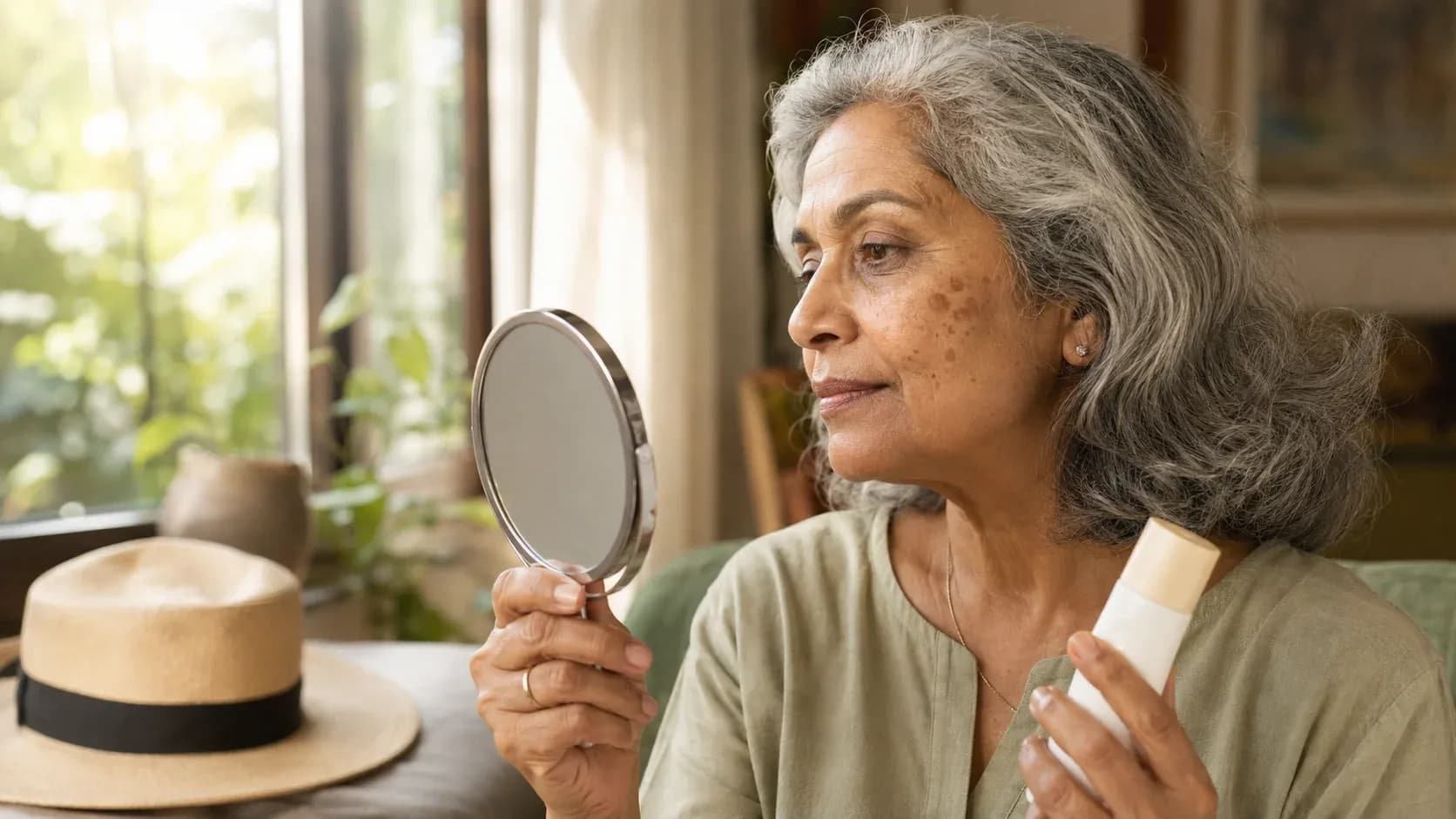
Age spots are flat areas of darker pigmentation that you can develop on parts of your skin that receive regular sun exposure.
Your skin produces melanin, the pigment responsible for your skin colour, as part of its natural response to ultraviolet (UV) radiation. With repeated exposure over the years, you may develop areas where pigmentation becomes more concentrated and noticeable.
You can develop age spots at different ages. Your lifetime sun exposure, skin type, and individual tendency to develop pigmentation can all influence when they develop.
What Do Age Spots Look Like?
When you develop an age spot, you will usually notice a:
- Flat, rather than raised, patch.
- Brown, tan, or darker area.
- Round or oval shape.
- Clearly defined border.
- Spot that can range from a few millimetres to 2 centimetres across. If two spots merge, it can appear larger.
You may have a single spot or several pigmented areas. Your spots may also become more noticeable after spending time in the sun.
Where Do Age Spots Usually Appear?
You are most likely to notice age spots on areas of your body that receive regular sun exposure, including your:
- Face or forehead
- Hands and forearms
- Shoulders or upper chest
You may notice them more on your hands and face because these areas tend to remain exposed throughout the year.
Are Age Spots the Same as Sunspots?
Age spots and sunspots often refer to the same type of hyperpigmentation. Both commonly refer to solar lentigines (flat, non-cancerous, brown, or black spots on the skin), which develop with cumulative UV exposure. So, while you may call them age spots, your sun exposure is an important part of why they develop.
What Causes Age Spots?
If you are wondering what causes age spots, cumulative UV exposure is one of the biggest factors. Whenever your skin is exposed to UV radiation, it produces melanin as part of its natural protective response.
Over time, repeated exposure can cause some areas of your skin to develop persistent pigmentation. You may eventually notice these areas as flat brown spots. You do not necessarily need to have experienced repeated sunburns to develop age spots. Everyday sun exposure accumulated over many years can also contribute.
Who Is More Likely to Develop Age Spots?
You may be more likely to develop age spots if you have had considerable sun exposure over the years. Your chances may also be influenced by:
- Your natural skin type
- Your history of outdoor sun exposure
- Your tendency to develop pigmentation
- Your cumulative UV exposure over time
You can develop age spots at any age, and it has nothing to do with gender. However, if you are over 40, you may likely notice age spots on your skin.
What Are the Symptoms of Age Spots?
You usually notice age spots by their appearance rather than by sensation. Typical age spots are flat areas of pigmentation and generally do not cause discomfort.
If you notice that a spot is persistently itchy, painful, bleeding, crusting, rapidly changing, or becoming raised, it is worth having a dermatologist examine it. Several skin conditions can look similar to an age spot, and getting a professional opinion can help you understand what you are seeing.
When Should You Get a Dark Spot Checked?
You do not need to worry every time you notice a new dark spot. Pigmentation can develop for many harmless reasons. However, you should consider getting a spot checked if you notice that it is:
- Changing noticeably in size, shape, or colour.
- Becoming raised
- Developing an irregular appearance
- Bleeding or crusting without an obvious cause
- Persistently itchy or painful
- Significantly different from your other spots
When you are unsure, a dermatologist can examine the spot and give you a clearer answer instead of leaving you to guess.
How Are Age Spots Diagnosed?
A dermatologist will examine the appearance, colour, shape, and location of your spot. They may also ask about your sun exposure and whether you have noticed any changes in the area to diagnose further.
A dermatoscope may be used to look at the pigmentation more closely. This allows your dermatologist to assess features that may not be visible to you with the naked eye.
Do You Need Tests to Diagnose Age Spots?
You may not need any tests if your spot has the typical appearance of an age spot. If your dermatologist is uncertain about the diagnosis, they may recommend further evaluation.
In some cases, this can include a skin biopsy to identify exactly what is causing the pigmentation. The purpose of this assessment is to give you clarity about the spot instead of assuming that every dark patch is concerning.
How to Remove Age Spots?
If you are looking for ways to remove age spots, you have several options. Your dermatologist can help you choose an approach based on your skin type, the location and number of spots, and your overall pigmentation pattern. The table shows some of the most common and reliable age spots treatment are:
| Treatment | What It Does |
|---|---|
| Topical Treatments | Ingredients such as retinoids and other pigment-targeting ingredients may improve the appearance of age spots. Introduce active products gradually, as irritation can sometimes cause additional pigmentation. |
| Chemical Peels | Professionally selected peels remove damaged outer skin layers and may help improve uneven pigmentation. |
| Laser and Light-Based Treatments | These treatments target pigment within the skin and may improve age spots. Consider skin tone and pigmentation history to reduce the risk of post-inflammatory hyperpigmentation. |
| Cryotherapy | A dermatologist can use controlled freezing to target individual pigmented areas, especially when there are only a few suitable spots. |
How to Get Rid of Age Spots at Home?
You can use several over-the-counter products designed to improve uneven pigmentation before considering professional treatment.
You can start with a simple skincare routine and include retinoids, vitamin C, niacinamide, and other pigment-targeting active ingredients. It may help improve the appearance of your dark spots over time.
You do not need to use several strong products together. Starting gradually and maintaining a consistent routine is usually more helpful than repeatedly changing your products.
How to Prevent Age Spots?
You cannot change the sun exposure you have already accumulated, but you can reduce additional UV exposure and help prevent further pigmentation.
- Use Sun Protection Regularly: Apply a broad-spectrum sunscreen with an appropriate SPF to exposed areas every day. If you are spending extended time outdoors, reapply your sunscreen as directed.
- Avoid Excessive Sun Exposure: Try to limit prolonged direct sun exposure, particularly when UV levels are high. Seeking shade can help reduce the amount of UV radiation reaching your skin.
- Protect Exposed Skin: You can give your skin additional protection with wide-brimmed hats, clothing, and shade. Pay particular attention to your face, hands, forearms and other areas that remain exposed regularly.
Clear Ritual’s Perspective on What Age Spots Are
Age spots are commonly linked to cumulative sun exposure and are generally harmless. For most of your age spots, the focus is on managing pigmentation and protecting your skin from further UV exposure.
Clear Ritual believes in following a holistic approach to achieve healthy skin while targeting skin issues. If you want to reduce their appearance, you have several options, from targeted skincare to professional treatments. The best choice depends on your skin and the type of pigmentation you have. The Clear Ritual Skin Test can give you clarity so you do not have to figure it out on your own.
Clear Ritual Skin Test
Understand Your Pigmentation Pattern
Take the free skin test to assess dark spots, sun exposure, sensitivity, barrier health, and other concerns, then get a routine suited to your skin.
Take the Free Skin Test
Frequently Asked Questions
1. How long does it take for age spots to fade?
You may notice improvement sooner with certain professional procedures, while topical products generally require consistent use over several weeks or months. Treating existing pigmentation does not prevent new spots from developing if you continue to receive significant UV exposure.
2. Can age spots come back after treatment?
You may develop new age spots after treatment because the underlying tendency to develop pigmentation does not disappear. Professional treatment can reduce the appearance of existing spots, but continued UV exposure can contribute to further pigmentation.
3. Can age spots go away on their own?
No, an age spot does not disappear completely on its own. You can prevent it from becoming darker by protecting your skin from UV exposure. Getting appropriate treatments can improve its appearance.
4. Are age spots harmful?
Typical age spots are generally harmless. If you notice a spot changing significantly, bleeding, crusting, becoming painful, or developing an unusual appearance, have a dermatologist examine it.
5. How can you tell if a dark spot is an age spot?
If you cannot identify the cause of a dark spot, you do not need to diagnose it yourself. A dermatologist can examine your skin and help you understand what you are dealing with.
References
https://dermnetnz.org/topics/solar-lentigo
https://www.aad.org/public/diseases/a-z/age-spots-causes
https://dermnetnz.org/topics/skin-pigmentation
https://www.aad.org/public/everyday-care/skin-care-secrets/routine/fade-dark-spots
https://www.cancer.gov/types/skin/patient/skin-treatment-pdq
Disclaimer
This article is intended for general informational purposes and is not a substitute for personalised medical advice, diagnosis or treatment. If you have a new or changing dark spot, or are unsure about a change in your skin, consult a qualified dermatologist for an appropriate evaluation and advice based on your individual skin and concerns.
Editorial Standards
Clear Ritual has Strict sourcing guidelines to ensure our content is accurate and current. We rely on peer-reviewed studies, academic research institutions, and medical associations. We strive to use primary sources and refrain from using tertiary references. See a mistake? Learn More about our Editorial Standards.