Fungal Acne vs Folliculitis: Are They the Same?
Quick Answer:
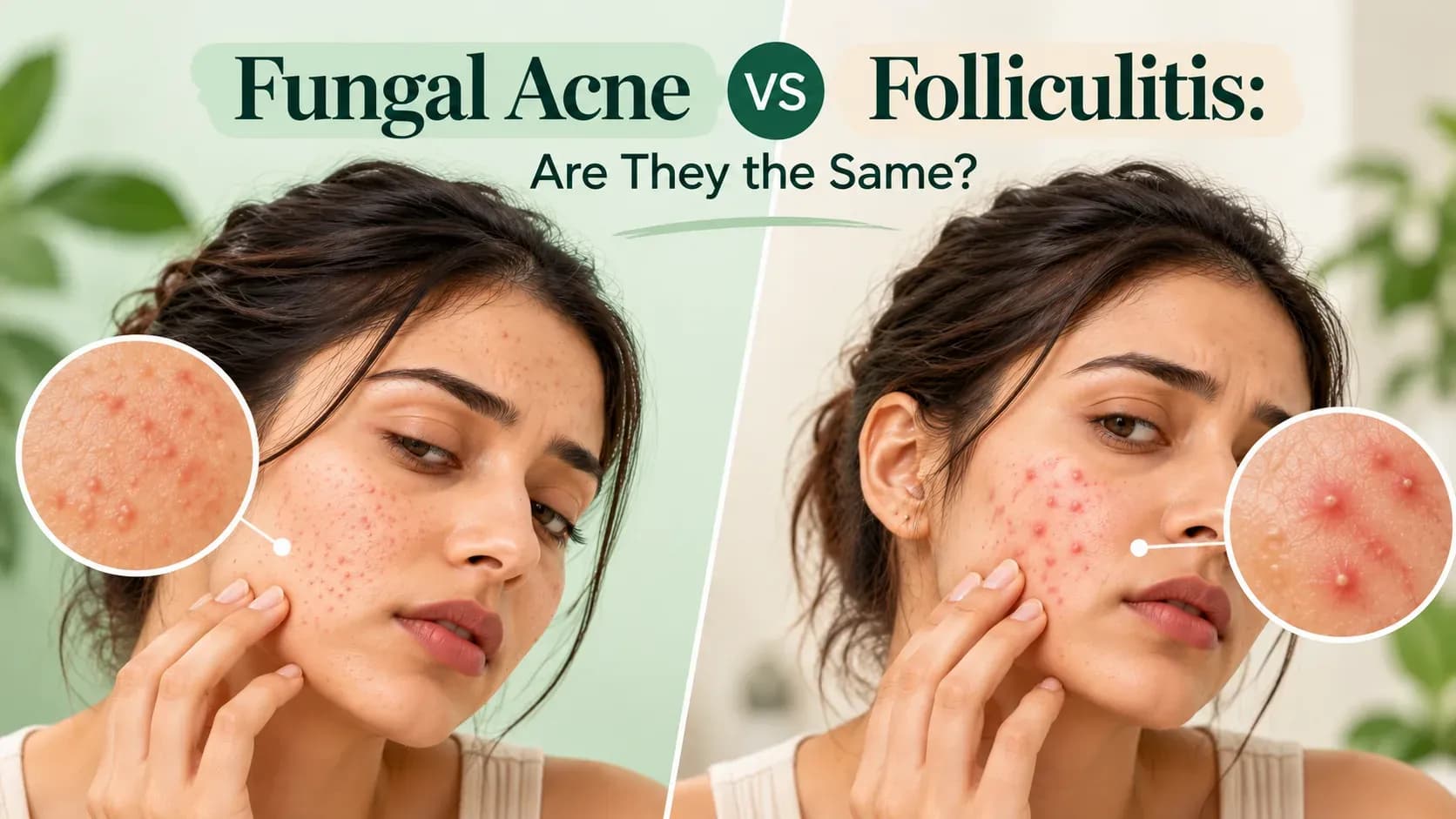
Bacterial and fungal folliculitis are not the same condition. Both inflame hair follicles, but the cause, appearance, and treatment differ completely. Using the wrong treatment does not just fail: it can actively make the other type worse.
What Is Folliculitis?
Folliculitis is inflammation of the hair follicles: the tiny skin pockets where individual hairs grow. When a follicle becomes irritated or infected, it produces small red or white bumps that may feel tender, itchy, or both.
Each follicle connects to a sebaceous gland that produces oil. When sweat, dead skin cells, or heavy skincare products accumulate around the follicle opening, they create conditions where bacteria or yeast can multiply. The immune system responds to this overgrowth with localised inflammation, producing the bumps visible at the skin surface.
Folliculitis can appear anywhere hair grows, but it most commonly affects:
- Chest and upper back
- Shoulders and buttocks
- Thighs and legs
- Scalp and forehead
These areas trap sweat and experience friction from clothing: two conditions that favour microbial overgrowth inside follicles.
What Is Fungal Folliculitis (Fungal Acne)?
Fungal folliculitis: also called Malassezia folliculitis or Pityrosporum folliculitis: is a specific subtype of folliculitis caused by yeast overgrowth inside hair follicles. The Malassezia yeast lives on everyone's skin as part of the normal microbiome. Under balanced conditions, it causes no problems.
When conditions shift in favour of yeast multiplication, Malassezia populations expand rapidly inside follicles. This triggers an inflammatory response that produces clusters of small, uniform, intensely itchy bumps.
Key characteristics of fungal folliculitis:
- Bumps are strikingly uniform in size, typically 1–2 mm papules or pustules
- Intensely itchy, with itch worsening in heat and after sweating
- Clustered on oil-rich, often occluded areas: forehead, temples, chest, upper back, shoulders
- No blackheads or whiteheads: folliculitis does not produce comedones
- Often appears after antibiotic use, humid climate exposure, or introducing heavy oil-based skincare
According to The Clear Ritual's clinical skin assessment approach, fungal folliculitis is among the most frequently misidentified skin conditions: commonly mistaken for acne vulgaris and treated with antibacterial products that worsen the yeast imbalance rather than resolving it.
What Is Bacterial Folliculitis?
Bacterial folliculitis is the most common form of folliculitis, typically caused by Staphylococcus aureus bacteria entering damaged hair follicles. A 2020 review in the Anais Brasileiros de Dermatologia confirmed Staphylococcus aureus as the predominant causative organism in community-acquired bacterial folliculitis, with methicillin-resistant strains (MRSA) increasingly found in recurrent or treatment-resistant cases.
Key characteristics of bacterial folliculitis:
- Bumps vary in size: some small red papules, others larger pustules with white or yellow centres
- Tender and sore when touched, rather than intensely itchy
- Can appear on any hair-bearing area: legs, face, scalp, buttocks
- Often follows a clear mechanical trigger: shaving, hot tub use, friction from athletic equipment
- Hot tub folliculitis: caused by Pseudomonas aeruginosa in inadequately disinfected water: typically presents 8–48 hours after exposure and resolves within 7–10 days in healthy individuals
Are Fungal Acne and Folliculitis the Same Thing?
No: but fungal acne is one type of folliculitis. Folliculitis is the umbrella term for inflamed hair follicles from any cause. Fungal acne (Malassezia folliculitis) sits under that umbrella as a specific subtype caused exclusively by yeast overgrowth.
The confusion is understandable. Both conditions produce follicle-based bumps that look similar at first glance. The critical difference is the underlying mechanism: and that difference determines whether antifungal or antibiotic treatment is needed.
A 2014 review in the Journal of Clinical and Aesthetic Dermatology found that a significant proportion of cases initially diagnosed as acne vulgaris are actually Malassezia folliculitis: particularly in young adults with persistent forehead and chest breakouts that do not respond to standard acne treatments.
Types of Folliculitis: Where Fungal Acne Fits
Understanding the full spectrum of folliculitis types clarifies where fungal acne sits and why it requires different treatment.
Bacterial folliculitis Caused by Staphylococcus aureus or Pseudomonas aeruginosa entering damaged follicles. Bumps vary in size and may develop pus-filled centres. Most common overall type.
Fungal folliculitis (Malassezia folliculitis / fungal acne) Caused by yeast overgrowth inside follicles. Bumps are uniform, itchy, and clustered on oil-rich areas. Resists antibacterial treatments completely.
Mechanical or irritant folliculitis Caused by physical irritation: tight clothing, helmet straps, backpack pressure: rather than infection. No microbial involvement; inflammation is a direct response to barrier disruption.
Eosinophilic folliculitis A rare form primarily affecting people with compromised immune function. Involves eosinophils: a type of white blood cell: accumulating around follicles. The exact trigger remains unclear and it is not infectious.
Bacterial vs Fungal Folliculitis: Key Differences
| Feature | Fungal Folliculitis | Bacterial Folliculitis |
|---|---|---|
| Cause | Malassezia yeast overgrowth | Usually Staphylococcus aureus bacteria |
| Appearance | Uniform 1–2 mm bumps, identical size | Varied sizes, may have white or yellow centres |
| Location | Forehead, chest, upper back, shoulders | Any hair-bearing area: legs, face, scalp, buttocks |
| Itchiness | Very itchy, worsens with heat and sweat | Tender and sore rather than itchy |
| Comedones | None | None |
| Response to acne treatments | Often worsens | May improve with antibacterial ingredients |
| Common triggers | Antibiotics, humidity, oil-based products | Shaving, hot tub use, friction, tight clothing |
| Typical resolution with correct treatment | 4–8 weeks | 1–4 weeks |
Why Fungal Folliculitis Develops: Causes and Triggers
Fungal folliculitis develops when the skin environment shifts in ways that favour Malassezia yeast proliferation over competing microorganisms.
Increased sebum production provides more lipid nutrients for yeast. Hormonal fluctuations, stress-driven cortisol elevation, and naturally oily skin create ideal feeding conditions, allowing Malassezia populations to expand rapidly inside follicles.
Antibiotic use is one of the most documented triggers. Broad-spectrum oral or topical antibiotics eliminate bacteria that normally compete with and suppress yeast. With bacterial competitors removed, Malassezia populations expand unchecked. This explains why some people develop fungal folliculitis mid-course of antibiotic acne treatment: particularly on the chest and back.
Hot, humid climates create the warmth and moisture yeast prefer. Sweating without showering promptly keeps the follicle environment damp and warm, enabling yeast to colonise follicle openings. Occlusive clothing that traps heat compounds this effect.
Heavy, oil-based skincare products feed Malassezia directly. Ingredients with fatty acid chains of C11–C24 chain length: including coconut oil, olive oil, and many plant butters: serve as nutrients for yeast. When these ingredients sit on skin under makeup or sunscreen, they create an oxygen-poor, nutrient-rich environment ideal for yeast overgrowth.
Compromised immune function from chronic stress, sleep deprivation, or illness reduces the body's ability to regulate microbial populations on the skin surface. When immune surveillance weakens, opportunistic yeast expansion goes unchecked.
Why Bacterial Folliculitis Develops: Causes and Triggers
Bacterial folliculitis develops when physical damage to follicle openings allows skin-surface bacteria to enter: or when bacteria are introduced directly to vulnerable skin.
Hair removal through shaving, waxing, or plucking creates microscopic wounds where follicles exit the skin. Dull razors increase the trauma and bacterial entry risk substantially. Shaving over already-inflamed skin reintroduces bacteria and creates new entry points.
Friction from clothing and equipment damages the protective barrier around follicle openings. Backpacks, sports pads, helmets, and synthetic fabrics create constant pressure that inflames tissue and allows bacteria to penetrate.
Contaminated water exposure introduces bacteria directly to vulnerable skin. Hot tubs, whirlpools, and pools with inadequate disinfection harbour Pseudomonas aeruginosa. Soaking allows bacteria to penetrate follicles: particularly if skin barrier function is already compromised by prolonged water exposure.
Prolonged sweating without cleansing traps moisture and bacteria against the skin. When sweat and bacteria cannot evaporate, follicles become hospitable to bacterial multiplication. This is common after intense exercise when showering is delayed beyond 30 minutes.
Folliculitis vs Acne Vulgaris: What Is the Difference?
Folliculitis and acne both produce bumps involving hair follicles and sebaceous glands. The underlying mechanisms, however, are distinct: and this distinction determines which treatments work.
For a closer look at why the two conditions can be confused, read our guide to fungal acne vs acne vulgaris.
Acne vulgaris is driven by excess sebum production, dead skin cells blocking pores, and Cutibacterium acnes bacteria proliferating inside blocked follicles. It is strongly hormonal. It produces a range of lesion types: open comedones (blackheads), closed comedones (whiteheads), papules, pustules, nodules, and cysts.
Folliculitis is inflammation of the follicle itself from infection or mechanical irritation. It does not produce comedones. Bumps are typically uniform: especially in the fungal type: associated with specific triggers, and frequently itchy.
| Feature | Acne Vulgaris | Folliculitis |
|---|---|---|
| Primary cause | Hormone-driven sebum + C. acnes bacteria | Bacterial or fungal infection of follicle |
| Comedones (blackheads/whiteheads) | Yes | No |
| Lesion variety | Mixed (papules, pustules, nodules, cysts) | Usually uniform papules or pustules |
| Itch | Rarely | Frequently, especially in fungal type |
| Common triggers | Puberty, hormonal shifts, stress, diet | Shaving, heat, humidity, antibiotic use |
| Responds to benzoyl peroxide | Yes | Bacterial: sometimes. Fungal: often worsens |
| Responds to retinoids | Yes | Minimal effect |
Practical rule: if your bumps have no blackheads, cluster in groups, itch persistently, and appeared after a specific trigger, folliculitis is more likely than acne vulgaris.
How to Tell If Your Folliculitis Is Bacterial or Fungal: A 5-Step Checklist
Work through these questions in order. Each answer points toward a likely type. If you remain unsure after completing all five, a dermatologist can confirm with a KOH scraping: a simple lab test that detects fungal cells: or a bacterial swab.
Step 1: Are the bumps all the same size? Fungal folliculitis produces clusters of strikingly uniform bumps: typically 1–2 mm papules or pustules that look almost identical. Bacterial folliculitis produces variable bumps: some small red papules, others larger pustules with white or yellow centres. If all bumps look stamped from the same mould, fungal origin is more likely.
Step 2: Are the bumps intensely itchy? Persistent itch: especially worsening in heat, after sweating, or in humid conditions: points toward fungal folliculitis. Malassezia yeast metabolites directly irritate follicle nerve endings, producing characteristic itch. Bacterial folliculitis tends to be tender and sore rather than itchy.
Step 3: Where are the bumps located? Fungal folliculitis clusters on oil-rich, often occluded areas: forehead, temples, chest, upper back, and shoulders. Bacterial folliculitis appears more broadly: on legs, scalp, face, or buttocks: especially in areas recently shaved or exposed to friction.
Step 4: What happened in the two weeks before the bumps appeared?
- Took oral or topical antibiotics → points toward fungal
- Moved to or visited a hot, humid climate → points toward fungal
- Introduced a heavy oil-based skincare product or comedogenic sunscreen → points toward fungal
- Shaved, waxed, or used a razor → points toward bacterial
- Used a hot tub, pool, or whirlpool → points toward bacterial
Step 5: How did your skin respond to regular acne treatments? If benzoyl peroxide, salicylic acid, or topical antibiotics produced no improvement: or worsened bumps: after two or more weeks of consistent use, fungal folliculitis is more likely. These treatments do not affect Malassezia yeast and may worsen the microbiome imbalance driving yeast overgrowth.
When a checklist isn't enough: Up to 30% of cases presenting as acne are actually Malassezia folliculitis, according to the 2014 Journal of Clinical and Aesthetic Dermatology review. A dermatologist can confirm the diagnosis in a single appointment using a KOH scraping or Wood's lamp examination.
What Makes Each Type of Folliculitis Worse
Certain products and behaviours selectively aggravate one type of folliculitis.
What worsens fungal folliculitis:
- Oil-based products containing coconut oil, olive oil, or plant butters: these feed Malassezia directly
- Occlusive ingredients such as heavy silicones and petroleum-based products that trap moisture and create oxygen-poor follicle environments
- Antibacterial acne treatments that eliminate bacteria while leaving yeast populations untouched, worsening microbiome imbalance
- Delayed showering after exercise in hot, humid conditions
What worsens bacterial folliculitis:
- Continuing to shave or wax inflamed areas, reintroducing bacteria and creating new follicle entry points
- Using the same contaminated razor across multiple sessions, spreading bacteria to new follicles
- Applying thick creams or lotions over inflamed follicles, trapping bacteria inside
- Not showering after sweating, allowing bacteria to multiply in warm, damp conditions
How Each Type Is Treated
Treatment for folliculitis is only effective when it targets the actual cause. Using an antibiotic for a fungal condition: or an antifungal for a bacterial one: will not resolve the condition and can intensify it.
Treating Fungal Folliculitis (Malassezia)
The goal is to reduce Malassezia yeast populations on the skin surface and inside follicles.
- Antifungal wash (first-line OTC): Ketoconazole 2% shampoo used as a body wash. Apply to affected areas, leave for 3–5 minutes, then rinse. Use daily for the first two weeks, then 2–3 times weekly for maintenance. Selenium sulfide 2.5% is an alternative.
- Topical antifungal creams: Clotrimazole, miconazole, or econazole applied directly to affected areas. Available over the counter in most markets.
- Remove triggering products immediately: Eliminate oil-based moisturisers and products containing fatty acid chains (C11–C24 length) for at least 4–6 weeks. Malassezia metabolises these lipid chains as a food source.
- Oral antifungals (prescription only): Oral fluconazole or itraconazole for widespread or persistent presentations. Reserved for moderate-to-severe cases.
Expected timeline: Most people see reduction in new bumps within 2–4 weeks of consistent antifungal treatment. Existing papules typically take 4–8 weeks to fully flatten. Recurrence is common if triggers: heat, occlusive products, antibiotic use: are not addressed alongside treatment.
Treating Bacterial Folliculitis
The goal is to eliminate the bacterial infection and prevent reinfection.
- Antibacterial wash: A clinician may recommend a benzoyl peroxide wash for suitable cases. Follow the product directions and seek advice if irritation develops.
When to seek treatment: If bumps spread, become painful, recur, or do not improve, see a dermatologist. Depending on the cause, a clinician may prescribe a topical antibiotic, consider oral treatment, or take a swab to guide therapy. Do not use leftover antibiotics or antifungal medicines without a diagnosis.
Prevention and When to See a Dermatologist
Keep skin clean without aggressive scrubbing, change out of sweaty clothing, avoid shaving over inflamed follicles, and follow safe hygiene practices for shared towels, razors, and hot tubs. Recurrent or widespread bumps may need a professional examination because fungal, bacterial, and noninfectious folliculitis can look alike.
Conclusion
Fungal acne is a form of folliculitis caused by Malassezia yeast, whereas bacterial folliculitis has a different cause and may require different treatment. Appearance, itching, and triggers can offer clues, but they do not confirm a diagnosis. Persistent or worsening symptoms deserve professional assessment.
Understand What Your Skin Needs
Take the Clear Ritual Skin Test to identify your skin type, concerns, and potential triggers before building your routine.
Take the Free Skin Test
Frequently Asked Questions
Q. Is fungal acne the same as folliculitis?
A. Fungal acne is the common name for Malassezia folliculitis, one specific type of folliculitis. Not all folliculitis is fungal.
Q. How can I tell bacterial and fungal folliculitis apart?
A. Fungal folliculitis often causes similarly sized, itchy bumps on the chest, back, or forehead. Bacterial folliculitis may cause tender pustules, often after shaving or friction. A dermatologist can confirm the cause when symptoms overlap.
Q. Can antibiotics make fungal folliculitis worse?
A. Antibiotic use can sometimes contribute to Malassezia folliculitis by changing the skin's microbial balance. Do not stop a prescribed antibiotic without consulting the prescriber.
Q. Does fungal folliculitis respond to ordinary acne treatments?
A. Standard acne treatments do not directly treat Malassezia yeast. A clinician may recommend antifungal treatment if fungal folliculitis is confirmed.
Q. When should I see a dermatologist for folliculitis?
A. Seek professional advice if bumps are painful, spreading, recurrent, accompanied by fever, or not improving with appropriate care.
Disclaimer: This article is for educational purposes and does not replace diagnosis or treatment from a qualified healthcare professional.
Editorial Standards
Clear Ritual has Strict sourcing guidelines to ensure our content is accurate and current. We rely on peer-reviewed studies, academic research institutions, and medical associations. We strive to use primary sources and refrain from using tertiary references. See a mistake? Learn More about our Editorial Standards.
Related Articles
Acne and Diet: What’s the Real Link Between Food and Breakouts?
Published 21 July 2026

Aanya’s Blemish-Prone Skin Journey With Clear Ritual
Published 9 September 2026

Acne Around the Mouth: Causes, Triggers and Treatment Options
Published 16 July 2026
Acne Breakout: Why It Happens All at Once and How to Calm It
Published 8 August 2026