Laser Treatment for Blackheads: What It Does and What to Expect

Quick Answer:
Laser treatment is not usually the first treatment recommended for blackheads. Some dermatologist-operated energy-based devices may help acne, but results for blackheads alone are less certain than results for inflammatory pimples. Topical retinoids and other pore-focused treatments are usually considered first, while procedures may be discussed if blackheads persist.
What Are Blackheads and Why Do They Keep Coming Back?
Blackheads, also called open comedones, develop when oil and dead skin cells accumulate within a hair follicle. Their dark surface is caused by exposure of the follicular material to air, not by dirt.
Blackheads may return because follicles continue producing oil and shedding skin cells. Factors that contribute include hormonal changes, acne-prone skin, and products that do not suit your skin.
- Increased sebum production and natural variations in oiliness
- Dead skin cell buildup within hair follicles
- Hormonal fluctuations that influence acne
- Some occlusive or comedogenic products
- Repeated squeezing or harsh exfoliation that irritates the skin
Understanding the relationship between sebum and blackheads can help you select a more sustainable routine. Unlike inflammatory acne, blackheads are not primarily caused by bacterial infection.
What Is Laser Treatment for Blackheads?
Laser procedures use focused light energy to affect selected structures in the skin. Different systems target different concerns, such as inflammation, sebaceous gland activity, or skin texture. A laser does not simply pull a blackhead out of the pore, and not every acne laser is effective for open comedones.
Dermatologists sometimes use energy-based procedures as an additional treatment when standard acne care does not achieve the desired results. However, evidence for laser treatment specifically for blackheads remains limited. Devices, settings, and expected outcomes cannot be treated as interchangeable.
Laser and Light-Based Options You May Hear About
| Procedure | What it targets | Role for blackheads | Important limitation |
|---|---|---|---|
| Nd:YAG laser | Various skin targets depending on wavelength and settings | May be considered for selected acne concerns | Not an established first-line treatment specifically for blackheads |
| Fractional CO2 laser | Skin resurfacing and texture | May address separate concerns such as acne scars or texture | More downtime and pigmentation risk; not routine blackhead extraction |
| Pulsed dye laser (PDL) | Blood vessels and acne-related redness | More relevant to inflammation than clogged pores | Not a standard way to remove individual blackheads |
| Photopneumatic therapy | Uses light together with gentle suction | Specifically used for blackheads, whiteheads and some pimples | Availability and individual response vary; not a conventional laser-only treatment |
| Sebum-targeting lasers | Sebaceous glands in selected acne patients | Studied mainly for inflammatory acne | Evidence from inflammatory acne cannot be assumed to predict blackhead clearance |
How Does Laser Treatment Work on Blackheads?
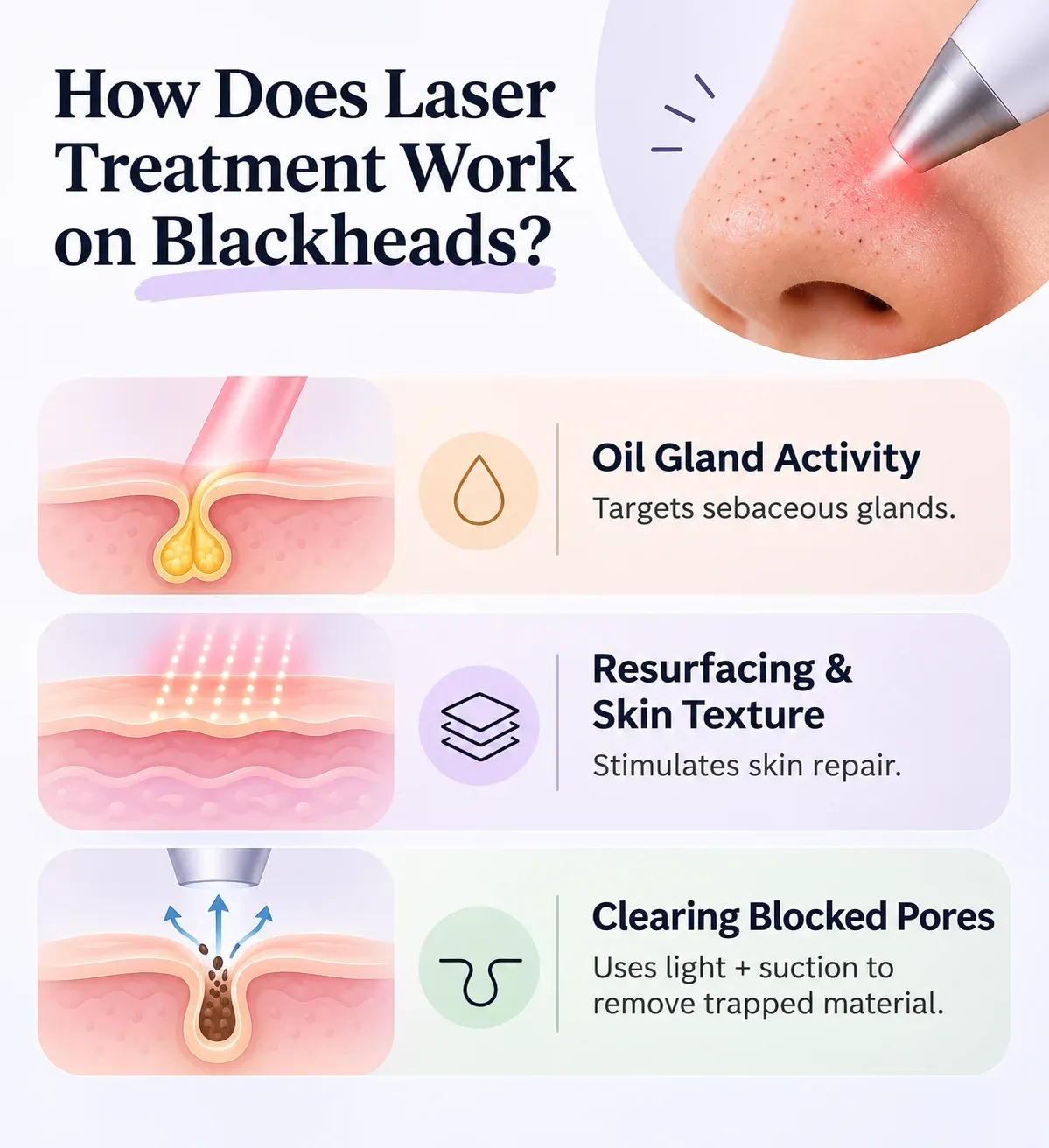
The mechanism depends on the device. Some laser systems are designed to influence oil glands or acne-related inflammation, while resurfacing lasers stimulate tissue repair. Those effects do not necessarily mean that material trapped inside an open comedone is removed.
Oil Gland Activity
Some newer laser technologies selectively target sebaceous glands. Clinical studies have reported benefits for inflammatory acne, but the evidence cannot be directly translated into a promised reduction in blackheads.
Resurfacing and Skin Texture
Fractional resurfacing creates controlled areas of skin injury to stimulate healing. Dermatologists may use it for appropriate texture or scarring concerns, but its potential risks are harder to justify when isolated blackheads are the only concern.
Clearing Blocked Pores
Photopneumatic treatment combines light with suction to help clear material from pores. This differs from ordinary visible-light devices, which generally target inflammatory pimples and do not reliably treat blackheads or whiteheads.
Which Laser Is Best for Blackhead Removal?
There is no universally best laser for blackheads. A dermatologist should first confirm whether the spots are open comedones, sebaceous filaments, or another condition. For example, whiteheads and milia are different types of bumps, and the same approach will not work for every lesion.
For predominantly comedonal acne, topical treatment is usually a more appropriate starting point. If a procedure is being considered, ask whether that particular device has evidence for blackhead reduction, what risks apply to your skin tone, and whether simpler alternatives have already been tried.
Choose a qualified dermatologist experienced with the equipment and your skin type rather than selecting a laser based only on a clinic's treatment name or marketing claim.
Does Laser Treatment for Blackheads Actually Work? What Research Shows
Research on lasers and acne is evolving. The American Academy of Dermatology explains that no single laser or light device treats every acne lesion. It also notes that conventional visible-light therapies are not effective for blackheads and whiteheads, while photopneumatic therapy can treat some comedones.
The 2024 American Academy of Dermatology acne guideline found insufficient evidence to make broad recommendations for laser and light-based procedures. A newer European acne guideline likewise does not make a firm recommendation for laser treatment of comedonal acne. In contrast, topical retinoids have a clearer role in managing blocked follicles.
Recent studies of sebum-selective lasers report improvements in inflammatory acne, but those outcomes should not be advertised as equivalent blackhead removal rates. The source draft's exact claims about 50 to 70 percent blackhead reduction, fixed session counts and 6 to 12 months of results are not sufficiently supported for general use.
Laser Treatment for Blackheads on the Nose: What Is Different?
Small dark dots on the nose may be blackheads, but they can also be normal sebaceous filaments. These structures help move sebum to the skin surface, and repeatedly trying to remove them can cause irritation.
A dermatologist can determine whether treatment is needed. If the issue is truly recurring blackheads, a suitable acne routine is usually worth discussing before an energy-based procedure. For concerns about visible pores, expectations should be realistic because pores cannot be permanently closed.
Laser procedures on the nose require careful assessment of skin tone, sensitivity, underlying skin conditions and potential post-inflammatory pigmentation. There is no standard nose-specific laser schedule that applies to everyone.
Is Laser Treatment for Blackheads Long-Lasting?
Blackheads can recur because oil production and skin cell shedding are ongoing processes. Even where a procedure helps, it is not a permanent solution, and published results from one laser or acne population may not apply to another.
Maintenance should focus on an effective, tolerable skincare plan. A dermatologist can advise whether repeat procedures offer a meaningful benefit, but a universal maintenance interval should not be promised.
| Approach | Expected role | Duration of benefit |
|---|---|---|
| Laser or light-based procedure | Possible adjunct for selected cases | Varies greatly by device and individual; not predictable for blackheads alone |
| Professional extraction | Clears a visible plugged pore | Immediate clearing, but blackheads can recur |
| Topical retinoid | Helps prevent new comedones | Usually requires continued appropriate use |
| Salicylic acid | Helps loosen buildup in pores | Requires ongoing appropriate use if beneficial |
What to Expect Session by Session: A Realistic Timeline
There is no validated session-by-session blackhead clearance timeline that applies to all lasers. The treatment course depends on the device, the reason for using it, skin type, medical history, and response.
| Stage | What to expect | What to ask your dermatologist |
|---|---|---|
| Initial consultation | Diagnosis, review of previous treatments, assessment of skin type and risks | Is this device actually indicated for comedones? |
| Procedure day | Eye protection and a device-specific procedure; discomfort varies | Will I need numbing or any special aftercare? |
| Early recovery | Possible redness, swelling or sensitivity; downtime varies widely | Which symptoms are expected, and which require urgent advice? |
| Follow-up | Assessment of benefits, side effects and whether further treatment is justified | How will success be measured without relying on photographs alone? |
Improvement may be gradual or absent. Avoid assuming that a particular number of sessions will eliminate blackheads.
How to Prepare for Your First Laser Blackhead Treatment
- Confirm the diagnosis. Ask a dermatologist to distinguish blackheads from sebaceous filaments and other causes of dark pores.
- Discuss medicines and medical history. Disclose prescription acne treatments, isotretinoin, past pigmentation problems, skin conditions, allergies and pregnancy or breastfeeding status when relevant. Do not stop a prescribed medicine without guidance.
- Ask about sun exposure. A recent tan or sunburn may change the safety of a procedure. Follow the practitioner's specific sun-protection advice.
- Get a device-specific preparation plan. Whether and when to pause retinoids, exfoliating acids or other treatments depends on the procedure and your skin. Avoid a universal fixed washout schedule.
- Understand aftercare and possible complications. Discuss redness, burns, infection, scarring, pigment changes and the signs that warrant medical attention.
Do not book a laser procedure immediately after another aggressive skin treatment without clearance from the treating clinician.
Laser Treatment for Blackheads vs Other Treatments: A Full Comparison
Laser procedures are only one of several options. For many people, simpler treatments offer a better balance of evidence, convenience and cost. Your dermatologist can help select a suitable approach for your skin and the severity of congestion.
| Treatment | How it works | Best for | Not ideal for | Downtime and cost considerations |
|---|---|---|---|---|
| Laser or light-based procedure | Varies by device; may target acne-related inflammation, sebum or texture | Selected patients with additional acne concerns after clinical evaluation | Routine first-line care for a few blackheads | Potentially expensive; downtime and pigmentation risk depend on device |
| Professional extraction | Careful removal of comedonal contents by a trained clinician | Visible, persistent blackheads needing targeted clearing | Repeated aggressive extraction or self-squeezing | Usually brief recovery; recurring lesions remain possible |
| Salicylic acid | Helps loosen debris within pores | Mild comedonal acne when tolerated | Highly irritated skin or unsupervised layering with strong exfoliants | Relatively accessible; may cause dryness or irritation |
| Topical retinoids | Normalise shedding within follicles and reduce new comedones | Recurring comedonal acne | Pregnancy or use without appropriate medical guidance | May irritate initially; prescription/access costs vary |
| Chemical peel | Supervised exfoliation with a selected chemical agent | Some acne or texture concerns under dermatologist care | Broken, irritated skin or unsuitable peel selection | Cost, downtime and pigmentation risk vary by peel strength |
For comedonal acne, retinoids for acne and salicylic acid are commonly used treatment options.
Can Blackheads Be Removed Without Laser Treatment?
Yes. Most blackheads do not require laser treatment. A simple routine may include a gentle cleanser, a non-comedogenic moisturiser, appropriate sun protection and a targeted acne treatment. Start new active ingredients gradually rather than combining several exfoliants at once.
If a clogged pore is especially persistent, professional blackhead extraction may be an option. Avoid at-home needles, forceful squeezing and aggressive suction tools because they can damage the skin.
When Should You See a Dermatologist?
Seek an assessment when blackheads keep returning despite appropriate skincare, when lesions become painful or inflamed, or when you are unsure whether the dark dots are acne at all. A dermatologist can also help if you have a history of pigmentation changes or scarring and are considering procedures.
For ongoing care, a dermatologist-guided blackhead removal routine can provide a more practical starting point than committing to a laser package.
Clear Ritual's Perspective on Blackhead Treatment
Not every dark dot needs a laser procedure. Confirm whether you have blackheads or sebaceous filaments, begin with suitable evidence-based care, and consider devices only after discussing the likely benefit, costs, recovery and risks with a qualified dermatologist.
Blackheads are a common, manageable form of acne. A laser may have a role in selected treatment plans, but the right choice depends on a confirmed diagnosis, realistic expectations and evidence for the device being offered.
The Clear Ritual Skin Test can help you explore your skincare concerns and routine. It is not a medical diagnosis and does not replace a dermatologist's advice about laser procedures.
Understand What Your Skin Needs
Take the Clear Ritual Skin Test to identify your skin concerns and explore a plan for your routine.
Take the Free Skin Test
Frequently Asked Questions
Q. Can laser treatment permanently remove blackheads?
A. No procedure can guarantee permanent blackhead removal. Blackheads can recur because skin continues producing oil and shedding cells.
Q. Is laser treatment the best option for blackheads on the nose?
A. Not usually. Dark dots on the nose may be blackheads or normal sebaceous filaments. A dermatologist can identify the cause and recommend suitable care.
Q. How many laser sessions are needed for blackheads?
A. There is no standard number that applies to all devices or people. Ask your dermatologist what evidence supports the proposed treatment plan.
Q. Can salicylic acid or retinoids work better than laser for blackheads?
A. Topical retinoids and salicylic acid are established acne-care options, while evidence for laser treatment specifically for blackheads is more limited.
Q. Can laser treatment cause dark spots or scarring?
A. Yes. Depending on the device, skin tone and operator, laser treatment can cause pigment changes, burns or scarring. Discuss risks and alternatives with a qualified dermatologist.
References
- American Academy of Dermatology. Lasers and lights: How well do they treat acne?
- American Academy of Dermatology. Updated guidelines for the management of acne (2024).
- Reynolds RV, et al. Guidelines of care for the management of acne vulgaris. Journal of the American Academy of Dermatology. 2024.
- Ishii L, Deoghare S, Boen M. Light and laser-based therapy in treatment of acne vulgaris: A clinical review. Journal of the American Academy of Dermatology. 2025.
- Goldberg D, et al. Safe and effective acne treatment across skin types with a 1726 nm sebum-selective laser. Journal of the American Academy of Dermatology. 2026. This study concerns primarily inflammatory acne outcomes, not isolated blackheads.
Disclaimer: This article is for general information and cannot replace an examination or advice from a qualified dermatologist. Procedures and prescription treatments should be selected with professional guidance.
Editorial Standards
Clear Ritual has Strict sourcing guidelines to ensure our content is accurate and current. We rely on peer-reviewed studies, academic research institutions, and medical associations. We strive to use primary sources and refrain from using tertiary references. See a mistake? Learn More about our Editorial Standards.
Related Articles
Skincare Ingredients That Support Scar Healing
Published 17 July 2026

Skincare Ingredients Suitable for Acne Prone Skin
Published 24 July 2026

Niacinamide for Acne Scars: Benefits, Limits and Results
Published 4 November 2026
Dermal Fillers for Acne Scars: Types, Results and Risks
Published 4 November 2026