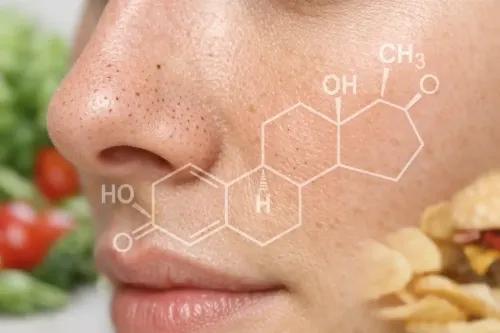
Are Closed Comedones Hormonal? Causes, Triggers and Treatment
Quick Answer:
Closed comedones can be influenced by hormones, particularly androgen-related oil production. However, clogged pores also involve skin-cell buildup and other triggers, so whiteheads alone do not prove a hormonal imbalance.
Most closed comedones are hormonal. Androgens like testosterone and DHT signal your sebaceous glands to overproduce oil while also making skin cells inside the follicle stickier and harder to shed. The result is a blocked pore sealed beneath the skin surface as a flesh-coloured or white bump.
Cleansing and exfoliation can clear the channel, but they cannot stop the gland from continuously refilling it with hormonally-driven oil. That is why understanding your specific hormonal trigger, not just the comedone itself, is what actually changes outcomes.
What Is Comedonal Acne?
Comedonal acne is non-inflammatory acne caused by the blockage of hair follicles with sebum and dead skin cells, most commonly driven by androgen activity.
The bumps appear in two forms:
- Open comedones (blackheads): The follicle opening stays partially open, and the top of the plug oxidises and darkens on contact with air. The dark colour is not dirt; it is melanin in the skin cells reacting with oxygen.
- Closed comedones (whiteheads): The pore opening closes completely, trapping the plug beneath the skin as a flesh-coloured or white bump.
Both blackheads and whiteheads are the same plug at different stages. They feel relatively smooth and do not hurt when touched, distinguishing them from inflammatory acne with its red, painful pustules.
The plug forms when sebum (the oily substance sebaceous glands produce) and keratinocytes (skin cells that naturally shed from the follicle lining) accumulate faster than they can exit the pore. Comedones concentrate on the forehead, nose, chin, and upper back because these zones have the highest density of sebaceous glands.
How Hormones Control Oil Production and Pore Clogging
Androgens are the primary hormones responsible for activating sebaceous glands. Both males and females produce androgens, though males typically have higher levels.
Your sebaceous glands contain androgen receptors. When hormones like testosterone and dihydrotestosterone (DHT) bind to these receptors, they signal the glands to increase oil production. DHT binds to sebaceous gland receptors with approximately five times the affinity of testosterone, which is why DHT-generating conditions such as PCOS and high 5-alpha-reductase activity tend to produce more oil and more severe comedones.
Androgens do not only increase oil volume. They also accelerate keratinocyte production inside follicles while making those cells stickier and more likely to clump together. This creates a traffic jam: increased oil combines with increased cell accumulation, and instead of flowing freely to the skin surface, everything gets stuck.
According to Clear Ritual's skin health team, this dual action on both oil production and cell shedding is what makes hormonal comedones so persistent and difficult to resolve with surface-level skincare alone.
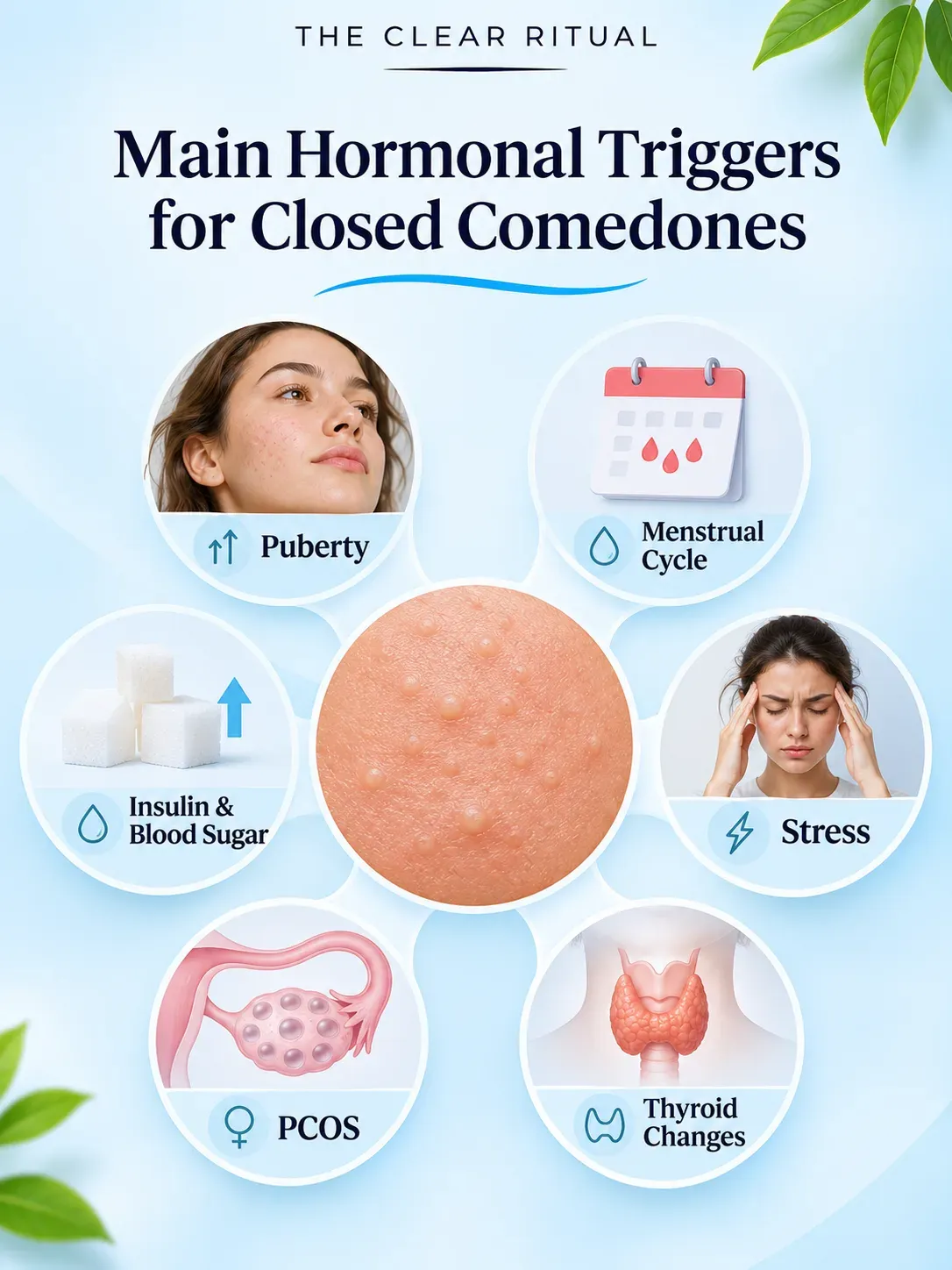
What Are the Main Hormonal Triggers for Closed Comedones?
Several distinct hormonal states consistently drive comedone formation. Each works through a slightly different pathway, but all converge on the same outcome: excess oil and excess skin cell buildup inside the follicle.
Puberty The adrenal glands and gonads begin producing significantly higher amounts of androgens, which is why comedonal acne often appears between ages 10 and 13. Sebaceous glands that were relatively quiet throughout childhood suddenly activate and enlarge. Blackheads and whiteheads typically appear before any inflammatory acne develops, making comedonal acne the first sign of adolescent skin changes in many people.
Boys generally experience more severe comedonal acne during puberty because they produce higher androgen levels. However, girls often notice comedones worsen at specific points in their menstrual cycle.
Menstrual cycle fluctuations In the week before menstruation (the luteal phase), oestrogen drops while progesterone rises. Oestrogen normally counters androgen activity at the sebaceous gland. When it falls, the relative androgen effect strengthens even without any actual increase in androgen levels. Oil production rises, follicle cells accumulate more quickly, and new comedones form. Most people notice this pattern worsening around days 21 to 28 of the cycle, then improving once menstruation begins and oestrogen rises again.
Chronic stress and cortisol Cortisol, the primary stress hormone, indirectly drives comedone formation through two pathways. First, elevated cortisol signals the adrenal glands to produce more DHEA-S, an androgen precursor that raises free androgen levels and stimulates sebaceous glands. Second, cortisol disrupts normal skin cell shedding inside follicles, so cells accumulate faster. Research by Zouboulis et al., published in Dermato-Endocrinology, demonstrated that corticotropin-releasing hormone (CRH), which rises under stress, directly stimulates sebaceous gland lipogenesis independent of adrenal androgen output. Even two to three weeks of sustained sleep deprivation produces measurable increases in sebum output.
Insulin and blood sugar Insulin does not directly bind to sebaceous gland receptors. It influences oil production indirectly by stimulating the liver and ovaries to produce more androgens, while simultaneously reducing sex hormone-binding globulin (SHBG), the protein that binds to androgens and keeps them inactive in the bloodstream. When SHBG levels drop, more free androgens circulate and bind to sebaceous gland receptors. A 2007 randomised controlled trial by Smith et al., published in the American Journal of Clinical Nutrition, found that a low-glycaemic-load diet reduced total acne lesion counts by approximately 23% compared to a control diet after 12 weeks, with reductions in free androgen levels as a measured mechanism.
PCOS (polycystic ovary syndrome) PCOS is one of the most common hormonal conditions affecting women of reproductive age. A review published in the Journal of the European Academy of Dermatology and Venereology (2020) reported that 70 to 80% of women with PCOS experience acne, with androgen excess identified as the primary mediator of both comedonal and inflammatory lesions. Women with PCOS often develop comedones along the jawline, chin, and lower cheeks in addition to the forehead and nose, and these comedones tend to resist standard skincare because the underlying hormonal imbalance remains unaddressed.
Thyroid dysfunction Thyroid hormones regulate overall metabolic rate, including skin cell regeneration speed. Hypothyroidism slows cell turnover throughout the body, meaning keratinocytes accumulate and shed more slowly, increasing the likelihood they will pile up inside follicles. The skin may also produce a thicker, more viscous sebum that flows less easily through pores. Hyperthyroidism can increase overall sebum production through metabolic acceleration, though this is less common than the hypothyroid pattern.
Diet vs Hormones: What Actually Causes Closed Comedones?
Both contribute, but hormones drive the engine and diet adjusts the throttle.
Androgens are the primary cause of closed comedones. Diet does not create the hormonal system that drives sebum production, but certain foods consistently amplify the androgen signal through the insulin pathway. High-glycaemic foods spike blood sugar, spike insulin, and spike free androgen levels within hours of eating. The Smith et al. (2007) trial confirmed this pathway is clinically measurable, not theoretical.
| Factor | Role in Closed Comedones | Magnitude of Effect | Can Skincare Fix It? |
|---|---|---|---|
| Androgens (testosterone, DHT) | Primary driver: stimulates sebum overproduction | High | No: needs topical actives or medical treatment |
| Insulin / high-glycaemic diet | Amplifier: raises free androgen levels | Moderate | Partially: dietary change reduces oil volume |
| Progesterone (pre-menstrual) | Cyclical amplifier: worsens follicle clogging monthly | Moderate | No: reduces at period onset naturally |
| Cortisol / stress | Indirect driver: triggers adrenal androgen output | Moderate | Partially: stress management reduces DHEA-S |
| Comedogenic products | Additive clogger: provides physical material | Low to moderate | Yes: switching products removes contribution |
| Dairy (high IGF-1 content) | Weak amplifier: may stimulate oil glands | Low | Partially: reducing intake has modest benefit |
The practical implication: cutting sugar and dairy may visibly reduce your closed comedone count, but if your androgens are elevated due to PCOS, puberty, or high stress, dietary changes alone will not clear the skin. Address the hormonal root cause first, then optimise diet as a supporting strategy.
Hormonal Comedonal Acne in Men vs Women: Key Differences
Hormonal comedonal acne affects both sexes, but the triggers, distribution, and severity differ in predictable ways.
In men, testosterone levels are consistently higher across adulthood. The androgen signal driving sebum production never fully quiets the way it does during low-oestrogen phases in women. Men with hormonal comedonal acne typically see it distributed across the forehead, nose, back, and chest, and it tends to be persistent rather than cyclical.
Common male triggers include:
- Puberty: the first and most dramatic androgen surge, typically producing the heaviest comedone burden between ages 12 and 17
- Anabolic steroid use: synthetic androgens bind aggressively to sebaceous gland receptors, often producing severe, treatment-resistant comedonal and cystic acne
- Chronic stress and poor sleep: DHEA-S output from the adrenal glands stays elevated, maintaining continuous sebum stimulation
- High-glycaemic diet: amplifies free testosterone through the insulin-SHBG pathway
In women, the hormonal picture is more cyclical. Oestrogen counterbalances androgen activity when levels are adequate, which is why many women find their skin clearer mid-cycle and worse in the luteal phase.
Key female-specific triggers include:
- Pre-menstrual fluctuations: the oestrogen drop in the luteal phase removes the counterbalance on androgens, worsening closed comedones in the week before menstruation
- PCOS: elevated androgens plus insulin resistance create a persistent comedone environment that does not resolve month to month
- Peri-menopause: declining oestrogen removes its protective effect on sebaceous glands, sometimes triggering adult-onset comedonal acne for the first time
- Stopping hormonal contraception: the artificial oestrogen that was suppressing androgen activity withdraws, and sebum production can spike for 3 to 6 months
One shared pattern: both men and women with closed comedones concentrated on the back, chest, and shoulders alongside the face typically have higher baseline androgen activity than those whose comedones are limited to the T-zone.
What Happens Inside the Follicle When Hormones Surge?
Understanding the follicle environment explains why hormonal comedones are so persistent.
A healthy follicle maintains a balance between oil production, cell shedding, and drainage. The sebaceous gland continuously produces sebum that flows through a duct into the hair follicle, then travels up and out through the pore opening. Keratinocytes lining the follicle wall naturally detach and move upward with the sebum flow.
When hormones elevate sebum production beyond the follicle's drainage capacity:
- Oil begins pooling inside the canal.
- The excess oil changes the environment, making it harder for keratinocytes to detach cleanly.
- Keratinocytes become embedded in the oil, creating a soft plug that gradually hardens.
- The plug expands as more oil and cells accumulate behind it.
- If the pore opening stays partially open, the plug's surface oxidises into a blackhead. If the pore closes completely, the plug remains white or flesh-coloured as a closed comedone.
The follicle walls stretch as the plug enlarges, which is why extracting a large comedone leaves a temporarily enlarged pore. With time and appropriate care, the follicle typically contracts back to its normal size.
A foundational study by Pochi and Strauss (1974), published in the Journal of Investigative Dermatology, demonstrated that sebum excretion rates in adolescents correlated directly with androgen levels, establishing the core hormonal-sebum link still referenced in dermatology today.
Where Comedones Appear and What That Pattern May Indicate
The location of closed comedones can offer clues about which hormonal factors are most active. These patterns are not diagnostic on their own, but they can help narrow down the likely trigger.
| Location | What It May Suggest |
|---|---|
| Forehead and nose (T-zone) | Baseline androgen activity; common in puberty and normal adult hormonal variation |
| Chin and jawline, cyclically worse | Menstrual hormone fluctuations; also associated with PCOS in women |
| Widespread across cheeks, forehead, and chin | More generalised androgen elevation; may appear during puberty, sustained stress, or with endocrine conditions |
| Back, chest, and shoulders alongside face | Substantial androgen activity; large sebaceous glands in these areas respond strongly to hormonal signals |
Environmental and Lifestyle Factors That Amplify Hormonal Comedones
Even with balanced hormones, certain habits and exposures make closed comedones more likely by adding additional material to already oil-rich follicles.
- Occlusive cosmetics and hair products: These create a physical barrier over pores. When combined with hormonally-driven excess oil, they trap sebum beneath the skin surface. This is particularly problematic along the hairline and forehead where styling products migrate onto facial skin.
- Over-washing: Harsh cleansers strip away surface lipids, triggering the skin to produce more oil as a compensatory response. This rebound oil production adds to the hormonally-driven sebum increase, overwhelming pores further.
- Friction from phones, face masks, or headbands: While this does not cause the initial plug, it can prevent natural drainage and push a closed comedone deeper into the skin.
- Certain medications: Corticosteroids, lithium, and some hormonal contraceptives can trigger comedone formation independent of baseline hormone levels.
How to Treat Hormonal Comedonal Acne: What the Evidence Supports
Treating hormonal comedonal acne requires a layered approach. One layer addresses existing plugs, another slows down oil production, and a third targets the hormonal signal itself. No single product does all three.
Step 1: Clear Existing Plugs (Weeks 1 to 4)
Retinoids (retinol, tretinoin, adapalene) are the most evidence-backed topical ingredient for comedone removal. They accelerate the natural skin cell turnover process that androgens have disrupted, helping the follicle lining shed more reliably. A meta-analysis published in the Journal of the American Academy of Dermatology confirmed adapalene's superiority over placebo for comedone reduction, with statistically significant lesion count reduction beginning at week 4 and maximal effect at week 12.
Adapalene 0.1% gel is available without a prescription in many markets. Tretinoin requires a doctor's prescription and should only be used under medical supervision. Neither retinol nor any retinoid has been confirmed safe during pregnancy; consult a healthcare provider before using any retinoid if you are pregnant or breastfeeding.
Salicylic acid (0.5 to 2%) is oil-soluble, so it penetrates the sebum-filled pore and loosens cellular debris from the inside. It is best used as a leave-on serum rather than a rinse-off cleanser, so the active has time to work inside the follicle.
Best for: people with mild to moderate closed comedones looking for an accessible starting point.
Not ideal for: people with severe or cystic acne, who should see a dermatologist before starting a topical routine.
Step 2: Slow Down Oil Production (Weeks 2 to 8)
Niacinamide (5 to 10%) reduces sebum secretion by signalling sebaceous glands to produce less oil, though it does not block androgens. Studies show sebum reduction is measurable within 4 weeks. Niacinamide is generally considered safe during pregnancy at typical skincare concentrations, but confirm with your healthcare provider.
Zinc (topical and oral) has mild anti-androgenic properties and reduces sebaceous gland activity. It is generally used alongside other actives rather than as a standalone treatment.
Best for: anyone who finds retinoids too irritating as a starting point, or who wants to layer a complementary active on top.
Not ideal for: replacing retinoids entirely if comedone count is high.
Step 3: Address the Hormonal Root Cause (Month 2 Onwards)
This step is relevant when closed comedones persist despite consistent treatment or occur alongside other symptoms of hormone-related conditions. A dermatologist can review the breakout pattern, medications, menstrual history and symptoms before deciding whether further investigations are appropriate.
- Hormonal treatment: For some patients, clinicians may consider prescription options such as combined oral contraceptives or spironolactone. Suitability depends on medical history, contraindications and pregnancy plans.
- PCOS assessment: Irregular periods, increased facial hair growth or scalp hair thinning alongside persistent acne may warrant a discussion with a healthcare professional. Acne alone does not establish PCOS.
- Severe acne: Painful cysts, nodules or developing scars need dermatological evaluation rather than self-treatment.
Best for: people whose acne is persistent or occurs alongside symptoms that suggest a hormonal contribution.
Not ideal for: starting hormonal medicines or supplements without a clinician's assessment.
A Simple Skincare Routine for Closed Comedones
Choose a routine that supports the skin barrier and can be followed consistently. Starting several new actives at once can make irritation harder to identify.
| When | Steps | Purpose |
|---|---|---|
| Morning | Gentle cleanser, moisturiser and broad-spectrum sunscreen | Cleanse without stripping and support sun protection |
| Evening | Gentle cleanser, an appropriate acne treatment and moisturiser | Address blocked follicles while limiting irritation |
| Review | Track breakouts, irritation and any recurring menstrual pattern | Identify what is helping and when medical input is needed |
Topical retinoids are a guideline-supported option for comedonal acne, and salicylic acid may help some people. Prescription treatment should be used only under appropriate medical supervision. Avoid topical retinoids during pregnancy or when planning pregnancy unless a treating clinician specifically advises otherwise.
How Long Does Hormonal Comedonal Acne Take to Improve?
Blackheads and whiteheads generally improve gradually with consistent care. Many acne treatment plans are assessed after about 12 weeks, but the right follow-up depends on severity, tolerability and the treatment being used. New irritation, scarring or worsening breakouts may need an earlier review.
When Should You See a Dermatologist?
- Closed comedones keep returning or spread despite a consistent routine.
- You develop painful, deep or scarring acne.
- Acne appears alongside irregular periods, excess facial hair or scalp hair thinning.
- Skincare causes substantial irritation, or you are uncertain whether the bumps are acne.
- You need advice on safe treatment during pregnancy or breastfeeding.
Conclusion
Hormones can influence oil production and contribute to closed comedones, but they are not the only factor behind clogged pores. Consistent skincare and evidence-supported acne treatments can help manage blackheads and whiteheads. A dermatologist can investigate further when breakouts are persistent, severe or occur with other symptoms suggesting a hormonal condition.
Understand What Your Skin Needs
Take the Clear Ritual Skin Test to identify your skin concerns and explore a plan for your routine.
Take the Free Skin Test
Frequently Asked Questions
Q. Are all closed comedones hormonal?
A. No. Hormonal activity can increase oil production, but comedones also involve dead skin cells, follicular blockage and other triggers. Having whiteheads does not prove a hormone disorder.
Q. Can PCOS contribute to closed comedones?
A. Yes. PCOS may be associated with acne, although whiteheads alone cannot diagnose PCOS. Seek medical assessment if acne occurs alongside irregular periods, excess facial hair or scalp hair thinning.
Q. Can closed comedones worsen before menstruation?
A. Some people notice more acne before their period, although patterns vary. Tracking breakouts over several cycles may help identify whether this happens to you.
Q. What treatment helps persistent closed comedones?
A. Topical retinoids are a common treatment for comedonal acne, while salicylic acid can help some people. A clinician can assess whether prescription or hormonal treatment is appropriate.
Q. When should I see a dermatologist for closed comedones?
A. Seek advice if acne persists despite consistent care, becomes painful or causes scarring, or occurs alongside other symptoms that may suggest a hormonal condition.
References
- American Academy of Dermatology. Acne clinical guidelines.
- National Institute for Health and Care Excellence. Acne vulgaris: management.
- World Health Organization. Polycystic ovary syndrome.
Disclaimer: This article is for general information and does not replace professional diagnosis or treatment. Ask a qualified clinician about prescription medicines, suspected hormonal conditions, pregnancy and breastfeeding.
Editorial Standards
Clear Ritual has Strict sourcing guidelines to ensure our content is accurate and current. We rely on peer-reviewed studies, academic research institutions, and medical associations. We strive to use primary sources and refrain from using tertiary references. See a mistake? Learn More about our Editorial Standards.
Related Articles
The Science of Sebum: How Oil Balance Impacts Blackheads
Published 21 July 2026
Do Sunscreens Cause Blackheads Breaking Down the Myth
Published 21 July 2026
Why Does Hormonal Acne Appear on the Jawline? The Real Reason It Keeps Coming Back
Published 16 September 2026

How Hormones & Diet Affect Blackhead Formation
Published 21 July 2026