Do Whiteheads Go Away on Their Own? Timeline & Healing Explained
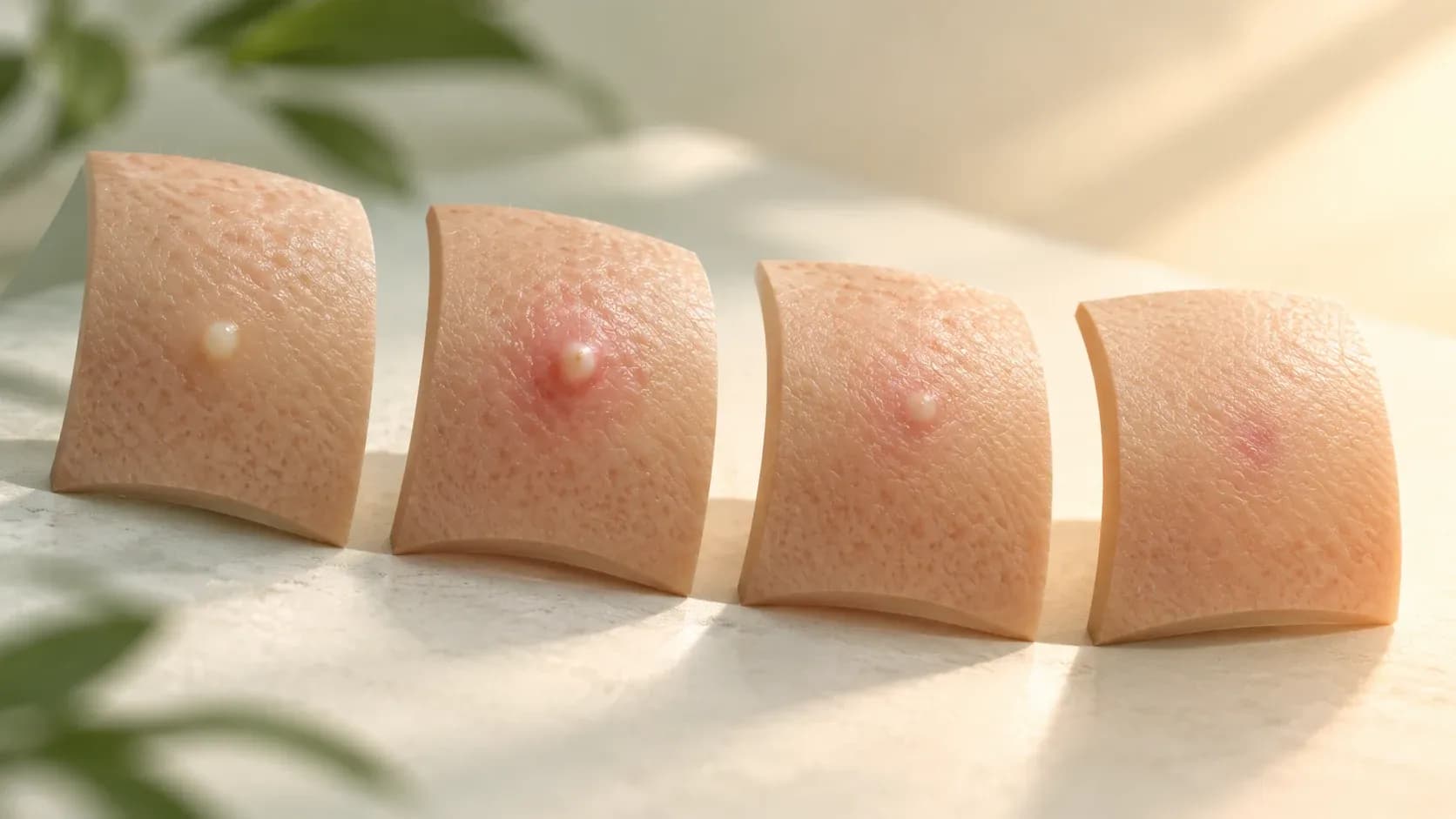
Quick Answer: Most whiteheads do go away on their own. The skin's natural renewal cycle gradually pushes the trapped plug to the surface and sheds it, typically within 3 to 6 weeks. The timeline depends on skin barrier health, oil production, hormonal balance, and whether you leave the whitehead undisturbed.
What Is a Whitehead and How Does It Form?
A whitehead is a closed comedone, a pore blocked with sebum (the skin's natural oil) and dead skin cells, where the pore opening at the surface stays sealed. Because air cannot enter, the trapped material stays white or pale rather than oxidising to black. That sealed surface also limits bacterial growth, which is why whiteheads are typically small, firm, and not painful, unlike inflamed pimples or cysts.
Whiteheads form through a predictable biological chain:
- Excess sebum production, triggered by hormones, stress, or a damaged skin barrier, accumulates in the follicle.
- Dead skin cells (keratinocytes) fail to shed normally and clump together inside the pore.
- The pore opening closes over, trapping the mixture beneath a thin layer of skin.
- A small, flesh-coloured or white bump appears at the surface.
The closed pore is what makes a whitehead capable of resolving naturally. The skin can shed the trapped material over time through its normal renewal cycle, but only if given the right conditions to do so.
Citable one-liner: A whitehead is a closed comedone, the sealed pore opening is what allows it to potentially resolve without intervention.
Can Whiteheads Go Away on Their Own?
Yes, many whiteheads clear without any intervention. As the skin naturally renews itself, dead cells shed, oil flow normalises, and the trapped material can gradually resolve over several weeks.
However, this process is slow and depends heavily on:
- Skin barrier health, a compromised barrier slows cell shedding
- Oil production levels, high sebum output can refill a clearing pore
- Hormonal balance, androgen fluctuations directly stimulate sebaceous glands
- Daily skincare habits, picking, over-cleansing, and frequent product switching all reset the healing timeline
According to Clear Ritual's skincare team, gentle and consistent care gives whiteheads the best chance of clearing naturally, usually within 6 to 8 weeks.
How Whiteheads Heal on Their Own: The Biological Process
When a whitehead is left alone and the skin is gently supported, the body clears it through its own renewal system, a process called desquamation, where the outermost skin cells naturally shed every 2 to 4 weeks.
Here is what actually happens beneath the skin's surface:
- Keratinocytes shed from the pore lining. Skin cells lining the follicle wall continuously turn over. As older cells shed, they gradually loosen the plug of dead cells and sebum trapped inside the pore.
- Sebum flow normalises. If the underlying trigger, excess oil, hormonal fluctuation, or barrier disruption, reduces, the follicle gradually stops being overfilled.
- The trapped plug softens. Over several weeks, the hardened sebum-and-cell mixture softens as it moves toward the surface with the natural upward flow of cell renewal.
- The whitehead flattens or surfaces. In most cases, the bump gradually becomes less raised. In some cases, the trapped material reaches the surface and releases naturally, without squeezing.
- The pore closes cleanly. If the surrounding skin barrier is intact, the follicle reseals without scarring or post-inflammatory pigmentation.
This entire process takes approximately 3 to 6 weeks from formation to resolution, based on the average human skin renewal cycle of 28 days. A 2021 review in the Journal of the European Academy of Dermatology and Venereology confirmed that comedone resolution follows the skin's natural cell-turnover cycle, making patience and barrier support the most evidence-consistent approach for mild comedonal acne.
Citable one-liner: Most whiteheads resolve naturally within 3 to 6 weeks because the skin's cell-turnover cycle gradually pushes the trapped plug to the surface without intervention.
Whitehead Healing Timeline: What Happens Week by Week
Understanding which stage a whitehead is in helps determine the right response, and avoid interventions that reset the clock.
| Stage | Timeline | What You See | What's Happening Inside | Best Action |
|---|---|---|---|---|
| Formation | Days 1–4 | Small, firm bump; flesh-coloured or white; no redness | Sebum and dead cells clog the follicle; pore seals over | Leave alone; cleanse gently twice daily |
| Stabilisation | Days 4–10 | Bump remains similar size; may feel slightly less firm | No new material entering; plug begins to shift position | Moisturise; avoid touching |
| Natural Turnover | Weeks 2–3 | Bump flattens or becomes less raised; may become slightly more visible before fading | Skin renewal pushes plug toward surface; keratinocytes shedding | Continue gentle routine; consider a mild BHA like salicylic acid |
| Resolution or Progression | Weeks 3–6 | Either fades entirely, or becomes red and inflamed | Clean resolution if undisturbed; inflammation if picked, barrier stripped, or hormonal surge | If resolving: maintain routine. If inflamed: stop actives, restore barrier |
| Full Clearance | Weeks 6–8 | No visible bump; pore closes | Follicle has shed the plug and resealed | Maintain preventive routine |
The resolution window shifts depending on three factors: how frequently the area is touched, whether the skin barrier is intact, and whether the underlying cause, such as hormonal fluctuation or excess oil, is ongoing. A whitehead with an active hormonal trigger will often reform in the same pore even after clearing.
Citable one-liner: Whitehead healing moves through five predictable stages over 3 to 8 weeks, the skin does the work if the barrier stays intact.
Whiteheads vs. Blackheads: Do They Heal the Same Way?
No, whiteheads and blackheads do not heal the same way, and understanding why changes what you should do about each.
| Whitehead (Closed Comedone) | Blackhead (Open Comedone) | |
|---|---|---|
| Pore status | Sealed at the surface | Open at the surface |
| Colour | White or flesh-coloured | Black or dark brown (from oxidation, not dirt) |
| Self-resolution | Yes, can resolve naturally in 3–6 weeks | Unlikely without intervention, open pores accumulate debris continuously |
| Inflammation risk | Low (bacteria limited by sealed pore) | Moderate (exposed to bacteria) |
| Best approach | Gentle barrier support; patience | BHAs (salicylic acid), regular gentle exfoliation |
| Avoid | Picking, over-cleansing | Aggressive pore strips, mechanical scrubs |
Why blackheads rarely clear on their own: Because the pore is open, oxidised sebum is constantly exposed to air and new material keeps entering. The pore does not have the same mechanism to seal and shed its contents the way a closed comedone does. Dermatological research consistently shows that open comedones respond better to topical exfoliating acids, particularly salicylic acid, a beta-hydroxy acid (BHA) that is oil-soluble and can penetrate the follicle wall, than to hands-off waiting.
What they share: Both whiteheads and blackheads worsen with harsh cleansing, barrier disruption, and high sebum production. A consistent, gentle routine benefits both.
Citable one-liner: Whiteheads can resolve naturally because the sealed pore has a clearing mechanism; blackheads typically need exfoliating support because the open pore continues accumulating debris.
Whiteheads vs. Milia: Why This Distinction Matters
Not every small white bump on the skin is a whitehead, and this distinction matters because the answer to "will this go away on its own?" depends entirely on which one you have.
Milia are tiny white cysts that form when keratin (a skin protein) becomes trapped beneath the surface. They look almost identical to whiteheads: small, white, and firm. But unlike whiteheads, milia do not have a pore opening, not even a sealed one. There is no natural pathway for the trapped keratin to exit.
Key differences:
- Whiteheads feel soft to slightly firm and sit within a follicle. They can self-resolve in 3–6 weeks.
- Milia feel very hard and round, like a tiny grain of rice. They do not resolve on their own and require professional extraction or a topical retinoid used consistently over months.
- Location clue: Milia commonly appear around the eye area and on the nose bridge. Whiteheads appear wherever follicles are largest, forehead, chin, and nose.
Clear Ritual recommends that if a bump has not changed at all after 6 to 8 weeks of consistent gentle skincare, professional assessment is advisable. It may be milia rather than a whitehead, in which case, waiting indefinitely will not help.
Citable one-liner: Milia look identical to whiteheads but have no pore opening, so they cannot self-resolve, professional assessment is needed if a white bump persists beyond 8 weeks without any change.
Does a Whitehead Appearing Mean Your Skin Is Healing?
A whitehead appearing can signal healing, but the context determines what it means.
Context 1: A pimple becoming a whitehead
When an inflamed pimple develops a white or yellowish top, this is usually a sign of the immune response working, white blood cells (pus) have gathered at the site. This is a pustule, not a comedone-type whitehead. However, it often signals that inflammation is resolving and moving toward the surface. The right response is still to leave it alone. The skin will typically release the contents and begin healing within a few days without picking.
Context 2: New whiteheads appearing during a new skincare routine
If a retinoid or exfoliating acid like salicylic acid has been recently started, an initial increase in whiteheads is common. This is called purging, the treatment accelerates cell turnover, pushing existing blockages to the surface faster than they would naturally appear. Purging typically lasts 4 to 6 weeks and resolves as the skin adapts. If breakouts appear in entirely new areas where you do not usually break out, this is more likely a reaction to the product than purging.
Citable one-liner: A whitehead appearing on an inflamed pimple usually signals the immune response is working, the skin is moving toward resolution, not getting worse.
What Slows Down Whitehead Healing?
Whiteheads may linger or recur when certain habits disrupt the skin's natural clearing process. Clear Ritual identifies these as the most common causes of delayed whitehead resolution:
1. Popping or squeezing This pushes the blockage deeper into the follicle, introduces bacteria from the fingers, triggers inflammation, and resets the entire healing timeline. A whitehead that would have cleared in 3 weeks may take 6 to 8 weeks after being squeezed.
2. Over-cleansing and harsh treatments Stripping the skin barrier:
- Triggers oil rebound, causing the skin to produce more sebum to compensate
- Disrupts cell turnover, slowing the natural shedding mechanism
- Makes pores clog again within days of clearing
3. Frequent product switching Constantly changing routines prevents the skin from stabilising. Each new product requires approximately 28 days of adaptation. Switching before this period forces repeated adjustment phases and leaves the follicle vulnerable to re-blocking.
4. Ongoing hormonal triggers If androgen levels remain elevated, due to menstrual cycle fluctuation, high stress, or underlying conditions like PCOS, sebaceous glands continue overproducing sebum, refilling clearing pores faster than the skin can shed them.
5. Repeatedly touching the face Hands transfer oils and bacteria that can introduce new triggers into already-vulnerable follicles and create micro-friction that irritates the sealed pore.
How to Help Whiteheads Go Away Faster: Step-by-Step
You cannot force a whitehead to disappear overnight, but you can create the conditions where your skin clears it in the shortest time possible.
Step 1: Cleanse gently, twice daily Use a mild, pH-balanced cleanser, not a foaming or stripping formula. The goal is to remove excess oil without disrupting the acid mantle (the skin's protective surface layer). Over-cleansing triggers oil rebound, which means your skin produces more sebum to compensate, refilling the very pore you are trying to clear.
Step 2: Apply a non-comedogenic moisturiser immediately after cleansing A well-moisturised skin barrier sheds dead cells more efficiently, which is the biological mechanism that clears the whitehead. Look for ingredients like niacinamide (which also helps regulate sebum) or hyaluronic acid.
Step 3: Add a BHA exfoliant 2–3 times per week (not daily) Salicylic acid (a beta-hydroxy acid) is oil-soluble, which means it can penetrate the follicle and dissolve the sebum-and-cell plug from inside. Concentrations of 0.5% to 2% applied 2–3 times per week are typically sufficient for whitehead-prone skin. Daily use often tips into over-exfoliation, which damages the barrier and slows clearing.
Step 4: Do not touch the area between cleansing steps Every touch transfers bacteria and oils that can introduce new triggers into already-vulnerable follicles, and creates micro-friction that can irritate the sealed pore and trigger inflammation.
Step 5: Be consistent for at least one full skin cycle (28 days) Switching products before completing one skin cycle prevents the skin from stabilising. The clearing mechanism, natural cell turnover, takes a minimum of 3 to 4 weeks. Inconsistent application resets this cycle.
Common mistake to avoid: Using multiple actives at once, retinoid + BHA + vitamin C, in the hope of faster results. Layering actives disrupts the barrier and commonly makes whiteheads worse in the short term. Start with one active, assess for 4 weeks, then add a second if needed.
Citable one-liner: Gentle daily cleansing, consistent moisturising, and BHA exfoliation 2–3 times a week create the optimal conditions for whiteheads to clear within one skin cycle.
Research and Evidence: What Studies Say About Whitehead Resolution
The biology of whitehead resolution is supported by meaningful clinical research, not just convention.
Skin renewal cycle: The average epidermal turnover time in adults is approximately 40 to 56 days, with the outer stratum corneum shedding every 14 to 28 days. This is the biological clock behind the 3–6 week whitehead resolution timeline, the skin cannot shed a comedone faster than it sheds its own surface cells.
Salicylic acid efficacy: A 2018 randomised controlled trial published in the Journal of Clinical and Aesthetic Dermatology found that 2% salicylic acid significantly reduced comedone count within 4 weeks compared to vehicle control, with continued improvement at 8 weeks. This supports BHA use as an evidence-based adjunct, not a replacement, for natural resolution.
Barrier disruption and acne: Research published in Skin Research and Technology (2019) demonstrated that compromised skin barrier function is associated with increased comedone formation, supporting the clinical recommendation to prioritise moisturiser and gentle cleansing over aggressive treatments.
Hormonal influence on sebum: A review in Dermato-Endocrinology confirmed that androgen hormones, including testosterone and its derivative DHT, directly stimulate sebaceous gland activity, explaining why whiteheads often persist or recur in people with hormonal fluctuations during menstrual cycles, puberty, or periods of high stress.
The practical takeaway from the evidence: no clinical intervention accelerates whitehead resolution by more than 30–40% compared to a gentle, consistent routine. More product does not mean faster results, barrier preservation is the rate-limiting step.
When Whiteheads May Not Go Away on Their Own
Professional guidance may be appropriate if any of the following apply:
- Whiteheads persist beyond 6 to 8 weeks of consistent gentle skincare
- They frequently become inflamed or painful
- They are widespread across multiple facial zones
- Hormonal or lifestyle triggers, such as PCOS or post-pill hormonal shifts, are suspected
- A bump has not changed in size, texture, or appearance after 8 weeks (which may indicate milia rather than a whitehead)
In these cases, a dermatologist can assess whether prescription-strength retinoids, hormonal therapy, or clinical extraction is appropriate.
Understand Your Whitehead Pattern
Take the free skin test to assess recurring whiteheads, oiliness, sensitivity, congestion, and other concerns, then get a routine suited to your skin.
Take the Free Skin Test
Frequently Asked Questions
Q: Do whiteheads go away on their own?
A: Many whiteheads can clear naturally as the skin renews itself, usually within three to six weeks when they are left undisturbed.
Q: How long does a whitehead take to disappear?
A: A mild whitehead may flatten within three to six weeks, although complete clearance can take up to eight weeks depending on oil production, skin barrier health, and hormonal triggers.
Q: Should you squeeze a whitehead?
A: No. Squeezing may push the blockage deeper, increase inflammation, introduce bacteria, and extend the healing timeline.
Q: What helps whiteheads clear faster?
A: Gentle cleansing, consistent moisturising, avoiding picking, and carefully using salicylic acid two or three times weekly may support natural clearing.
Q: When should a persistent white bump be checked?
A: Seek professional assessment if a white bump remains unchanged after six to eight weeks, becomes painful, repeatedly inflames, or may be milia rather than a whitehead.
Disclaimer: This article is for general educational purposes and is not a substitute for personalised medical advice. Consult a qualified dermatologist for persistent, painful, widespread, or frequently inflamed whiteheads.
Editorial Standards
Clear Ritual has Strict sourcing guidelines to ensure our content is accurate and current. We rely on peer-reviewed studies, academic research institutions, and medical associations. We strive to use primary sources and refrain from using tertiary references. See a mistake? Learn More about our Editorial Standards.
Related Articles
Whitehead Removal Myths You Need to Stop Believing
Published 21 July 2026

Should You Pop Whiteheads? Why Dermatologists Say No
Published 21 July 2026
Are Pore Strips Safe for Blackhead Removal? (Expert Breakdown)
Published 21 July 2026
Blackhead Removal Myths You Need to Stop Believing
Published 21 July 2026