Does AC Cause Acne? How Air Conditioning Affects Your Skin
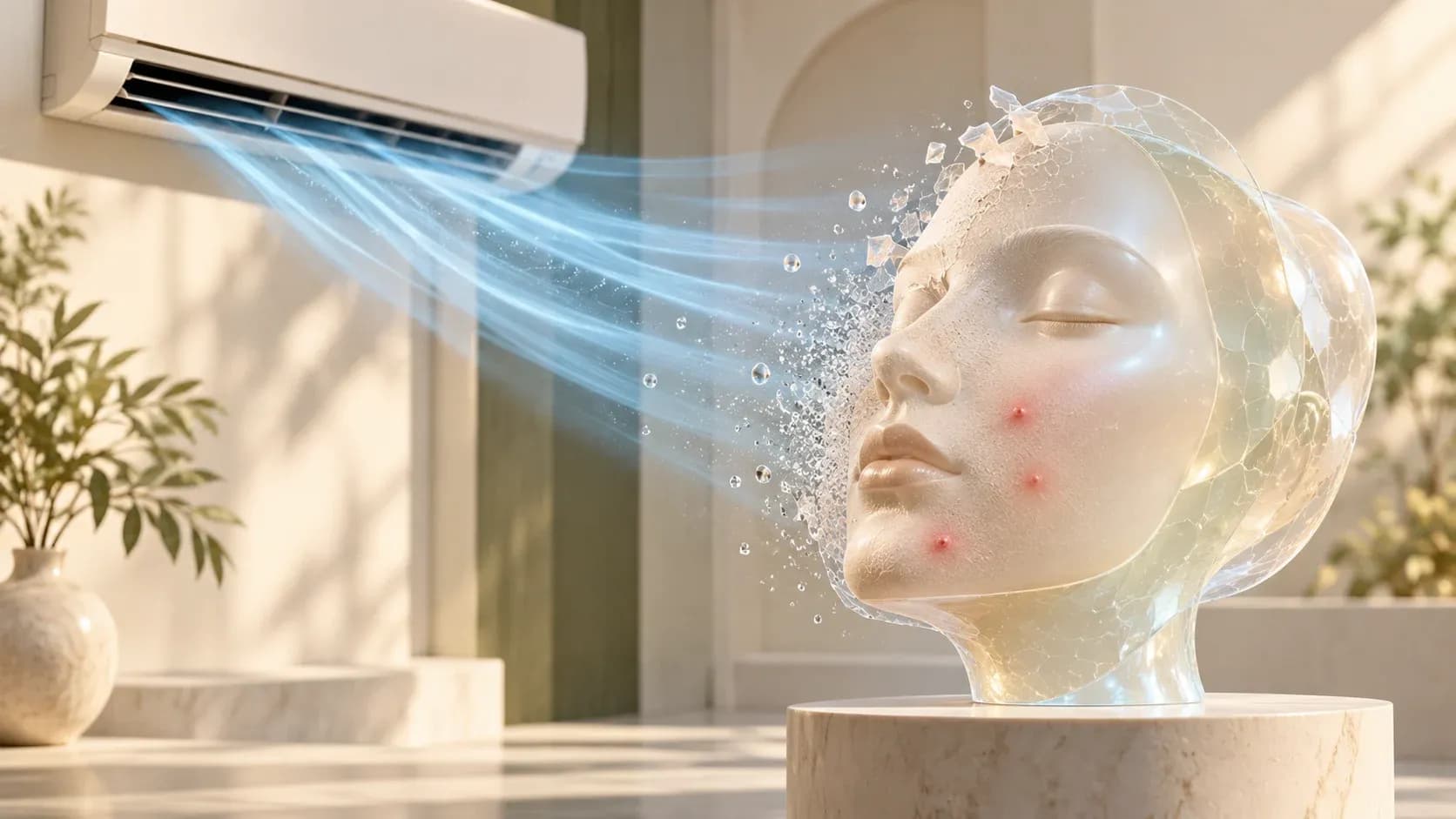
Quick Answer: Air conditioning does not directly cause acne. But it reliably creates three conditions that do: skin dehydration, a weakened barrier, and excess compensatory oil production. When these three occur together, pores clog more easily, inflammation rises, and breakouts follow, especially in already acne-prone skin.
What Is AC-Related Acne?
AC-related acne is not a distinct skin condition. It is a breakout pattern triggered by the environmental effects of air conditioning, specifically low indoor humidity, airborne particles, and temperature-induced stress, acting on skin that is predisposed to congestion or inflammation.
The key distinction: air conditioning is a trigger, not a root cause. It amplifies existing vulnerabilities in your skin barrier rather than introducing a new disease process. According to Clear Ritual's dermatology team, most people who break out in AC environments are dealing with a manageable environmental trigger layered on top of a barrier that needs more support.
How Does Air Conditioning Change Your Indoor Environment?
When an air conditioner runs, it removes humidity from indoor air as a by-product of the cooling process. In a sealed room with continuous AC use, relative humidity can drop below 30%. The skin-safe range is 40–60%.
Your skin constantly loses water to the surrounding air through a process called transepidermal water loss (TEWL). The lower the ambient humidity, the steeper the water gradient between your skin and the air, and the faster that loss occurs. Research published in the British Journal of Dermatology (2016) found that reducing relative humidity from 50% to 30% increased TEWL by an average of 28% in healthy adults over a four-hour exposure period.
The outermost skin layer, the stratum corneum, holds water using natural moisturising factors and a lipid matrix. When TEWL outpaces the skin's ability to replenish water, this matrix becomes disorganised. Microscopic gaps form between skin cells, and barrier function begins to break down.
What Is the Step-by-Step Mechanism From AC to Acne?
Understanding the full pathway helps you interrupt it at the right point. Clear Ritual's skin science team outlines six sequential steps:
- AC removes humidity from indoor air. The cooling process condenses moisture out of the air. Relative humidity drops to 20–30% in continuously air-conditioned rooms.
- Low humidity accelerates transepidermal water loss (TEWL). Skin loses roughly 30–40% more water in a 25% humidity environment than at 50% humidity.
- The stratum corneum begins to weaken. The lipid matrix between skin cells becomes disorganised. Microscopic gaps form.
- Irritants penetrate deeper, triggering inflammation. Dust particles, mould spores, and pollution fragments from recirculated air enter through barrier gaps. Your immune system responds with an inflammatory cascade, a core driver of acne, independent of bacteria.
- Sebaceous glands overproduce sebum. The skin interprets a dry, compromised surface as a shortage of protective oil. Glands increase production, a mechanism that routinely overshoots. Elevated cortisol from temperature shock further alters sebum composition, making it thicker and more prone to oxidation.
- Excess sebum plus dead cells plus inflammation blocks pores. Excess sebum mixes with dead skin cells that are not shedding efficiently due to barrier dysfunction. This mixture accumulates in follicles and triggers the inflammatory cascade behind breakouts.
The result: prolonged AC exposure leads to acne not because AC causes it directly, but because it creates six sequential conditions that together make breakouts nearly inevitable in predisposed skin.
How Does AC Affect Different Skin Types?
Not all skin types respond to AC exposure the same way. The risk profile and most effective protective response differ meaningfully by skin type.
| Skin Type | Primary AC Effect | Acne Risk | Biggest Risk Factor | Most Effective Fix |
|---|---|---|---|---|
| Dry skin | Extreme TEWL, flaking, tightness | Moderate | Dead-cell accumulation clogs pores | Rich humectant + occlusive layering |
| Oily skin | Compensatory sebum surge after initial relief | High | Sudden sebum overproduction | Lightweight hydration + regular cleansing |
| Combination skin | T-zone oily, cheeks tight and dry | High | Using wrong products for each zone | Zone-specific routine |
| Sensitive / reactive skin | Barrier breaks down faster, redness, stinging | Very high | Inflammatory particles penetrate easily | Barrier-repair ceramide serums + humidifier |
| Acne-prone (any type) | All AC effects amplified | Very high | Pre-existing compromised barrier | All of the above + pillow cover changes, filter cleaning |
The most vulnerable profile is combination or oily-acne-prone skin spending 8 or more hours daily in a low-humidity AC environment, particularly with AC running overnight. This person experiences maximum sebum overproduction combined with minimum barrier repair, the worst-case scenario for morning breakouts.
A note on sensitive skin: sensitive skin types are not always acne-prone, but inflammatory particles circulated by dirty AC filters disproportionately affect them. A histamine-mediated inflammatory response can look and feel exactly like acne, but responds to antihistamines and filter cleaning rather than acne treatments.
What Does Nighttime AC Exposure Do to Skin?
Sleeping with AC running all night means six to eight hours of continuous exposure to dry, recirculated air. Your skin performs most of its repair and regeneration during sleep, but this process requires adequate hydration.
When the surrounding air is too dry, the skin struggles to complete repair cycles effectively. You wake up with a compromised barrier that is more vulnerable throughout the day. Morning tightness or a feeling of discomfort indicates your skin has been working overtime to manage dehydration.
Overnight AC exposure also affects the skin's microbiome. Excessive dryness can favour certain bacterial populations over others, potentially increasing populations that compete poorly with Cutibacterium acnes regulation. Combined with fabric friction from pillowcases, nighttime AC exposure creates conditions for inflamed or newly formed pimples by morning.
Is AC Bad for Skin Compared to Outdoor Air?
AC is not uniformly bad for skin. The impact depends entirely on exposure duration, humidity management, and your baseline skin type. According to Clear Ritual's dermatology review, short-term AC use in a humidity-controlled environment poses minimal skin risk. Problems arise with prolonged, unmanaged exposure.
| Factor | AC Environment (Unmanaged) | AC Environment (Managed) | Outdoor / Fresh Air |
|---|---|---|---|
| Indoor humidity | <30%, promotes TEWL | 40–50%, skin-safe range | Variable, often 50–70% |
| Airborne particles | Dust, mould spores (dirty filter) | Low (clean filter) | Pollen, pollution, UV |
| Temperature stability | Stable but cold | Stable, moderate | Variable, can stress barrier |
| Sebum response | Compensatory overproduction | Balanced | Heat-driven overproduction |
| Acne risk | Moderate–high (dry skin + excess oil) | Low | Moderate (heat + sweat) |
| Best for | , | Sensitive, rosacea-prone skin | Normal, resilient skin |
What AC does that outdoor air does not:
- Removes moisture continuously rather than adding it
- Recirculates the same air with accumulated particles
- Eliminates the natural humidity variation that skin adapts to outdoors
- Suppresses sweat, which in moderate amounts helps clear debris from pores
What outdoor air provides that AC does not:
- Natural humidity that supports barrier hydration
- Temperature gradients that skin has evolutionarily adapted to
- UV exposure (pro: vitamin D synthesis; con: UV-induced inflammation)
A well-maintained AC at moderate temperature with a humidifier running is not bad for your skin. It is unmanaged, low-humidity, high-particle AC that creates the breakout conditions most people associate with "AC acne."
How to Protect Your Skin from AC-Related Breakouts
These steps address each point in the AC-to-acne pathway. Follow them in sequence for the most impact. Clear Ritual recommends beginning with the environment, not the skincare shelf.
Control your indoor humidity first. Target 40–50% relative humidity using a room humidifier. This single change reduces TEWL by an estimated 20–30% and is more effective than adding extra skincare products. A basic hygrometer costs under ₹500 and tells you exactly when the humidifier needs to run.
Cleanse gently, not aggressively. AC environments tempt oily-skin types to over-cleanse. Over-cleansing strips the barrier further and worsens TEWL. Use a gentle, low-pH cleanser twice daily, no more. Use blotting papers for midday oiliness rather than an additional cleanse.
Apply humectants immediately after cleansing, within 60 seconds. Humectants such as hyaluronic acid, glycerin, niacinamide, and aloe vera draw water into the upper skin layers. They work best on slightly damp skin before the surface dries completely.
Seal with a barrier-supportive layer. Follow humectants with a product containing ceramides, squalane, or a lightweight oil such as rosehip or jojoba. For acne-prone skin, avoid heavy petroleum-based occlusives, these can trap sebum and worsen congestion.
Clean your AC filter every 4–6 weeks. Manufacturer guidelines of every 1–3 months are set for energy efficiency, not skin health. In high-use environments or for acne-prone skin, monthly cleaning removes the dust, mould spore, and allergen load circulated onto your skin. This is especially important for split AC units without external ventilation.
Change your pillowcase every 2–3 nights when sleeping with AC. Fabric absorbs the excess sebum and barrier-repair compounds your skin releases overnight. Silk or tightly woven cotton reduces friction and re-contamination.
Hydrate internally, add 250ml per 4 hours of AC exposure. AC increases respiratory water loss in addition to cutaneous loss. Internal hydration supports sebum composition: well-hydrated skin produces sebum richer in anti-inflammatory linoleic acid, which is protective rather than comedogenic.
Common mistake to avoid: Applying a facial mist and stopping there. In a low-humidity environment, a water mist without a sealing layer evaporates within minutes, potentially increasing TEWL by raising the water gradient at the skin surface. Always follow a mist with a humectant or light moisturiser.
What Does the Research Say About AC and Skin Health?
The link between indoor air quality, humidity, and skin health is well-documented in peer-reviewed literature. The following studies are directly relevant to how AC affects acne.
Study 1, Low humidity and TEWL: A study in the British Journal of Dermatology (2016) found that reducing ambient relative humidity from 50% to 30% increased TEWL by an average of 28% in healthy adults over a four-hour exposure period. Barrier recovery was slower in participants with a history of eczema or acne, suggesting pre-existing barrier compromise amplifies AC-related skin stress.
Study 2, Compensatory sebum production: Research from the Journal of Investigative Dermatology (2018) demonstrated that skin exposed to low-humidity environments for six or more hours showed a statistically significant increase in sebum output two to four hours post-exposure. The researchers attributed this to a lagged compensatory response, meaning increased oiliness may appear after leaving the AC environment, not during it.
Study 3, Indoor air quality and inflammation: A 2020 review in the International Journal of Environmental Research and Public Health found that buildings with poorly maintained HVAC filters showed 2.3× higher levels of airborne particulates deposited onto skin surfaces. The review linked this to increased histamine-mediated inflammatory responses, a mechanism distinct from but additive to comedogenic acne.
Study 4, Cortisol, temperature shock, and sebum: A 2019 study in Psychoneuroendocrinology documented that repeated acute thermal stress, temperature changes of 10°C or more within 15 minutes, elevated serum cortisol by 8–12% on average. Elevated cortisol has independently been shown to increase sebaceous gland activity and shift sebum toward a more oxidised, pro-inflammatory lipid profile.
What the evidence means in practice: three independent pathways, humidity-driven TEWL, compensatory sebum overproduction, and airborne particle-induced inflammation, each individually worsen acne. Together, they explain why prolonged AC exposure can convert mild, occasional breakouts into persistent patterns.
What Timeline Should You Expect for Skin Improvement?
If AC exposure is a significant trigger for your breakouts, environmental and routine adjustments show results in a predictable sequence. Clear Ritual's clinical team outlines realistic expectations below.
Days 1–3: Immediate comfort improvement Adding a humidifier and switching to a gentle humectant-first routine typically reduces skin tightness and discomfort within 48–72 hours. This is barrier stabilisation beginning, not acne clearing.
Weeks 1–2: Reduction in surface oiliness When the skin's compensatory sebum overproduction signal is removed because humidity is adequate, sebaceous glands gradually reduce output. Most people notice less midday shine and fewer new surface-level breakouts within two weeks.
Weeks 3–4: Existing breakouts begin to resolve With barrier function improving, inflammatory signals decrease. Existing comedones and papules begin to resolve more quickly. Sensitive or severely acne-prone skin may need an additional one to two weeks.
Months 2–3: Skin texture and consistency normalise With the environmental trigger consistently managed, pore congestion reduces and the dehydration-oiliness-breakout cycle is interrupted. If breakouts persist at this stage despite environmental management, the primary driver is likely internal, hormonal, dietary, or stress-related, rather than environmental.
What does not improve on this timeline:
- Hormonal acne (jawline, lower cheeks, cyclical pattern), requires hormonal support
- Cystic or nodular acne, requires dermatological treatment
- Post-inflammatory hyperpigmentation, fades over 3–6 months with consistent SPF use
When Should AC-Related Breakouts Prompt a Dermatologist Visit?
Most people can manage mild AC-related skin changes with environmental and routine adjustments. However, certain patterns suggest professional consultation is warranted.
- Breakouts are painful, deep, or forming cysts, these indicate a more complex acne process that needs targeted treatment to prevent scarring
- Skin becomes persistently red, burns, or develops a rash rather than typical pimples, this may indicate dermatitis or another inflammatory condition requiring a different treatment approach
- You have made consistent environmental and skincare adjustments for six to eight weeks without meaningful improvement
- Skin behaviour changes suddenly and coincides with new medications, supplements, or significant life stressors, these warrant evaluation to rule out systemic triggers
Understand Your Breakout Triggers
Take the free skin test to assess oiliness, dehydration, sensitivity, barrier concerns, and recurring breakouts, then build a routine suited to your skin.
Take the Free Skin Test
Frequently Asked Questions About AC and Acne
Q: Can sleeping with AC on cause acne?
A: Sleeping with AC running all night exposes your skin to prolonged dryness for six to eight hours, exactly when your skin performs barrier repair. This can compromise the stratum corneum and trigger compensatory oil production. AC alone does not cause acne, but overnight dehydration combined with pillowcase friction and reduced barrier function can contribute meaningfully to morning breakouts in acne-prone skin.
Q: Does turning off AC help clear skin?
A: Reducing AC use or maintaining higher indoor humidity often helps skin feel more comfortable and can reduce mild breakouts related to dehydration. However, if your acne has multiple drivers, hormonal, dietary, stress-related, simply turning off AC will not clear skin completely. It is one adjustment among several, and typically the most impactful environmental one.
Q: Why does my face get oily in air conditioning?
A: AC removes moisture from the air, which accelerates water loss from your skin's surface. Your sebaceous glands detect this dryness and increase oil production to protect and hydrate your skin. This compensatory mechanism often overshoots, leaving your face oilier than normal despite the cool, dry environment. Research suggests this sebum surge may appear two to four hours after AC exposure, not during it.
Q: Can AC cause dry skin and pimples at the same time?
A: Yes. This is a common and well-documented pattern. AC-induced dehydration weakens your skin barrier, causing tightness and dryness. Simultaneously, oil glands increase sebum production in response to surface dryness. The combination of excess oil, dead skin cells that are not shedding efficiently, and barrier dysfunction creates ideal conditions for clogged pores and breakouts, both problems present together.
Q: How often should I clean my AC filter to prevent skin problems?
A: For skin health purposes, clean or replace your AC filter every four to six weeks, not every three months as manufacturer energy-efficiency guidelines suggest. Dirty filters can recirculate dust, mould spores, and allergens that may aggravate sensitive or acne-prone skin.
Disclaimer: This article is for general educational purposes and is not a substitute for personalised medical advice. Consult a qualified dermatologist for persistent, painful, inflamed, or scarring acne.
Editorial Standards
Clear Ritual has Strict sourcing guidelines to ensure our content is accurate and current. We rely on peer-reviewed studies, academic research institutions, and medical associations. We strive to use primary sources and refrain from using tertiary references. See a mistake? Learn More about our Editorial Standards.