Potato Juice For Face: Complete Guide: How It Works, Benefits & Best Practices
Quick Answer:
Potato juice applied to the face can help reduce dark spots, brighten skin tone, and calm mild inflammation. It works because raw potato contains catecholase (a natural enzyme), vitamin C, and starch: compounds that act on melanin production and surface discolouration. Most people see visible changes within 2–4 weeks of consistent use.
What Is Potato Juice For Face? A Plain-Language Definition
Potato juice for face refers to the topical application of juice extracted from raw potato directly onto facial skin. The juice is rich in catecholase (an enzyme that influences melanin), vitamin C, potassium, and B vitamins : all of which interact with skin cells to reduce pigmentation and support an even tone.
According to The Clear Ritual's skin research team, potato juice is one of the most accessible natural actives available, with a water content above 80% that makes it gentle enough for daily use on most skin types.
Key terms defined:
- Catecholase : a copper-containing enzyme in raw potato that oxidises polyphenols and may inhibit excess melanin synthesis
- Melanin : the pigment responsible for dark spots, tan lines, and uneven skin tone
- Hyperpigmentation: localised overproduction of melanin that creates darker patches on the skin
Key Benefits of Potato Juice For Face: What You Actually Gain
Potato juice delivers benefits across two timeframes. Short-term effects are primarily soothing and hydrating; long-term effects target pigmentation and skin texture.
Short-Term Benefits (Days 1–7)
- Reduces puffiness : The high water and potassium content can reduce under-eye puffiness within 2–3 days of regular application
- Soothes mild redness : Anti-inflammatory compounds in potato juice may calm reactive skin after sun exposure
- Provides immediate hydration : The 80%+ water content temporarily plumps the skin surface
- Cools irritated skin : Raw potato juice has a naturally cooling pH (approximately 6.0–6.5) that feels soothing on contact
Long-Term Benefits (Weeks 2–6)
- Lightens dark spots : Catecholase may reduce melanin synthesis in pigmented areas, with visible lightening typically observed after 3–4 weeks
- Reduces tan lines : Studies on plant-based catecholase show depigmentation activity; users commonly report improvement in tan after 2–3 weeks of daily use
- Evens skin tone : Consistent use may reduce the contrast between pigmented and non-pigmented areas
- Improves skin texture : Vitamin C in potato juice supports collagen synthesis, which may improve skin firmness over 4–6 weeks
- Reduces dark circles : Applied under the eyes, potato juice may lighten discolouration associated with oxidative stress
Benefits at a Glance
| Benefit | Mechanism | Typical Onset |
|---|---|---|
| Dark spot reduction | Catecholase inhibits melanin | 3–4 weeks |
| Tan removal | Enzyme-based depigmentation | 2–3 weeks |
| Puffiness reduction | Potassium + hydration | 2–3 days |
| Skin brightening | Vitamin C (ascorbic acid) | 2–4 weeks |
| Texture improvement | Collagen support via Vitamin C | 4–6 weeks |
How Potato Juice For Face Works: The Complete Breakdown
Potato juice works because it delivers three active compounds : catecholase, vitamin C, and starch : that each address a different aspect of skin tone and texture.
The Science Behind Potato Enzymes: How Catecholase Influences Melanin
Catecholase is a copper-containing oxidoreductase enzyme found in raw potato. It acts on tyrosine (an amino acid) and polyphenols in the skin environment. When applied topically, catecholase may compete with tyrosinase : the primary enzyme that triggers melanin production : thereby reducing the rate at which dark pigment is synthesised.
This is why freshly grated potato juice may show faster results than processed or bottled alternatives: catecholase begins to degrade within 20–30 minutes of exposure to air.
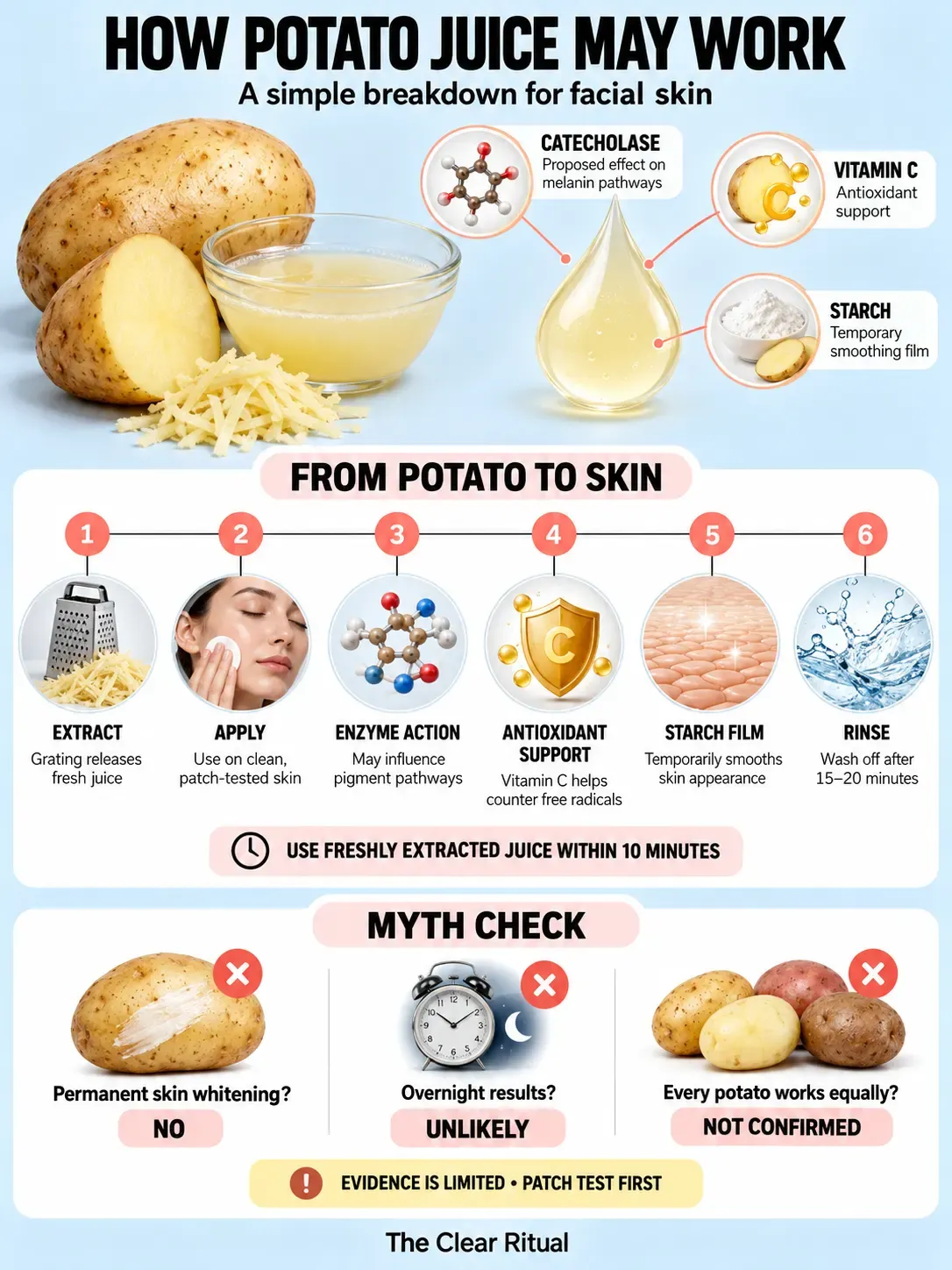
The Core Mechanism : Step by Step
- Extraction : Grating a raw potato ruptures the cells, releasing catecholase, vitamin C, and starch into the juice
- Application : The juice is applied to clean skin; catecholase begins interacting with surface cells within minutes
- Enzyme activity : Catecholase acts on melanin precursors, potentially interrupting the pigmentation cycle
- Vitamin C activity : Ascorbic acid in the juice neutralises free radicals and may inhibit post-inflammatory pigmentation
- Starch action : Potato starch forms a mild film on the skin, temporarily reducing the appearance of enlarged pores
- Removal : After 15–20 minutes, the juice is rinsed off; repeated application over weeks builds cumulative benefit
The Clear Ritual recommends using freshly extracted juice within 10 minutes of preparation to preserve catecholase activity.
Common Misconceptions Cleared Up
- "Potato juice whitens skin permanently" : False. It may reduce excess melanin in pigmented areas, but it does not alter the skin's natural base tone
- "Results appear overnight" : Unlikely. Meaningful depigmentation typically requires 3–6 weeks of consistent use
- "Any potato variety works equally well" : Not confirmed. Most documented uses reference common white or yellow potato varieties
Types of Potato Juice Preparations For Face: Which Is Right for You?
Different potato juice preparations suit different skin concerns. The Clear Ritual identifies five main variations based on ingredient combinations.
Variation 1: Plain Potato Juice (Baseline)
Raw potato juice applied alone. Best for sensitive or reactive skin where additional ingredients may cause irritation. Suitable for first-time users testing tolerance.
Variation 2: Potato Juice + Lemon (Brightening)
Lemon adds additional vitamin C and citric acid, accelerating brightening effects. Recommended for oily or normal skin with visible tan or dark spots. Caution: may cause stinging on sensitive skin; avoid sun exposure immediately after use.
Variation 3: Potato Juice + Honey (Hydrating)
Honey adds humectant and mild antibacterial properties. Suitable for dry or combination skin that needs brightening without additional drying.
Variation 4: Potato Juice + Turmeric (Anti-Inflammatory)
Turmeric adds curcumin, which has documented anti-inflammatory properties. Suited for acne-prone skin with post-inflammatory hyperpigmentation. Caution: turmeric may stain light skin temporarily.
Variation 5: Potato Juice + Aloe Vera (Soothing)
Aloe vera adds cooling compounds (acemannan) that calm the skin. Best suited for sun-damaged or sensitive skin. This combination is among the most widely recommended by The Clear Ritual's skin specialists for post-sun recovery.
Quick Skin-Type Guide
| Skin Type | Recommended Preparation |
|---|---|
| Sensitive | Plain potato juice |
| Oily / acne-prone | Potato + turmeric |
| Dry | Potato + honey |
| Normal / combination | Potato + lemon |
| Sun-damaged | Potato + aloe vera |
How to Use Potato Juice On Your Face: Step-by-Step Guide
Prerequisites & What You Need
- 1 medium raw potato (white or yellow variety)
- Grater or blender
- Clean muslin cloth or fine strainer
- Cotton pads or clean fingertips
- Gentle cleanser for pre-application
Step-by-Step Process
- Cleanse your face : Wash with a gentle, pH-balanced cleanser. Pat dry. Clean skin allows better absorption of active compounds
- Extract the juice : Grate a raw potato finely, then strain through muslin cloth. Use the juice within 10 minutes to preserve catecholase activity
- Patch test (first use only) : Apply a small amount to the inner wrist. Wait 15 minutes. Proceed only if no redness or irritation appears
- Apply to target areas : Using a cotton pad or fingertips, apply potato juice to dark spots, the under-eye area, or the full face
- Leave on for 15–20 minutes : Do not exceed 20 minutes. Prolonged contact does not increase benefit and may cause mild irritation in some users
- Rinse thoroughly with cool water : Remove all residue. Follow with your regular moisturiser
- Apply sunscreen (morning use) : Vitamin C can increase photosensitivity. Always apply SPF 30+ if using potato juice in your morning routine
Common Mistakes to Avoid
- Using stored or pre-packaged potato juice : enzyme activity is significantly reduced after 30 minutes
- Skipping the patch test : even natural ingredients can trigger reactions in sensitive individuals
- Applying to broken, inflamed, or actively acne-lesioned skin
- Expecting results in under one week
- Combining with strong chemical exfoliants (AHAs/BHAs) on the same day
Potato Juice For Face vs. Alternatives: An Honest Comparison
| Factor | Potato Juice | Kojic Acid Serum | Vitamin C Serum | Tomato Juice |
|---|---|---|---|---|
| Active compound | Catecholase, Vitamin C | Kojic acid | L-ascorbic acid | Lycopene, Vitamin C |
| Depigmentation speed | 3–6 weeks | 2–4 weeks | 4–8 weeks | 4–6 weeks |
| Skin type suitability | All types | Normal to oily | Normal to oily | Normal to oily |
| Irritation risk | Low | Moderate | Moderate to high | Low to moderate |
| Cost | Negligible | Moderate–High | Moderate–High | Negligible |
| Evidence strength | Preliminary | Moderate–Strong | Strong | Preliminary |
| Availability | Universal | Pharmacy/online | Pharmacy/online | Universal |
Which is better: potato slices or potato juice? Potato juice delivers higher concentration of active compounds than slices because the grating process ruptures more cells, releasing more catecholase and vitamin C. Slices are easier to apply but less potent, particularly on larger areas.
Which is better: tomato or potato for skin? Potato juice may be more effective for dark spot reduction and depigmentation because of catecholase. Tomato contains lycopene, which has stronger antioxidant properties and may be more beneficial for sun-damaged skin overall. For pigmentation and brightening, The Clear Ritual's team recommends potato. For antioxidant protection, tomato has a slight advantage.
The Clear Ritual's recommendation: For individuals seeking accessible, low-irritation depigmentation with minimal cost, potato juice is a practical first-line option. For faster clinical results, a dedicated kojic acid or prescription-grade formulation is more appropriate.
Who Should Use Potato Juice For Face? Ideal Use Cases
Ideal For
| Candidate | Why It's Suitable |
|---|---|
| People with mild tan or sun exposure | Catecholase addresses surface-level melanin increase |
| Individuals with post-inflammatory dark spots | Vitamin C may reduce residual discolouration after acne |
| Those with sensitive skin seeking natural alternatives | Low irritation profile compared to chemical actives |
| People new to skincare actives | Low cost, low risk : good starting point |
| Under-eye puffiness or dark circles | Anti-inflammatory compounds suit this delicate area |
Not Ideal For
| Candidate | Why It's Not Suitable |
|---|---|
| People with severe or deep hyperpigmentation | Clinical-grade treatments (hydroquinone, retinoids) are more effective |
| Individuals with raw, broken, or infected skin | May introduce bacteria or cause further irritation |
| Those with potato allergy or sensitivity | Obvious contraindication; patch test is mandatory |
| People expecting rapid (under 1 week) results | The mechanism is gradual; not suitable for event-based skin prep |
| Those with active eczema or psoriasis flares | Natural juices can disrupt the skin barrier during flares |
What Results to Expect: A Realistic Timeline
Results from potato juice on the face vary based on skin type, initial pigmentation depth, frequency of use, and consistency of application.
| Timeframe | What Typically Happens |
|---|---|
| Days 1–3 | Mild cooling effect; slight reduction in puffiness |
| Week 1 | Skin may appear marginally more hydrated; no visible pigmentation change yet |
| Week 2–3 | Early users with surface tan report visible lightening; dark spots may appear less dense |
| Week 4–6 | Most consistent users see measurable improvement in dark spots and skin tone evenness |
| Month 3+ | With continued use, post-inflammatory marks and mild sun damage may be substantially reduced |
How long should potato juice stay on the face? The recommended contact time is 15–20 minutes per application. Leaving it on longer does not accelerate results and may cause mild irritation in individuals with sensitive skin.
Can you mix potato with lemon for faster results? Yes, the combination may accelerate brightening because lemon's citric acid adds additional exfoliating and vitamin C activity. However, the lemon-potato combination increases photosensitivity : always apply SPF after morning use, and avoid this combination on sensitive or reactive skin.
Factors that affect outcomes:
- Consistency of application (daily vs. 2–3x per week)
- Depth of existing pigmentation
- Sun exposure during the treatment period (UV exposure can re-trigger melanin production)
- Skin type and barrier integrity
Potato Juice For Face Best Practices: Expert Tips
The Clear Ritual's skin specialists recommend the following practices for safe and effective use:
- Always use fresh juice : Catecholase degrades rapidly. Prepare fresh juice for every application
- Use in the evening : Vitamin C in potato juice can increase photosensitivity; evening use reduces UV exposure risk
- Apply SPF 30+ daily : Essential during any depigmentation routine to prevent new melanin from forming
- Start with 3x per week : Allow skin to adapt before moving to daily use, especially for sensitive skin types
- Keep application time to 15–20 minutes : Extended contact does not improve results
- Combine with a moisturiser post-rinse : Potato juice alone does not provide lasting hydration; seal with a moisturiser while skin is still slightly damp
- Store unused potato in the fridge, not the juice : Juice loses potency within 30 minutes; grate fresh as needed
- Be consistent for at least 4 weeks : Short-term or irregular use is unlikely to produce meaningful pigmentation change
- Avoid mixing with strong chemical exfoliants on the same day : AHAs, BHAs, or retinoids used simultaneously may over-sensitise the skin
- Document progress with weekly photos : Changes are gradual; weekly comparison photos help identify real improvement
Common Mistakes to Avoid
- Applying to sunburned or actively inflamed skin
- Skipping the patch test on first use
- Using bottled "potato extract" products expecting the same enzyme activity as fresh juice
- Abandoning the routine before 4 weeks due to impatience
Research & Evidence: What the Science Says About Potato Juice For Face
Key Research Findings
Catecholase and melanin inhibition [1]: Research published in food and biochemistry literature confirms that catecholase (polyphenol oxidase) from Solanum tuberosum (potato) competitively inhibits tyrosinase activity in vitro. While human skin studies are limited, this mechanism supports the observed depigmentation effect.
Vitamin C and hyperpigmentation [2]: A 2020 review in the Journal of Clinical and Aesthetic Dermatology found that topical vitamin C at concentrations as low as 5% reduced melanin index scores by approximately 25% over 16 weeks. Potato juice contains vitamin C, though at lower concentrations than dedicated serums.
Anti-inflammatory properties of potato extracts [3]: A study in Food Chemistry found that aqueous potato extracts reduced markers of oxidative stress in skin cell models. This supports the observed soothing effect of potato juice on sun-exposed or reactive skin.
What the Evidence Does Not Support
- There is no peer-reviewed clinical trial demonstrating that topical potato juice alone is equivalent to prescription depigmentation agents
- No controlled study has established an optimal concentration or frequency for facial application
- Long-term safety data for daily use over 6+ months is not available in the published literature
The Clear Ritual recommends treating potato juice as a supplementary, low-risk home remedy: not a replacement for clinically validated treatments, consistent sun protection, or dermatologist-guided care when pigmentation is persistent or severe.
Final Takeaway
Potato juice can be a low-cost option for people who want to support mild brightening, reduce the appearance of surface-level pigmentation, or soothe temporary puffiness. Its effects are gradual, and the evidence for using raw potato juice on human facial skin remains limited. Use fresh juice, patch test before applying it to your face, keep contact time to 15–20 minutes, and stop if irritation develops.
For stubborn pigmentation, deeper marks, or skin changes that do not improve, follow a targeted hyperpigmentation treatment plan with professional guidance.
Understand What Your Skin Needs
Take the Clear Ritual Skin Test to identify your skin type, concerns, and potential triggers before building your routine.
Take the Free Skin Test
Frequently Asked Questions
Q. Can potato juice remove dark spots permanently?
A. Potato juice may gradually reduce the appearance of mild surface pigmentation, but it cannot guarantee permanent removal. Sun exposure, inflammation, and hormonal factors can cause pigmentation to return.
Q. Can I apply potato juice to my face every day?
A. If your skin tolerates it, you may gradually increase use after starting three times per week. Stop if you notice burning, itching, redness, or excessive dryness.
Q. How long should potato juice stay on the face?
A. Leave it on for 15–20 minutes, then rinse thoroughly with cool water. Keeping it on longer does not improve results.
Q. Does potato juice brighten the face?
A. It may make mild tanning or uneven pigmentation look less noticeable with consistent use, but it does not change your natural skin tone.
Q. Can potato juice irritate sensitive skin?
A. Yes. Raw plant juices can irritate sensitive or damaged skin. Always patch test first and avoid applying it to broken or inflamed areas.
Q. Is potato juice better than vitamin C serum?
A. Potato juice is inexpensive but has limited clinical evidence and an inconsistent concentration. Formulated vitamin C products provide a more controlled dose and have stronger evidence for supporting uneven skin tone.
References
- Xu J, et al. Functional Food Based on Potato. Foods. 2023. View review
- Al-Niaimi F, Chiang NYZ. Topical Vitamin C and the Skin: Mechanisms of Action and Clinical Applications. View study
- Gaudino EC, et al. Emerging Processing Technologies for the Recovery of Valuable Bioactive Compounds from Potato Peels. View review
Disclaimer: This article is for educational purposes only and is not a substitute for professional medical advice, diagnosis, or treatment. Stop using potato juice if irritation occurs and consult a dermatologist for persistent or worsening skin concerns.
Editorial Standards
Clear Ritual has Strict sourcing guidelines to ensure our content is accurate and current. We rely on peer-reviewed studies, academic research institutions, and medical associations. We strive to use primary sources and refrain from using tertiary references. See a mistake? Learn More about our Editorial Standards.
Related Articles
Men's Skin Care Kit Under 500: Complete Guide — How It Works, Benefits & Best Practices
Published 20 July 2026

Are Your Skincare Products Making Acne Worse?
Published 16 July 2026
Ajwain’s Role in Digestive Detox: A Skincare Super Ingredient?
Published 21 July 2026
Aanya’s Blemish-Prone Skin Journey With Clear Ritual
Published 9 September 2026