Hand Acne and Pimples on Hands: Causes, Types, and Treatment
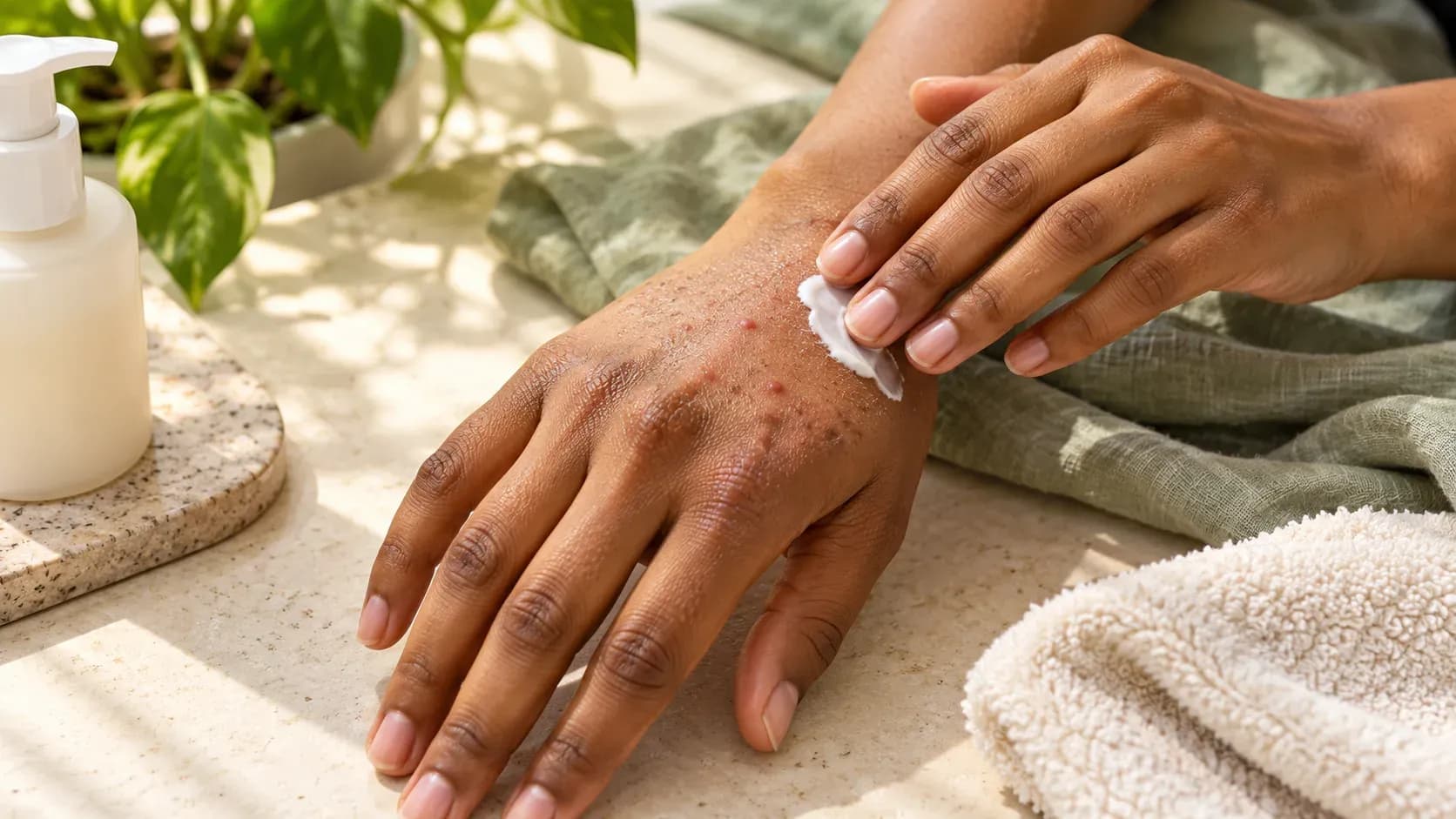
Quick Answer:
Bumps on your hands are rarely true acne. Your palms and fingers have far fewer sebaceous glands than your face, so the classic oil-and-dead-cell pathway almost never triggers here. What you're seeing is most likely folliculitis, contact dermatitis, or keratosis pilaris, each with a distinct cause, location pattern, and treatment approach.
Identifying which type you have changes everything about how you treat it.
What Is Hand Acne, And Is It Actually Acne?
Hand acne is an umbrella term for bumps that appear on the hands or fingers. True acne, caused by excess sebum mixing with dead skin cells inside a pore, rarely develops on hands because this area produces significantly less sebum than the face. Your face generates approximately 800 to 900 sebum secretions per square centimetre daily; your hands produce a fraction of that.
According to The Clear Ritual's skin science team, what most people call hand acne falls into one of four categories:
- Folliculitis, bacterial or fungal infection of a hair follicle, producing pus-filled, tender bumps
- Contact dermatitis, an inflammatory reaction to an irritant or allergen, producing red patches or blisters
- Keratosis pilaris, keratin plugs blocking follicle openings, producing rough, sandpaper-like bumps
- Dyshidrotic eczema (pompholyx), small, intensely itchy fluid-filled blisters on the palms and sides of fingers, frequently mistaken for acne
Each condition involves a different mechanism, a different location on the hand, and a different treatment. The sections below walk through each one in detail.
Where Your Bump Appears: What the Location Tells You
Where a bump appears on your hand is one of the most useful diagnostic clues. Different areas have different anatomy, and different conditions favour each zone.
Back of the hand has hair follicles and thinner skin, making it the most common site for folliculitis. Clusters of red, pus-filled bumps here, especially after gym equipment use or hot tub exposure, point strongly to bacterial folliculitis caused by Staphylococcus aureus or Pseudomonas aeruginosa.
Palms have no hair follicles at all, which means folliculitis cannot form there. Bumps on the palm are more likely to be dyshidrotic eczema (tiny, clear, itchy blisters), friction blisters, warts (verruca vulgaris), or milia (small, hard white keratin cysts).
Fingers and knuckles most commonly develop contact dermatitis, particularly from nickel allergy caused by rings or metal tools, or latex allergy from gloves. The rash appears precisely where the irritant contacts skin. Folliculitis can also occur on knuckles where hair follicles are present.
| Location | Most Likely Cause | Key Sign | What Helps |
|---|---|---|---|
| Back of hand | Folliculitis | Pus-filled, tender, on follicle | Topical antibiotic, hygiene |
| Palm | Dyshidrotic eczema | Itchy clear blisters | Barrier repair, avoid triggers |
| Palm | Friction blister or callus | Firm, no redness | Padding, reduce friction |
| Fingers | Contact dermatitis | Pattern matches irritant contact | Identify and remove allergen |
| Fingers or knuckles | Folliculitis | Tender bumps on hair follicles | Topical antibiotic |
| Any location | Wart (HPV) | Rough surface, no pus | Salicylic acid or cryotherapy |
| Any location | Milia | Hard white dome, no redness | Gentle exfoliation or extraction |
How to Tell Folliculitis, Contact Dermatitis, and Keratosis Pilaris Apart
These three conditions cause similar-looking bumps but involve different mechanisms, and treating one with the protocol for another will not work.
Folliculitis presents as small, pus-filled bumps centred on hair follicles. The bumps are tender and may itch. Hot tub folliculitis, caused by Pseudomonas aeruginosa in inadequately chlorinated water, typically produces clusters of bumps within 48 hours of exposure and resolves within 7–10 days with proper hygiene and topical antibiotics if needed.
Contact dermatitis manifests as red, itchy patches that may develop small fluid-filled vesicles. The pattern often reveals the trigger: bumps between fingers or under a ring point to nickel allergy, while linear streaks suggest plant contact. Nickel sensitivity is detected in approximately 17–19% of women and 3–5% of men in patch test studies, making it one of the most common contact allergens globally.
Keratosis pilaris produces a rough, sandpaper-like texture of small bumps, typically across the back of the hands. It causes minimal itching and does not involve pus. It is a chronic condition that improves with consistent management but does not resolve permanently.
| Feature | Folliculitis | Contact Dermatitis | Keratosis Pilaris |
|---|---|---|---|
| Appearance | Pus-filled bumps | Red patches with vesicles | Rough, small bumps |
| Location | Hair follicles | Contact areas | Back of hands, fingers |
| Sensation | Tender, painful | Itchy, burning | Rough texture, minimal itch |
| Timing | Days after exposure | Hours to days | Chronic, gradual |
Why Do Bumps Keep Appearing on Your Hands? Root Causes Explained
Most people who keep getting hand bumps are caught in a cycle: one trigger weakens the skin barrier, a second trigger exploits the compromised skin, and the result looks like a recurring pimple that never fully heals. The Clear Ritual's skin assessment team identifies five recurring root cause patterns.
1. The Overwashing Cycle Frequent handwashing strips the skin's natural lipid layer. Post-pandemic handwashing frequency, often 20–30 times daily, has directly correlated with increased rates of occupational contact dermatitis in healthcare and food service workers. A 2021 study published in Contact Dermatitis found that healthcare workers washing hands more than 35 times per shift showed a 3.5-fold increase in transepidermal water loss (TEWL) compared to those washing fewer than 15 times. Applying a barrier cream within 3 minutes of washing reduced TEWL by up to 38%.
2. The Occlusion-Heat Loop Wearing gloves, surgical, work, or winter, traps heat and moisture against the skin. This creates an environment where Staphylococcus aureus and Malassezia yeast multiply rapidly. The longer the occlusion, the higher the bacterial load, and the more likely folliculitis is to develop.
3. The Friction-Sweat-Bacteria Triad Repetitive gripping, weights, racquets, tools, creates micro-abrasions in the skin surface. Sweat adds moisture. Bacteria already present on skin surfaces colonise the micro-wounds. The result is folliculitis that reappears in exactly the same location after every workout or workday.
4. Systemic Inflammation Spilling Over High-glycaemic diets, poor sleep, and chronic stress all elevate circulating inflammatory markers. A 2020 meta-analysis in the Journal of the European Academy of Dermatology and Venereology found that high dietary glycaemic load was associated with significantly elevated levels of IGF-1 and interleukin-6, both of which promote follicular inflammation. When the skin barrier is already weakened by external triggers, systemic inflammation amplifies follicular reactivity, turning minor irritation into persistent bumps.
5. Allergen Contact (Often Overlooked) Nickel from rings, fragrance from hand creams, rubber accelerants from gloves, and preservatives from sanitisers are among the most common contact allergens in India and globally. If bumps appear in a consistent pattern matching where a particular object or product touches your skin, allergen contact is the most likely explanation.
How Your Skin Barrier Breaks Down, And Why It Matters
The skin barrier on your hands faces more daily assault than almost any other body part. Each wash removes not just dirt but also natural moisturising factors and ceramides that maintain barrier integrity.
Once this protective layer weakens, irritants penetrate more easily. Inflammation becomes chronic rather than acute, meaning the immune response stays partially activated even without obvious triggers. This low-grade inflammation makes follicles more reactive to bacteria, friction, and trapped debris that healthy skin would normally clear without issue.
The British Journal of Dermatology (2019) reported that occupational contact dermatitis accounts for 80% of all occupational skin diseases, with healthcare workers, hairdressers, food handlers, and mechanics showing the highest rates. Among these groups, the combination of repeated wet work and chemical exposure increased the odds of hand folliculitis 2.4-fold compared to office workers.
How to Treat Pimples on Your Hands: A Step-by-Step Guide
Most hand bumps respond to home care within 7–14 days when the root cause is addressed alongside the bump itself. The Clear Ritual recommends the following systematic approach.
Step 1: Stop the trigger (Days 1–2) Before applying anything to your skin, identify what is causing the bumps. Review the past 48–72 hours: new product, new gloves, gym equipment, change in handwashing frequency? Removing the trigger is the most effective first intervention, more so than any topical treatment applied on top of an ongoing cause.
Step 2: Restore the skin barrier (Days 1–7) Switch to a pH-balanced, fragrance-free cleanser (pH 4.5–5.5). Use lukewarm water, not hot water, which strips lipids more aggressively. Apply a ceramide-containing moisturiser within 3 minutes of washing, while hands are still slightly damp. Repeat after every wash.
Key ingredients to look for:
- Ceramides, replenish the lipid layer stripped by washing
- Glycerin or hyaluronic acid, humectants that draw moisture into the skin
- Niacinamide (Vitamin B3), supports barrier function and has mild anti-inflammatory properties
- Colloidal oatmeal, soothes active inflammation, particularly in contact dermatitis
Step 3: Treat the specific bump type (Days 3–10)
For folliculitis (pus-filled, tender bumps on hair follicles): Apply a warm compress for 10 minutes, 2–3 times daily, this encourages natural drainage without squeezing. Topical benzoyl peroxide (2.5–5%) reduces bacterial load in the follicle. If bumps are spreading, a topical antibiotic such as mupirocin or clindamycin (prescription required in India) may be needed.
For contact dermatitis (itchy, red patches or blisters): Apply 1% hydrocortisone cream twice daily for up to 7 days to reduce inflammation. More critically: identify and eliminate the allergen or irritant. Without removing the trigger, topical treatment provides only temporary relief.
For keratosis pilaris (rough, sandpaper-like bumps): Gentle chemical exfoliation with urea (10–20%) or lactic acid (5–10%) softens keratin plugs. Consistent daily moisturisation is essential, this is a chronic condition that improves with maintenance, not a condition that resolves with one-time treatment.
For dyshidrotic eczema (itchy clear blisters on palms): Cool compresses reduce acute inflammation. Avoid known triggers including sweat, nickel, and stress. A dermatologist may prescribe a short course of topical corticosteroids for severe flares.
Step 4: Protect against re-exposure (Ongoing) Wear breathable cotton glove liners under work or winter gloves. Use barrier cream before activities involving chemical exposure. Switch to unscented, alcohol-free hand sanitiser if sanitiser use is frequent.
Understand What Your Skin Needs
The Clear Ritual Skin Test can help you understand your skin type and identify concerns that may be affecting your routine.
Take the Free Skin Test
How Long Will Hand Bumps Take to Heal? A Timeline
Setting realistic expectations helps you stay consistent with treatment and know when to escalate.
| Condition | Expected Timeline | What Determines Speed |
|---|---|---|
| Folliculitis (friction or sweat-related) | 5–7 days | Hygiene improvements and trigger removal |
| Contact dermatitis | 1–2 weeks to improve; 2–3 weeks for full resolution | How quickly allergen is removed |
| Keratosis pilaris | Visible improvement in 4–6 weeks | Consistency of urea or lactic acid use |
| Dyshidrotic eczema (acute blisters) | 2–4 weeks for acute flare | Addressing systemic triggers |
| Hot tub folliculitis | 7–10 days | Usually self-limiting |
Bumps that show no improvement after 2–3 weeks of consistent, correctly targeted home care warrant professional evaluation. Spreading bumps, increasing pain, or bumps accompanied by fever or joint pain require urgent medical attention, do not wait for a 3-week window in these cases.
OTC vs Prescription vs Professional Treatment: What to Try First
Most hand bumps respond to over-the-counter care within 2 weeks. The table below helps determine the right level of intervention.
| Scenario | Try First | If No Improvement In… | Next Step |
|---|---|---|---|
| Single pus-filled bump, back of hand | Warm compress + benzoyl peroxide 2.5% | 7–10 days | Topical antibiotic (prescription) |
| Red itchy rash matching product or jewellery | Remove trigger + 1% hydrocortisone | 10–14 days | Patch testing with dermatologist |
| Rough bumpy texture across back of hands | Urea 20% moisturiser daily | 6 weeks | Dermatologist for prescription retinoids |
| Itchy clear blisters on palms | Cool compress, barrier repair, remove stress triggers | 2–3 weeks | Topical corticosteroid (prescription) |
| Spreading bumps with fever or joint pain | , | Immediately | GP or dermatologist urgently |
| Bumps unchanged after 3 weeks of home care | , | 3 weeks | Dermatologist for culture or patch test |
For most mild-to-moderate hand bumps, an effective OTC starting protocol involves three elements: a pH-balanced cleanser, a ceramide moisturiser, and either a benzoyl peroxide or hydrocortisone treatment depending on bump type. Patch testing for contact allergens, which tests 30 to 80 common substances over 48 hours, is worth pursuing when bumps follow a consistent pattern linked to product or material contact.
Lifestyle Factors That Affect Hand Skin Health
Sleep, stress, diet, and hydration all influence how reactive hand skin is to external triggers.
Sleep: Deprivation elevates cortisol, which increases circulating inflammatory cytokines. These markers make all skin more reactive, meaning triggers that would normally cause no reaction can produce noticeable bumps. Seven to nine hours of consistent sleep helps regulate this inflammatory baseline.
Diet: Omega-3 fatty acids from fish, flaxseed, and walnuts provide building blocks for anti-inflammatory compounds that support barrier repair. Antioxidant-rich foods, berries, leafy greens, colourful vegetables, neutralise free radicals generated during inflammation. High-glycaemic foods spike insulin and IGF-1, amplifying follicular inflammation in already-compromised skin.
Gut health: The gut-skin axis means that gut dysbiosis can increase systemic inflammatory markers that make skin more reactive. Probiotic-rich foods such as yogurt, kefir, and fermented vegetables support microbial diversity, which modulates this inflammatory baseline.
Hydration: Dehydration reduces the moisture gradient that draws water from deeper skin layers to the surface. Without adequate systemic hydration, topical moisturisers work less effectively. Eight glasses daily serves as a baseline, with individual needs varying by activity level and climate.
Environment: Cold weather combined with indoor heating accelerates moisture loss from hand skin, making the barrier more fragile. Excessive heat and humidity create occlusion problems where sweat cannot evaporate, macerating skin and encouraging bacterial overgrowth. Fine pollution particles that settle on hands throughout the day can enter follicle openings and trigger immune responses.
When Should You See a Dermatologist for Hand Bumps?
Seek professional evaluation in the following situations:
- Bumps persist beyond 3 weeks despite consistent, correctly targeted home care
- Bumps are spreading rapidly or becoming increasingly painful
- Signs of deeper infection are present, expanding redness, increasing warmth, significant pus
- Bumps appear alongside systemic symptoms such as fever, fatigue, or joint pain
- Bumps developed after starting a new medication, drug-induced folliculitis is a recognised side effect of certain drugs
Clear Ritual’s Perspective on Hand Acne
Bumps on the hands are not always acne, so identifying whether you are dealing with folliculitis, contact dermatitis, keratosis pilaris or eczema is the first step. A gentle routine, skin-barrier support and avoiding repeated triggers may help mild bumps settle.
If the bumps remain painful, spread or keep returning, consult a dermatologist instead of repeatedly trying different acne products.
Frequently Asked Questions
1. Can acne appear on your hands?
True acne is uncommon on the hands because the area has fewer sebaceous glands than the face. Acne-like bumps may instead be folliculitis, contact dermatitis, keratosis pilaris or eczema.
2. What causes pimple-like bumps on hands?
Possible causes include irritated hair follicles, bacterial or fungal folliculitis, allergens, frequent handwashing, friction, trapped sweat and dyshidrotic eczema.
3. How can you treat pimples on your hands?
Treatment depends on the cause. Removing the trigger, using a gentle cleanser and supporting the skin barrier may help. Some conditions may require benzoyl peroxide, hydrocortisone or dermatologist-prescribed treatment.
4. Why do hand bumps keep coming back?
Recurring bumps may be linked to repeated exposure to irritants, allergens, gloves, friction, sweat or frequent washing. Persistent bumps should be assessed by a dermatologist.
5. When should you see a dermatologist for hand bumps?
Seek professional care if the bumps persist beyond three weeks, spread quickly, become increasingly painful, contain significant pus or occur with fever, fatigue or joint pain.
References
- American Academy of Dermatology. Acne-like breakouts could be folliculitis.
- American Academy of Dermatology. Contact dermatitis overview.
- American Academy of Dermatology. Keratosis pilaris overview.
- American Academy of Dermatology. Hand eczema.
- NHS. Pompholyx (dyshidrotic eczema).
Disclaimer
This article is intended for general informational purposes and is not a substitute for personalised medical advice, diagnosis or treatment. If the bumps are persistent, painful, spreading or accompanied by other symptoms, consult a qualified dermatologist.
Editorial Standards
Clear Ritual has Strict sourcing guidelines to ensure our content is accurate and current. We rely on peer-reviewed studies, academic research institutions, and medical associations. We strive to use primary sources and refrain from using tertiary references. See a mistake? Learn More about our Editorial Standards.
Related Articles
Arm Acne: Causes, Symptoms, Treatment, and Prevention
Published 6 August 2026

Leg Acne: Causes, Types, Treatment & How to Get Rid of It
Published 11 September 2026

Acne on the Temples: Causes, Types, and How to Clear It
Published 16 September 2026
Eyebrow Acne: Causes, Triggers, Treatment and Prevention
Published 11 September 2026
