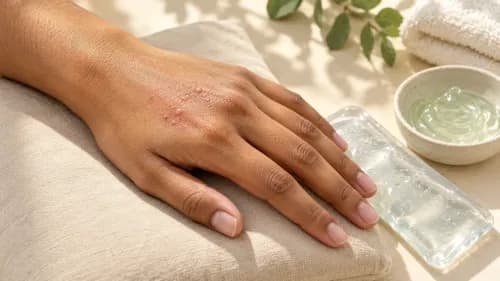
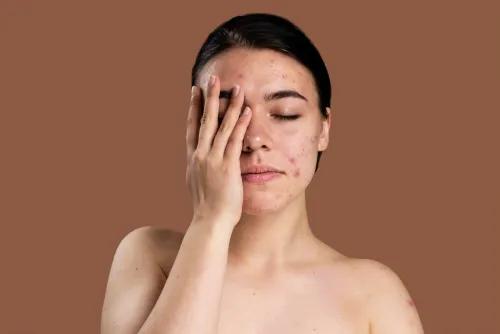
Natural Home Remedies for Whiteheads: What Actually Works
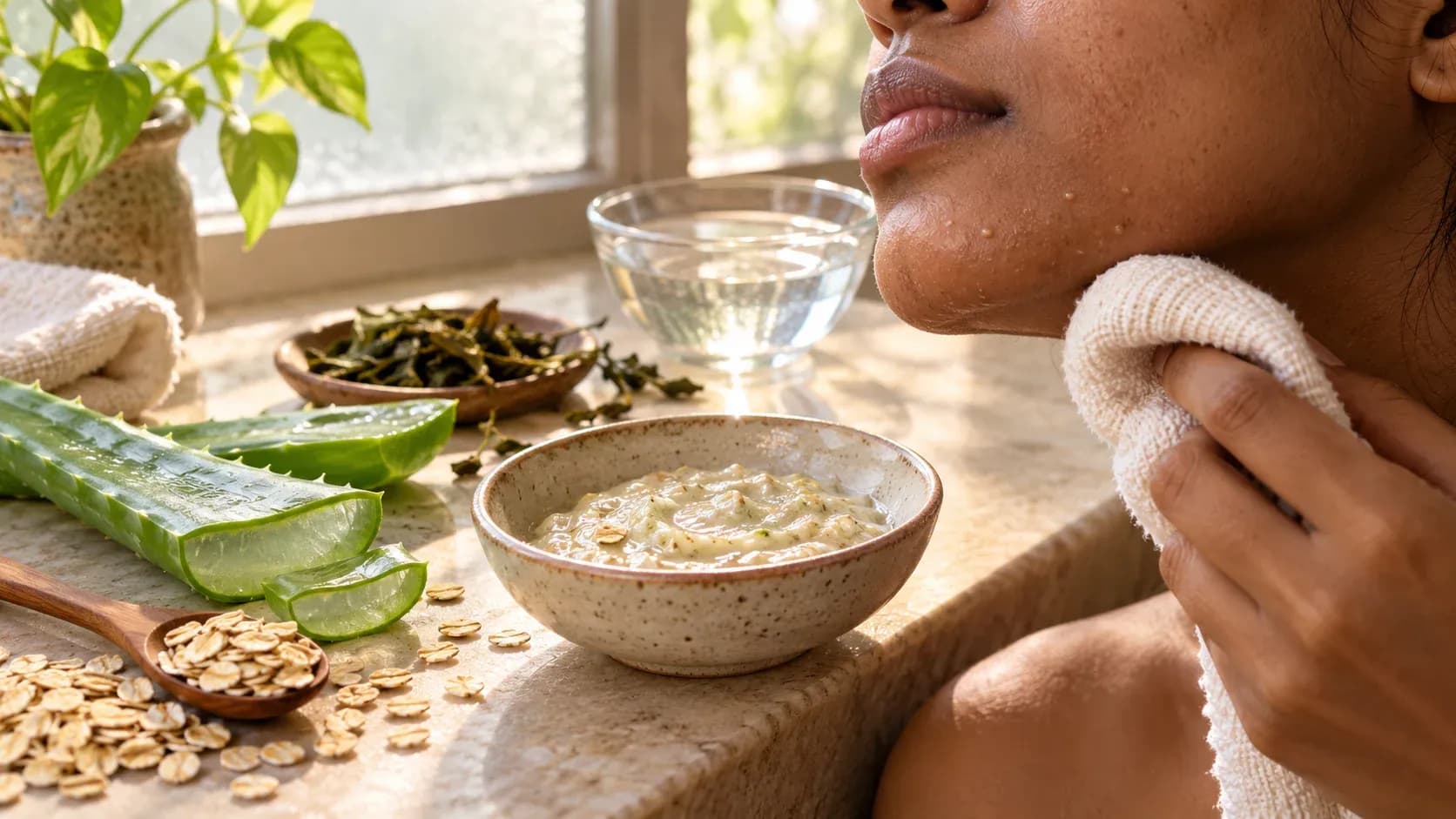
Home remedies cannot remove a whitehead that already exists. The blockage is sealed inside the pore, beneath the skin surface, and no kitchen ingredient reaches it. What the right remedies genuinely do: calm the oil environment on your skin's surface, reduce the inflammation that makes whiteheads look angrier, and slow the rate at which new ones form.
The three with a real mechanism: clay masks (kaolin or bentonite), aloe vera gel, and steam used as a prep step. The three that cause more harm than good: lemon juice, baking soda, and toothpaste - all three disrupt the skin's natural pH range of 4.5 to 5.5 and worsen congestion.
What Are Whiteheads and Why Do They Keep Forming?
A whitehead is a closed comedone - a pore blocked by a mix of sebum and dead skin cells. Because the pore opening stays sealed, the trapped material sits below the surface rather than oxidising into a blackhead. The result is a small, flesh-coloured or white bump just beneath the skin.
Whiteheads form when two processes go out of balance:
- Excess sebum production - driven by hormones, stress, diet, or humidity
- Slowed skin cell turnover - dead cells fail to shed efficiently and pile up at the pore opening
This is why whiteheads cluster in the T-zone, chin, and forehead, where sebaceous glands are most active. It also explains why most home remedies work only at the surface level: they can hydrate or soothe, but they cannot reach inside the pore to clear the blockage or regulate sebum production at the source.
According to The Clear Ritual's skin science team, understanding this mechanism is the first step to choosing remedies that genuinely support the skin rather than irritate it further.
Which Natural Home Remedies Actually Help Whiteheads?
Not every natural remedy earns its reputation. The options below are ranked from most to least supportive, based on their plausible mechanism against whitehead biology.
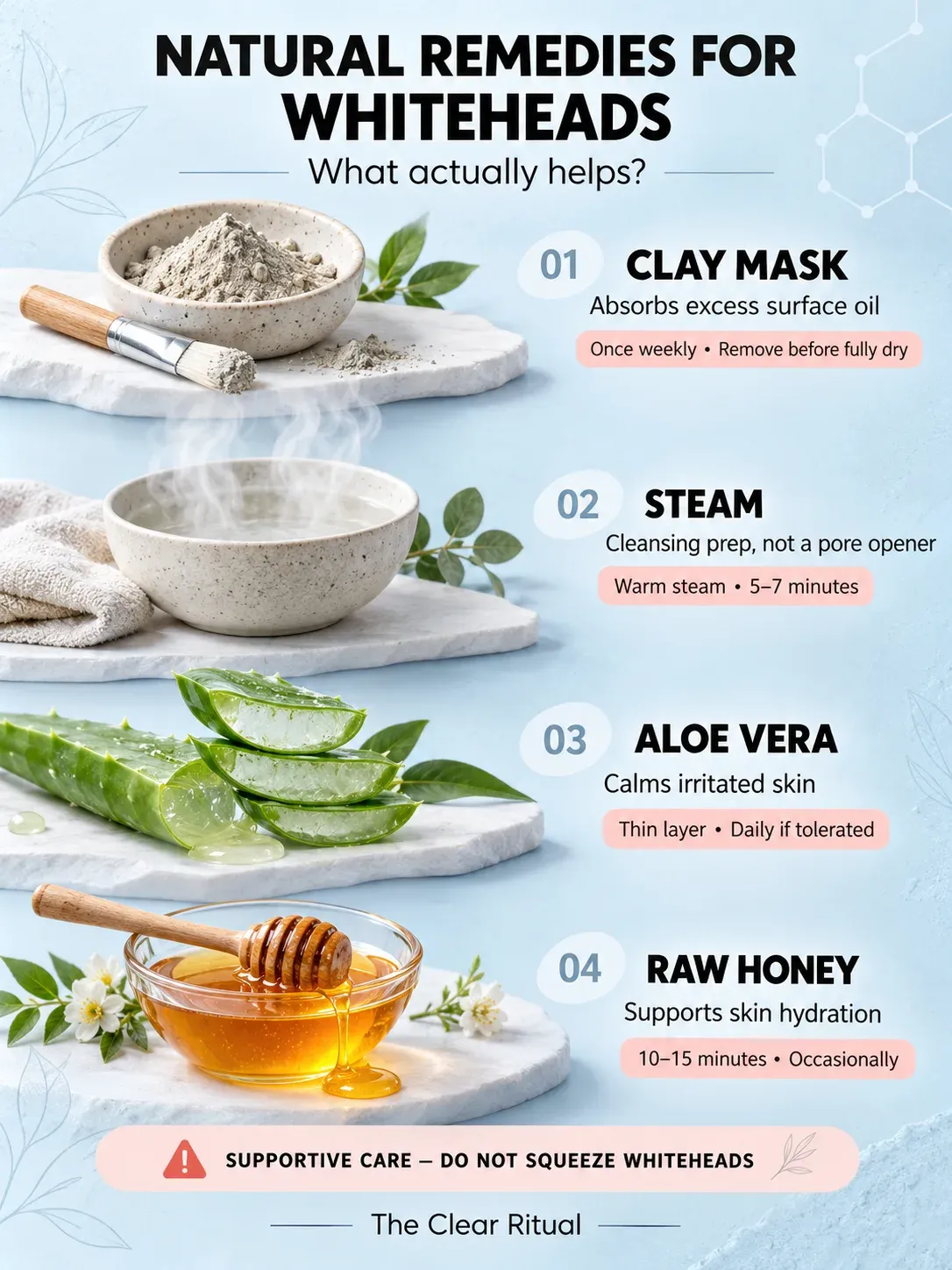
1. Clay Masks - Best for Absorbing Excess Surface Oil
Clay (kaolin or bentonite) draws excess sebum away from the skin surface. This reduces the oily environment that makes pore blockages more likely. A weekly clay mask is one of the few home remedies with a direct, plausible mechanism for whitehead-prone skin.
How to use a clay mask correctly:
- Apply a thin, even layer to clean skin
- Leave on for no longer than 10 minutes - remove before it fully dries
- Rinse with lukewarm water
- Follow immediately with a lightweight moisturiser
- Limit use to once a week
Fully dried clay pulls moisture from the skin, not just excess oil. That disrupts the barrier and can make congestion worse over time.
2. Steam - Best as a Cleansing Prep Step
Steam softens the surface of the skin and loosens surface debris, making cleansers work more effectively. Steam does not open pores - pores have no muscles and cannot open or close - but it does support cleansing when used occasionally.
How to use steam correctly:
- Cleanse the face first
- Hold the face 25 to 30 cm from warm (not boiling) water
- Drape a towel over the head to trap the steam
- Steam for 5 to 7 minutes maximum
- Follow with a gentle cleanser or clay mask
Do not squeeze whiteheads after steaming. The skin is softened, not sterile, and squeezing risks pushing bacteria deeper and causing post-inflammatory hyperpigmentation.
3. Aloe Vera Gel - Best for Calming Irritated Whitehead-Prone Skin
Aloe vera contains compounds including acemannan and polyphenols with documented anti-inflammatory properties. Aloe vera gel will not unclog a pore, but it can calm the low-grade inflammation that makes whiteheads appear more pronounced and the surrounding skin more reactive.
How to use aloe vera correctly:
- Use pure, fragrance-free aloe vera gel - not a scented body lotion
- Apply a thin layer to clean skin after cleansing
- Allow to absorb before applying moisturiser
- Can be used daily if the skin tolerates it
A 2019 review in the Journal of Dermatological Science identified acemannan - the primary bioactive polysaccharide in aloe vera - as having documented anti-inflammatory and wound-healing properties in skin tissue.
4. Raw Honey - Best as an Occasional Hydrating Mask
Raw honey is a humectant that draws moisture to the skin surface and has mild antimicrobial properties. Honey does not penetrate the pore, so its effect on whiteheads is indirect: better-hydrated skin maintains a healthier barrier, and a healthy barrier is less prone to congestion.
How to use raw honey correctly:
- Apply a thin layer of raw (not processed) honey to clean skin
- Leave for 10 to 15 minutes only
- Rinse thoroughly with lukewarm water
- Do not leave overnight - honey is occlusive and can trap heat and sweat against whitehead-prone skin
Which Home Remedies Make Whiteheads Worse?
Several commonly recommended natural remedies actively damage the skin barrier and worsen whitehead congestion. The Clear Ritual's clinical advisors identify the following as high-risk for whitehead-prone skin.
| Remedy | Why It Worsens Whiteheads |
|---|---|
| Lemon juice | Strongly acidic (pH 2-3) and photosensitising; disrupts skin pH (4.5-5.5) and increases post-inflammatory marks |
| Baking soda | Highly alkaline (pH ~9); destroys the skin's acid mantle and causes rebound congestion |
| Sugar or salt scrubs | Create micro-tears in the skin; worsen whiteheads and damage the barrier with repeated use |
| Undiluted essential oils | Irritate sensitive and acne-prone skin; require proper dilution and guidance before use |
| Toothpaste | Contains fluoride, sodium lauryl sulfate, and whitening agents that cause chemical irritation and worsen congestion |
The core principle: natural does not always mean safe, especially for whitehead-prone skin. A disrupted skin barrier produces more oil to compensate, which feeds the whitehead cycle directly. A 2021 review in Skin Pharmacology and Physiology identified barrier disruption - caused by pH imbalance - as a direct driver of increased sebum production and comedone formation.
Best Home Remedies for Whiteheads: Ranked by Evidence
Not all natural remedies are equal for whitehead-prone skin. This table ranks the most commonly recommended options by how well their mechanism maps to what actually causes whiteheads - excess sebum and slow cell turnover.
| Remedy | What It Actually Does | Evidence Level | Best For | Risk |
|---|---|---|---|---|
| Clay mask (kaolin/bentonite) | Absorbs surface sebum | Moderate | Oily T-zone, mild congestion | Low if used weekly; overuse strips barrier |
| Steam | Softens surface debris for cleansing | Low-moderate | Pre-cleanse prep | Low; never apply direct heat to skin |
| Aloe vera gel | Anti-inflammatory (acemannan) | Moderate | Calming redness around whiteheads | Very low; use fragrance-free only |
| Raw honey | Humectant; mild antimicrobial | Low | Hydration support | Low; avoid overnight on congestion-prone skin |
| Lemon juice | None that helps; disrupts pH | None - avoid | - | High - photosensitising and barrier-damaging |
| Baking soda | None that helps; pH ~9 | None - avoid | - | High - triggers rebound congestion |
| Sugar/salt scrubs | None that helps; causes micro-tears | None - avoid | - | High - worsens whiteheads |
One-line rule: if a remedy feels immediately satisfying but stings, tightens, or smells strongly, it is almost certainly damaging the skin barrier - which produces more oil and more whiteheads within days.
What These Home Remedies Cannot Do
Even the most effective home remedies have a firm biological ceiling. According to The Clear Ritual's approach to ingredient-led skin care, home remedies cannot:
- Dissolve the keratin plug inside a closed comedone
- Regulate sebum production at the follicle level
- Accelerate skin cell turnover - that requires chemical exfoliants like salicylic acid or retinoids
- Prevent new whiteheads from forming if the root cause - hormonal fluctuation, diet, or barrier damage - is not addressed
This is not a reason to avoid home remedies. It is a reason to use them for what they are genuinely good at: surface oil control, barrier support, and calming inflammation - while pairing them with active ingredients for pore-level clearance.
Home Remedies vs. Active Skincare Ingredients: An Honest Comparison
Home remedies and active skincare ingredients address different layers of the whitehead problem. Understanding the difference helps identify when a natural approach is enough and when the skin needs more structured support.
| Home Remedies | Active Skincare Ingredients | |
|---|---|---|
| What they target | Surface oil, hydration, calming irritation | Inside the pore: keratin build-up, sebum regulation, cell turnover |
| Primary examples | Clay, aloe vera, steam, raw honey | Salicylic acid (BHA), niacinamide, retinoids |
| How quickly they work | Some surface effects within 1 to 2 uses; no pore-clearing effect | Visible reduction in whiteheads typically within 4 to 8 weeks of consistent use |
| Suitable for | All skin types as supportive care | Oily, combination, and acne-prone skin; introduce gradually |
| Risk of irritation | Low if used correctly; high for lemon juice, baking soda, or undiluted oils | Low-to-moderate; increase concentration slowly |
| What they cannot do | Unclog pores, regulate sebum, accelerate cell turnover | Replace a barrier-supportive routine (moisturiser, SPF) |
| Best used as | Weekly or occasional support; calming and hydration | Core daily or alternate-day routine step |
The honest answer: if whiteheads are mild and infrequent, a consistent gentle routine plus an occasional clay mask may be sufficient. If they are persistent, clustered, or worsening, home remedies are unlikely to make a meaningful difference - and a BHA exfoliant or dermatologist-prescribed routine is worth considering.
How Long Do Home Remedies Take to Work on Whiteheads?
One of the most common frustrations with home remedies is expecting overnight results. The Clear Ritual recommends understanding the realistic timeline before judging whether a routine is working.
Week 1 to 2 No significant change to existing whiteheads is normal. The skin is adjusting. Gentle remedies like aloe vera and honey may reduce redness and surface irritation within a few applications.
Week 3 to 4 With a clay mask used once weekly alongside a consistent cleansing routine, skin may feel less congested and oilier patches calmer. Existing whiteheads are unlikely to have resolved, but new ones may appear less frequently.
Week 6 to 8 Most dermatologists consider 6 to 8 weeks the minimum timeline to evaluate any topical skincare change. With home remedies as the only intervention, mild improvement in skin texture and oiliness is the realistic expectation - not a significant reduction in closed comedone count.
What this means in practice:
- Home remedies work best as a supporting routine, not a standalone treatment
- The skin renews itself approximately every 28 days (slowing with age), so allow at least two full cycles before judging results
- If no meaningful change occurs after 8 weeks of consistent, barrier-friendly care, the skin likely needs a targeted active ingredient or professional assessment
Meaningful reduction in whitehead count typically requires 8 to 12 weeks and usually needs a chemical exfoliant alongside home care.
How to Get Rid of Whiteheads Overnight: What Is Realistic in 8 Hours
An existing whitehead cannot be removed overnight. No home remedy - not steam, not clay, not any kitchen ingredient - can dissolve a sealed comedone in 8 hours. What can be achieved overnight is measurable: reduced surface redness, a calmer oil environment, and a less inflamed appearance by morning.
What to do tonight:
- Cleanse gently with a non-comedogenic, fragrance-free cleanser. Stripped skin produces more oil overnight - the opposite of what whitehead-prone skin needs.
- Apply a thin clay mask to congested areas for 10 minutes. Set a timer. Remove before the clay dries completely to avoid pulling moisture from the skin barrier.
- Follow with a lightweight moisturiser. A compromised barrier overnight means more congestion by morning. Do not skip this step.
- Apply a small amount of pure aloe vera gel to inflamed spots. Aloe's acemannan polysaccharide has documented anti-inflammatory action. It will not unclog the pore, but it can reduce visible redness around a whitehead by morning.
- Sleep on a clean pillowcase. Fabric carrying yesterday's oil and bacteria is a direct cause of overnight congestion.
What to avoid tonight:
- Do not squeeze - softened skin after steam or a mask is more vulnerable, not less
- Do not apply toothpaste, lemon juice, or baking soda - all three disrupt the skin's pH (4.5 to 5.5) and worsen congestion in the days that follow
- Do not apply thick, occlusive creams - heavy products trap heat and sweat overnight, which whitehead-prone skin cannot tolerate
How to Remove Whiteheads in 5 Minutes: What Is Actually Possible
A whitehead cannot be dissolved in 5 minutes. No product, no home remedy, and no technique removes a sealed comedone in that time - the blockage is beneath the skin surface. What is possible in 5 minutes is a measurable reduction in surface shine and a calmer appearance around inflamed whiteheads.
The 5-minute visible-improvement protocol:
- Minute 1 - Splash with lukewarm water. Not hot. Hot water strips the barrier and triggers more oil production.
- Minutes 2-3 - Apply a thin clay mask to congested areas only. Target the T-zone, chin, or nose. Use a fingertip. Do not wait for it to dry.
- Minute 4 - Rinse thoroughly and pat dry with a clean cloth. Rubbing drags bacteria across congestion-prone areas.
- Minute 5 - Apply a fragrance-free, lightweight moisturiser immediately. Skipping this step produces a rebound oil surge within 2 to 4 hours.
What this achieves: reduced surface shine, calmer appearance around inflamed whiteheads, and a less congested feel. The whiteheads themselves remain - they are closed comedones that will not disappear in 5 minutes. For pore-level clearance, consistent use of salicylic acid or a retinoid over 6 to 8 weeks is required.
Whiteheads on Nose, Chin, and Forehead: Why Location Changes the Approach
Where whiteheads appear is not random. Location is a clue to cause, and it changes which home remedies are most useful.
Whiteheads on the Nose
The nose has a higher density of sebaceous glands than almost any other facial zone, which is why oil accumulates there faster and pore blockages are so common.
- Clay masks applied specifically to the nose and T-zone absorb excess sebum most effectively in this area
- Steam for 5 to 7 minutes before cleansing helps loosen tightly packed debris in nose pores
- Avoid pore strips - they remove surface sebum but do not clear the comedone, and can cause broken capillaries on the thin skin around the nose with repeated use
Caution: clay masks more than once a week on the nose will strip the barrier and trigger more oil production within days - the opposite of the intended result.
Whiteheads on the Chin and Jawline
Chin and jawline whiteheads are frequently linked to hormonal fluctuation, particularly the androgen-driven sebum surge that affects the lower face. These often worsen around the menstrual cycle or during high-stress periods.
- Aloe vera gel applied at night addresses the inflammation component, but because the root cause is hormonal, surface remedies have limited long-term impact
- A consistent gentle routine - non-comedogenic cleanser, lightweight moisturiser, weekly clay mask - reduces the oil environment but does not address the hormonal driver
- If whiteheads cluster along the chin and jawline and worsen predictably at certain times of the month, no home remedy addresses the hormonal signal; a BHA exfoliant used on the lower face is the evidence-supported next step
Whiteheads on the Forehead
Forehead whiteheads often develop where sweat, hair products, oil, and dead skin cells collect. Fringes, caps, helmets, and heavy hair oils can keep these substances against the skin and increase congestion.
- Keep hair and oily styling products away from the forehead
- Cleanse after heavy sweating without scrubbing the skin
- Use a clay mask only once weekly on oily areas
- Choose lightweight, non-comedogenic hair and skin products
If small bumps on the forehead are itchy, very uniform, and worsen with heat or sweat, they may not be ordinary whiteheads. A dermatologist can distinguish closed comedones from folliculitis or other conditions.
If lower-face congestion follows a recurring cycle, understanding hormonal acne may help explain why surface remedies alone have limited impact.
How to Build a Simple Whitehead-Friendly Routine
Home remedies work best when the rest of the routine protects the barrier and prevents additional pore blockage.
Morning routine:
- Cleanse gently without brushes or abrasive scrubs
- Apply a lightweight, non-comedogenic moisturiser
- Finish with sunscreen suited to acne-prone skin
Evening routine:
- Remove makeup and sunscreen completely
- Use a gentle cleanser
- Apply a suitable leave-on active gradually if home care alone is not enough
- Moisturise to reduce irritation and rebound oiliness
Trying to remove whiteheads permanently requires consistent pore-level care rather than squeezing, harsh scrubbing, or changing remedies every few days.
Do Whiteheads Go Away Without Treatment?
Some superficial whiteheads resolve as the skin naturally renews, while persistent closed comedones can remain for weeks or repeatedly form in the same areas. Whether whiteheads go away on their own depends on the depth of the blockage, oil production, cell turnover, product use, and hormonal factors.
Do not squeeze a whitehead to speed up this process. Pressure can rupture the follicle wall below the surface, increasing inflammation, dark marks, and scarring.
When Should You See a Dermatologist?
Consult a dermatologist if whiteheads remain persistent after 8 to 12 weeks, become inflamed or painful, spread rapidly, or leave marks and scars. Professional guidance is also useful when your routine causes burning, peeling, or worsening sensitivity.
Reviewing the wider symptoms of acne-prone skin can help you recognise patterns, but a dermatologist should confirm whether recurring bumps are whiteheads, folliculitis, milia, or another condition.
Clear Ritual's Perspective on Natural Whitehead Remedies
Natural remedies should support the skin rather than promise instant extraction. Clay, aloe vera, steam, and raw honey may help with surface oil, hydration, or irritation when used carefully, but they do not dissolve a sealed blockage inside the pore.
The Clear Ritual recommends combining gentle supportive care with a consistent routine and treatment selected for your skin's actual pattern. If congestion persists, targeted ingredients or dermatologist-supervised care may be appropriate.
Understand What Your Skin Needs
Take the Clear Ritual Skin Test to identify your skin type, concerns, and potential triggers before building your routine.
Take the Free Skin Test
Frequently Asked Questions
Q. What is the best natural remedy for whiteheads?
A. A clay mask may help absorb excess surface oil, while aloe vera may calm irritation. Neither remedy can dissolve an existing closed comedone.
Q. Can steam remove whiteheads?
A. No. Steam can soften surface debris and support cleansing, but it cannot open pores or remove a sealed whitehead.
Q. Can aloe vera remove whiteheads?
A. Aloe vera does not unclog closed pores. It may help calm inflammation and support irritated whitehead-prone skin.
Q. Can whiteheads be removed overnight?
A. No. Overnight care may reduce redness or surface oil, but an existing whitehead cannot be safely dissolved in a few hours.
Q. Is lemon juice safe for whiteheads?
A. No. Lemon juice is strongly acidic and can irritate the skin, disrupt its natural pH, and increase post-inflammatory marks.
Q. When should I stop using home remedies?
A. Stop if you develop burning, persistent redness, swelling, peeling, or worsening breakouts. Consult a dermatologist when whiteheads remain persistent or become inflamed.
References
- American Academy of Dermatology. Skin care habits that can worsen acne.
- American Academy of Dermatology. Acne treatment and skin care guidance.
- DermNet. Comedonal acne.
- National Center for Complementary and Integrative Health. Aloe vera.
Editorial Standards
Clear Ritual has Strict sourcing guidelines to ensure our content is accurate and current. We rely on peer-reviewed studies, academic research institutions, and medical associations. We strive to use primary sources and refrain from using tertiary references. See a mistake? Learn More about our Editorial Standards.