Fungal Acne Ingredients to Avoid for Clearer Skin
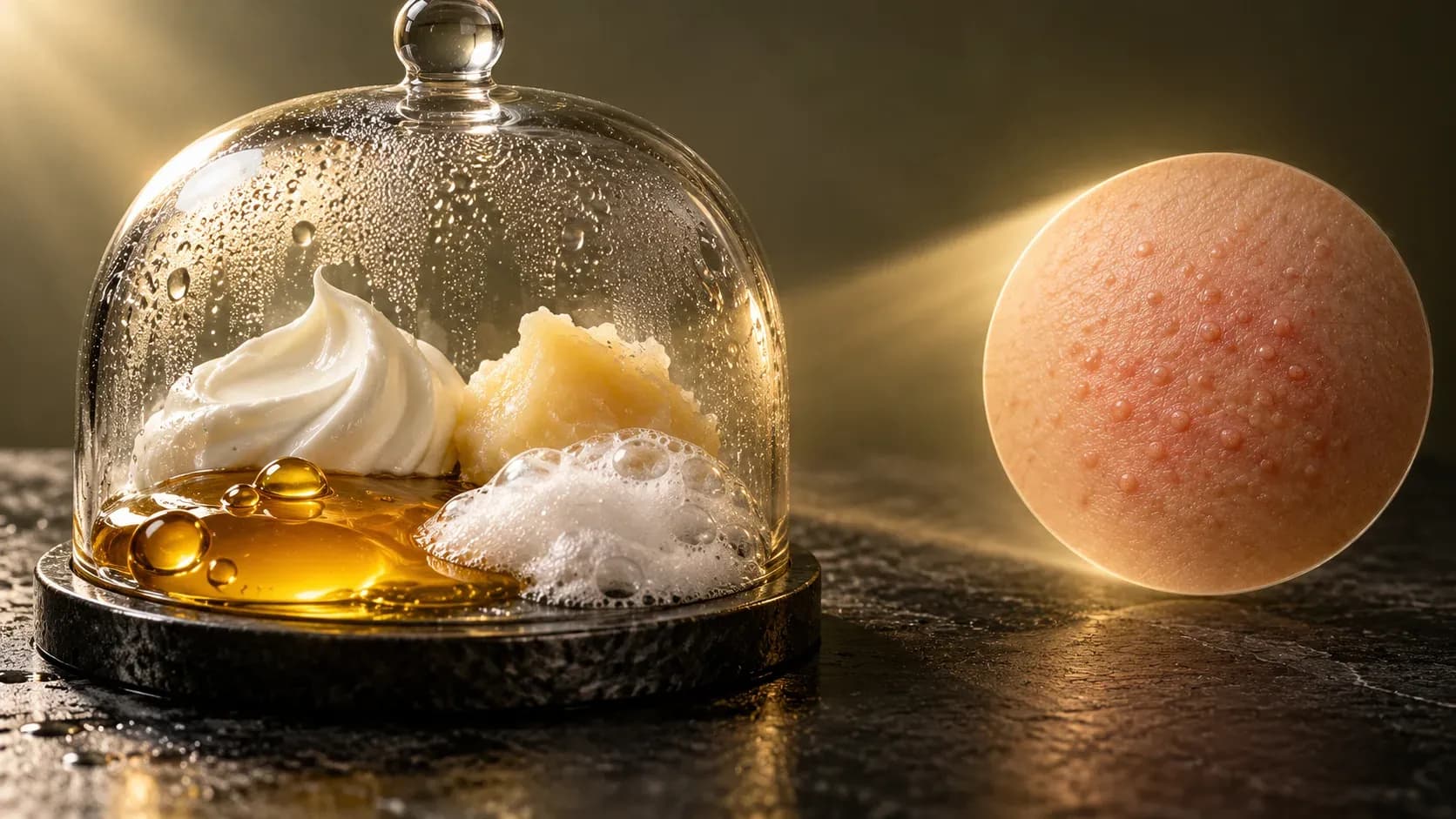
Certain skincare ingredients worsen fungal acne by directly feeding the Malassezia yeast responsible for it. The biggest culprits are fatty acids and esters with C11-C24 carbon chains, oils high in oleic acid (such as olive, argan, and avocado oil), fatty alcohol emollients, fermented yeast extracts like galactomyces, and some polysorbate emulsifiers. Removing these from cleansers, moisturisers, sunscreen, and hair products is typically the fastest way to calm breakouts.
Safe alternatives include squalane, mineral oil, dimethicone, glycerin, and hyaluronic acid - none of which Malassezia can metabolise.
What Is Fungal Acne and Why Do Ingredients Matter?
Fungal acne - clinically called Malassezia folliculitis - is not caused by bacteria. It is an overgrowth of Malassezia yeast inside the hair follicle. Because the trigger is yeast rather than bacteria, many standard acne treatments not only fail to clear it but may actively worsen the condition.
Malassezia yeast feeds on lipids, specifically fatty acids with carbon chain lengths between C11 and C24. When a skincare product contains these fatty acids - either as standalone ingredients or as components of oils and esters - the yeast has a direct food source inside the follicle. This allows it to proliferate, causing inflammation and the characteristic small, uniform, itchy bumps associated with fungal acne.
Fungal acne vs. regular acne - key differences:
| Feature | Fungal Acne (Malassezia Folliculitis) | Regular Acne (Bacterial) |
|---|---|---|
| Cause | Malassezia yeast overgrowth | C. acnes bacteria |
| Appearance | Small, uniform, itchy bumps | Varied: blackheads, whiteheads, cysts |
| Location | Forehead, chest, back | Face, jawline, back |
| Response to antibiotics | None or worsens | Often improves |
| Response to antifungals | Typically improves | No effect |
| Triggered by fatty acids | Yes | No |
Because ingredient choice directly determines whether Malassezia receives a food supply with each product application, selecting the wrong emollient or oil can undo antifungal treatment entirely.
How Malassezia Yeast Uses Skincare Ingredients to Grow
Malassezia folliculitis worsens when the yeast encounters its preferred lipid food sources in applied skincare products. Understanding this mechanism explains why ingredient selection is critical - and why antifungal treatment alone is often insufficient.
The mechanism, step by step:
- Malassezia yeast lives on normal skin. It is part of the standard skin microbiome and does not cause problems at low population levels.
- Conditions shift in its favour. Heat, humidity, occlusion, sweating, or antibiotic use can reduce competing bacteria, allowing Malassezia to multiply.
- Lipid-rich ingredients are applied to the skin. Products containing fatty acids, oils, or fermented extracts deliver a concentrated food source directly to the follicle.
- Yeast metabolises the lipids. Malassezia hydrolyses triglycerides and esters in skincare ingredients, releasing free fatty acids that sustain its growth.
- Follicular inflammation follows. As yeast colonises the follicle more densely, it triggers an immune response, producing the inflammatory papules and pustules seen in fungal acne.
- The cycle repeats with every product application. Unless problematic ingredients are removed, the yeast continues to receive fuel with each skincare step.
The two Malassezia species most commonly linked to folliculitis - Malassezia globosa and Malassezia restricta - are lipid-dependent organisms. They cannot synthesise their own fatty acids and must source them externally from sebum, sweat, or applied skincare products. This dependency is precisely what makes topical ingredient choice so impactful.
Which Ingredients Worsen Fungal Acne?
Several categories of skincare ingredients can worsen fungal acne by feeding Malassezia yeast or disrupting the skin barrier in ways that favour yeast overgrowth. The Clear Ritual formulation team groups these into five primary categories.
1. Oils High in Oleic Acid (C18:1)
Oils with a high proportion of oleic acid are among the most problematic ingredients for fungal acne-prone skin. Oleic acid falls within the C11-C24 fatty acid chain range that Malassezia metabolises most efficiently.
High-oleic oils to avoid:
- Olive oil (~70–80% oleic acid)
- Marula oil (~70–78% oleic acid)
- Avocado oil (~60–70% oleic acid)
- Almond oil (~62–68% oleic acid)
- High-oleic sunflower oil (~80% oleic acid)
- Argan oil (~43–49% oleic acid)
- Rosehip oil (~14–21% oleic acid; also contains linoleic acid - patch-test cautiously)
In contrast, oils high in linoleic acid (C18:2) - such as grapeseed oil (~70% linoleic) and hemp seed oil (~55% linoleic) - are generally considered safer. Malassezia does not metabolise linoleic acid as efficiently.
2. Fatty Acid-Rich Emollients and Esters
Many common emollients in moisturisers and serums are synthesised from fatty acids in the C11-C24 range. Even when they do not appear as "oil" on the label, these ingredients can still feed Malassezia.
Emollients and esters commonly flagged:
- Isopropyl myristate (myristic acid ester - one of the most frequently cited Malassezia-feeding emollients)
- Isopropyl palmitate (palmitic acid ester - similarly high risk)
- Glyceryl stearate (glycerol ester of stearic acid)
- Myristyl myristate (particularly documented as Malassezia-feeding)
- Polysorbate 80 (emulsifier containing oleic acid chains)
- Sorbitan oleate (oleic acid-derived surfactant)
3. Fatty Alcohols
Fatty alcohols are a moderate-risk category with individual variation in response.
Fatty alcohols to monitor:
- Cetyl alcohol (C16 - derived from palmitic or stearic acid)
- Stearyl alcohol (C18:0)
- Cetearyl alcohol (a blend of cetyl and stearyl alcohol)
- Behenyl alcohol (C22)
Cetearyl alcohol does not feed Malassezia as directly as oleic acid or isopropyl myristate, but in a leave-on product alongside high-oleic oils or fatty acid esters, it contributes to overall lipid load and is worth avoiding.
4. Fermented Ingredients
Fermented skincare ingredients have grown significantly in popularity due to their bioavailability. However, many fermented extracts contain lipid byproducts of fermentation that can directly feed Malassezia.
Fermented ingredients to use with caution:
- Galactomyces ferment filtrate (widely used in Korean skincare; produced by fermenting fungi, which can deliver fatty acid byproducts - studies suggest it may worsen Malassezia folliculitis in susceptible individuals)
- Saccharomyces ferment (yeast-based ferment; more likely to be problematic)
- Bifida ferment lysate (bacterial ferment - generally safer, but formulation context matters)
- Lactobacillus ferment (bacterial-origin - typically lower risk)
5. Standalone Fatty Acids and Polysorbate Emulsifiers
Some products list fatty acids directly as actives or texture agents. These are among the most direct Malassezia fuel sources.
Standalone fatty acids to avoid:
- Lauric acid (C12)
- Myristic acid (C14)
- Palmitic acid (C16)
- Stearic acid (C18:0)
- Oleic acid (C18:1)
- Linolenic acid (C18:3 - some evidence of Malassezia feeding)
Polysorbate emulsifiers to check:
- Polysorbate 80 (derived from oleic acid - higher risk)
- Polysorbate 60 (derived from stearic acid - higher risk)
- Polysorbate 20 (derived from lauric acid - lower risk, but not risk-free)
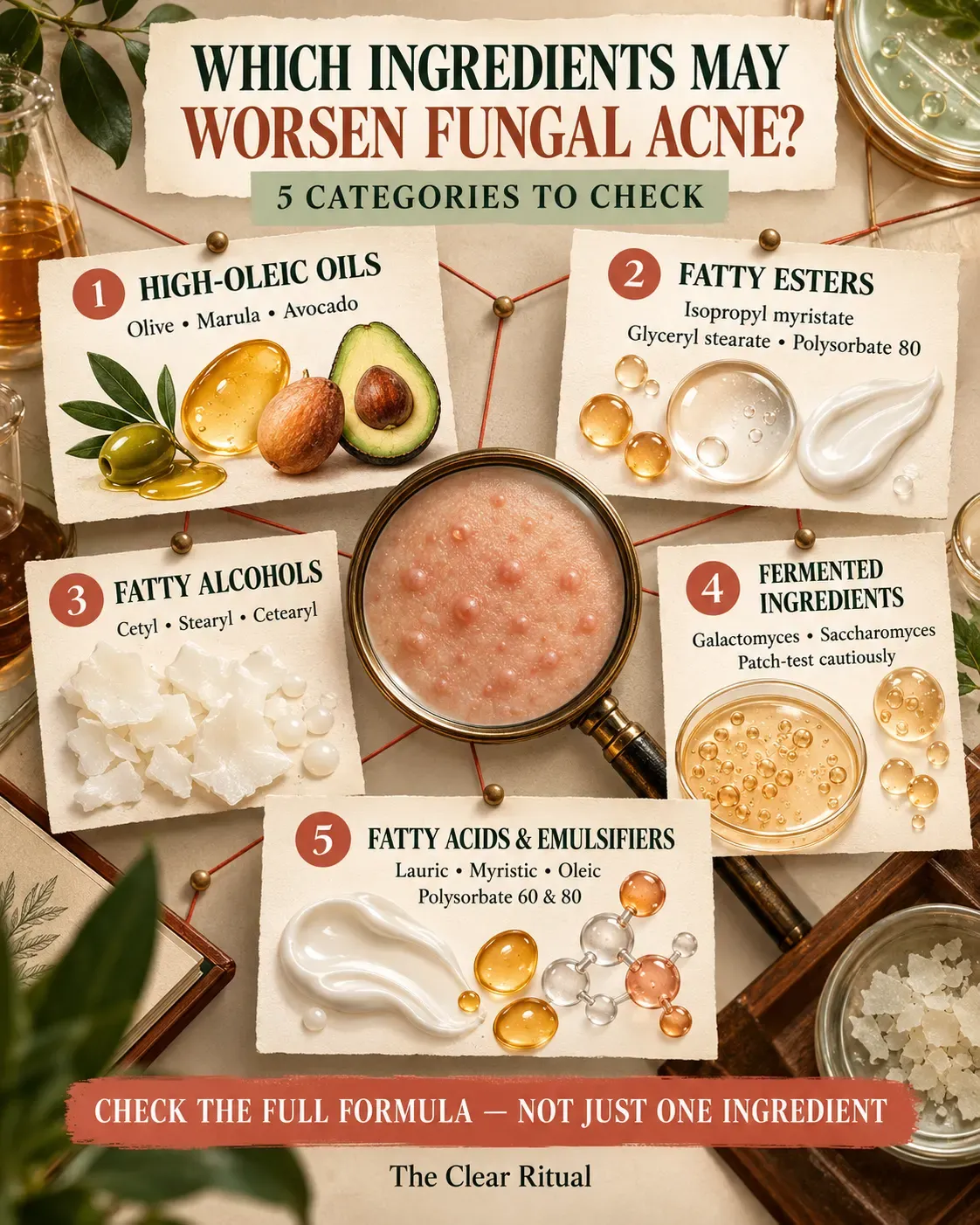
Risk Tier Classification: Fungal Acne Ingredients at a Glance
The Clear Ritual formulation team classifies fungal acne-worsening ingredients into three risk tiers based on available evidence.
| Risk Tier | Ingredient Category | Examples | Evidence Level |
|---|---|---|---|
| High Risk | C11-C24 fatty acids and esters | Isopropyl myristate, oleic acid, stearic acid | Strong - directly feeds Malassezia |
| High Risk | High-oleic oils | Olive oil, argan oil, avocado oil | Strong - documented in clinical literature |
| Moderate Risk | Fatty alcohols | Cetyl alcohol, stearyl alcohol, cetearyl alcohol | Moderate - individual variation observed |
| Moderate Risk | Fermented yeast ingredients | Galactomyces ferment filtrate | Moderate - case reports and clinical observation |
| Lower Risk | Polysorbate emulsifiers | Polysorbate 80, Polysorbate 60 | Emerging - mechanism plausible, fewer studies |
| Lower Risk | Amino acid hydrolysates | Wheat protein hydrolysate, silk amino acids | Preliminary - considered a secondary risk factor |
Why Did My Fungal Acne Get Worse With Standard Acne Treatments?
Standard acne treatments commonly worsen fungal acne because they are formulated for bacterial acne and may contain ingredients that actively feed Malassezia or remove its bacterial competition.
Specific reasons why traditional acne treatments can worsen fungal acne:
- Benzoyl peroxide - antibacterial; eliminates C. acnes bacteria that compete with Malassezia, removing a natural check on yeast overgrowth
- Topical antibiotics (clindamycin, erythromycin) - same mechanism; reduce bacterial competition, allowing Malassezia to dominate
- Retinoids in an oil-rich base - many retinol and tretinoin formulations use oleic acid-heavy carriers that feed the yeast
- Salicylic acid cleansers with fatty acid emollients - the active may be appropriate, but the vehicle may contain Malassezia-feeding esters
- Niacinamide serums - niacinamide itself is generally safe, but many niacinamide serums are formulated with glyceryl stearate or cetyl alcohol as co-emollients
If you have tried two or more topical antibiotic or benzoyl peroxide regimens without improvement, Malassezia folliculitis is worth ruling out before adding more products to your routine.
Fungal Acne-Safe Ingredients: What to Use Instead
Not all emollients, oils, and actives are problematic for fungal acne. Several categories are generally considered safe and are frequently used in Malassezia-friendly formulations recommended by Clear Ritual.
Hydrocarbons and silicones (safest category):
- Squalane (hydrocarbon - not metabolised by Malassezia)
- Mineral oil (hydrocarbon - no fatty acid chains)
- Dimethicone (silicone-based occlusive)
- Cyclomethicone and cyclopentasiloxane (silicone variants)
Humectants:
- Glycerin (no fatty acid structure)
- Hyaluronic acid / Sodium hyaluronate (water-binding polymer)
- Panthenol / Vitamin B5 (water-soluble, no lipid component)
- Niacinamide (safe as an active - verify formulation vehicle)
- Urea (keratolytic humectant - safe and beneficial)
- Allantoin (soothing humectant)
Antifungal actives:
- Zinc pyrithione (actively reduces Malassezia population)
- Ketoconazole (prescription antifungal - directly targets Malassezia)
- Sulfur (mild antifungal properties)
- Selenium sulfide (antifungal - often in shampoo form)
Acids (generally safe - verify the formulation vehicle):
- Azelaic acid (mild antimicrobial, reduces inflammation)
- Salicylic acid
- Glycolic acid and lactic acid
- Mandelic acid
Linoleic acid-dominant oils (lower risk):
- Grapeseed oil (~70% linoleic acid)
- Hemp seed oil (~55% linoleic acid)
- Evening primrose oil (~70% linoleic acid - patch-test; contains some oleic acid)
Safe vs. risky ingredient comparison:
| Ingredient | Fungal Acne Safety | Reason |
|---|---|---|
| Squalane | ✅ Safe | Hydrocarbon - not metabolised by yeast |
| Glycerin | ✅ Safe | No fatty acid structure |
| Dimethicone | ✅ Safe | Silicone-based - not a lipid |
| Hyaluronic acid | ✅ Safe | Water-binding polymer |
| Mineral oil | ✅ Safe | Hydrocarbon - no ester bonds |
| Zinc pyrithione | ✅ Beneficial | Actively reduces Malassezia |
| Cetearyl alcohol | ⚠️ Moderate risk | C16/C18 fatty alcohol |
| Glyceryl stearate | ⚠️ Moderate risk | Releases stearic acid when cleaved |
| Galactomyces ferment filtrate | ⚠️ Moderate risk | Yeast-derived ferment byproducts |
| Isopropyl myristate | ❌ High risk | Directly feeds Malassezia |
| Olive oil | ❌ High risk | ~70–80% oleic acid |
| Argan oil | ❌ High risk | ~43–49% oleic acid |
| Coconut oil | ❌ High risk | ~45–52% lauric acid (C12) |
How to Audit Your Skincare Routine for Fungal Acne Triggers
Removing ingredients that worsen fungal acne requires a systematic review of every product applied to affected areas - including hair products that contact the skin.
Step-by-step routine audit:
- List every product used on affected areas. Include cleansers, toners, serums, moisturisers, sunscreen, makeup, hair conditioners, and styling products.
- Check each ingredient list against the high-risk and moderate-risk categories above. An ingredient does not need to be listed first to be problematic - even trace amounts of C11-C24 fatty acids can support yeast growth.
- Use a Malassezia ingredient checker tool. Several free tools cross-reference INCI names against documented Malassezia-feeding ingredients. Clear Ritual also provides guidance through its product formulation database.
- Remove all high-risk products first. Do not swap one problematic product for another. Reduce total lipid load as much as possible in the first phase.
- Introduce one new product at a time. Wait 2-3 weeks before adding another new product so you can isolate any triggers.
- Check hair products and conditioners. Conditioner left on the scalp, neck, and back is a frequently missed source of Malassezia-feeding fatty acids.
- Review sunscreen last. Sunscreen is non-negotiable, but many formulations contain isopropyl myristate or high-oleic oils. Seek fluid, gel, or water-based alternatives.
Common mistakes to avoid:
- Assuming "natural" or "organic" means safe - olive oil and coconut oil are natural and highly problematic
- Ignoring scalp and hair products when auditing only facial products
- Switching to oils described as "dry oils" without checking their oleic acid percentage
- Using probiotic or fermented skincare without checking the fermentation source
- Applying antifungal treatment while continuing to use Malassezia-feeding products
How to Read an Ingredient Label for Fungal Acne Triggers
Reading a skincare ingredient list for fungal acne triggers is a learnable skill. Clear Ritual recommends checking the complete INCI list rather than relying on claims such as "oil-free", "non-comedogenic", or "for sensitive skin".
Use this label-reading method:
- Scan for direct fatty acids. Look for lauric, myristic, palmitic, stearic, oleic, and linolenic acid.
- Check esters and emulsifiers. Names containing myristate, palmitate, stearate, oleate, or polysorbate may indicate a fatty-acid component.
- Review plant oils individually. Do not assume every botanical oil is suitable. Check whether the oil is rich in oleic acid and whether your skin has reacted to it before.
- Check the product base. A helpful active such as niacinamide or salicylic acid can still sit in a base containing higher-risk emollients.
- Consider the complete routine. Several moderate-risk products used together may create a higher total lipid load than one product used alone.
- Patch-test one product at a time. Apply it to a small affected area for 2-3 weeks before using it more widely.
Ingredient lists appear in descending order of concentration until ingredients present at 1% or less, which may be listed in any order. A potentially problematic ingredient near the end of the list may therefore be present at a low level, but individual tolerance still matters.
How to Build a Fungal Acne-Friendly Routine
A simple routine makes it easier to identify triggers and reduces the chance of irritation from unnecessary layering. If you are also managing skin barrier damage, introduce changes slowly and avoid adding several strong actives together.
Morning routine:
- Use a gentle cleanser or rinse with water if your skin is dry or easily irritated.
- Apply a lightweight humectant containing glycerin, panthenol, or hyaluronic acid.
- Use a simple moisturiser based on squalane, mineral oil, or dimethicone if needed.
- Finish with a broad-spectrum sunscreen whose complete ingredient list has been reviewed.
Evening routine:
- Remove sunscreen and makeup with a fungal acne-compatible cleanser.
- Use any dermatologist-recommended antifungal treatment exactly as directed.
- Apply a minimal moisturiser only if your skin feels dry or tight.
People with acne-prone skin should avoid treating every bump with multiple acne actives at once. A simplified routine allows you to see whether the condition behaves like bacterial acne, irritation, or Malassezia folliculitis.
Can Hair Products Worsen Fungal Acne?
Yes. Conditioner, hair masks, leave-in creams, and styling oils can transfer to the forehead, hairline, shoulders, chest, and back. This is especially relevant when evaluating hair products causing back acne.
Rinse conditioner with your head tilted back, wash the skin after rinsing hair products, and avoid leaving oily products against affected areas. If bumps are concentrated near the hairline, compare your routine with the common pattern of fungal acne on the forehead.
How Long Does It Take to See Improvement?
Improvement does not occur at the same speed for everyone. Once likely triggers are removed and appropriate treatment begins, itching and new bumps may start to reduce within 1-2 weeks. More complete improvement can take several weeks, especially when inflammation has been present for a long time.
Heat, sweat, and occlusive clothing can slow progress. The relationship between humidity and yeast overgrowth is explained in the guide to fungal acne in humid weather.
If there is no meaningful improvement after a consistent routine, do not keep removing ingredients indefinitely. The bumps may be bacterial acne, contact dermatitis, keratosis pilaris, or another type of folliculitis that requires a different approach.
When Should You See a Dermatologist?
See a dermatologist if the bumps are painful, spreading, recurrent, leaving marks, or not improving with a simplified routine. Medical assessment is also important if you are unsure whether the condition is fungal acne or regular acne.
A dermatologist may examine the pattern of the bumps, review recent antibiotic or steroid use, and perform a skin scraping or microscopy when the diagnosis is unclear. Treatment may include a topical or oral antifungal, but oral medication should only be used under medical supervision because it can interact with other medicines and may require monitoring.
For a broader overview of evidence-based options for bacterial breakouts, refer to the Clear Ritual acne treatment guide.
Clear Ritual's Perspective
Fungal acne-friendly skincare is not about labelling every oil or emollient as universally bad. It is about identifying whether Malassezia is actually contributing to your bumps, reducing likely triggers, and building the simplest routine your skin can tolerate.
At Clear Ritual, we focus on the complete pattern: where the bumps appear, whether they itch, what products touch the area, and how the skin responds over time. This helps separate fungal acne from conditions that may look similar but need different care.
Understand What Your Skin Needs
Take the Clear Ritual Skin Test to identify your skin type, concerns, and potential triggers before building your routine.
Take the Free Skin Test
Frequently Asked Questions
Q. Which ingredients are most likely to worsen fungal acne?
A. C11-C24 fatty acids and their esters, high-oleic oils, certain fatty alcohols, yeast-derived ferments, and some polysorbate emulsifiers are the main categories to review.
Q. Is niacinamide safe for fungal acne?
A. Niacinamide itself is generally considered compatible, but the full formula may contain fatty-acid-derived emollients or emulsifiers that do not suit every person.
Q. Is hyaluronic acid safe for fungal acne?
A. Hyaluronic acid and sodium hyaluronate do not contain the fatty acids Malassezia uses as a lipid source, so they are generally suitable.
Q. Can natural oils worsen fungal acne?
A. Yes. Natural does not automatically mean compatible. Oils rich in oleic or other C11-C24 fatty acids may worsen symptoms in susceptible skin.
Q. Should I avoid every fatty alcohol?
A. Not necessarily. Fatty alcohols are a moderate-risk category and tolerance varies. Review the full formula, total lipid load, and your skin's response.
Q. Can antifungal treatment work if I keep using triggering products?
A. Treatment may be less effective if products continue to supply lipids that support Malassezia growth. Review the complete routine alongside medical treatment.
References
- DermNet. Malassezia folliculitis.
- Saunte DML, Gaitanis G, Hay RJ. Malassezia-associated skin diseases, the use of diagnostics and treatment. Frontiers in Cellular and Infection Microbiology.
- Leong C, Buttafuoco A, Glatz M, Bosshard PP. Antifungal susceptibility of Malassezia species. Journal of Clinical Microbiology.
Editorial Standards
Clear Ritual has Strict sourcing guidelines to ensure our content is accurate and current. We rely on peer-reviewed studies, academic research institutions, and medical associations. We strive to use primary sources and refrain from using tertiary references. See a mistake? Learn More about our Editorial Standards.