Professional Blackhead Extraction: What to Expect, Cost & Results
Quick Answer:
Professional blackhead extraction is a clinical procedure where licensed estheticians or dermatologists use sterile tools, steam, and suction to remove clogged pores safely. It is more effective than DIY removal, reduces scarring risk, and should be repeated every 4–6 weeks for lasting results.
What Are Blackheads and Why Do They Keep Coming Back?
A blackhead: medically called an open comedone: forms when a hair follicle becomes clogged with sebum (skin oil) and dead skin cells. Because the pore stays open, the trapped material contacts air. Oxygen oxidizes the pigment in the debris, turning it dark grey or black. This is not surface dirt: it is a chemical reaction inside the pore.
This oxidation process cannot be reversed by cleansing alone. A cleanser reduces new buildup, but it cannot dissolve or remove an already-oxidized plug. That is the core reason professional extraction exists.
Why blackheads keep returning:
- Excess sebum production continues regardless of how often you cleanse
- Incomplete skin cell turnover allows dead cells to accumulate inside pores
- Genetics and hormonal activity influence pore size and oil output
- Product buildup from non-comedogenic formulas compounds congestion over time
According to Clear Ritual's clinical advisory team, professional extraction clears the current backlog: but consistent skincare is what slows the refill.
Quick fact: A 2022 review in the Journal of the American Academy of Dermatology found that comedonal acne affects more than 85% of people aged 12–24, and continues into adulthood for a significant proportion.
Blackheads vs. sebaceous filaments: a critical distinction:
| Feature | Blackheads | Sebaceous Filaments |
|---|---|---|
| Structure | Enlarged, clogged pore | Natural pore-lining structure |
| Appearance | Dark, clearly visible plug | Small grey or tan dots |
| Can be extracted? | Yes, cleanly | No: they refill within 30 days |
| Should be extracted? | Yes, by a professional | No: extraction causes unnecessary trauma |
Knowing the difference prevents unnecessary extraction and skin trauma.
What Is Professional Blackhead Extraction?
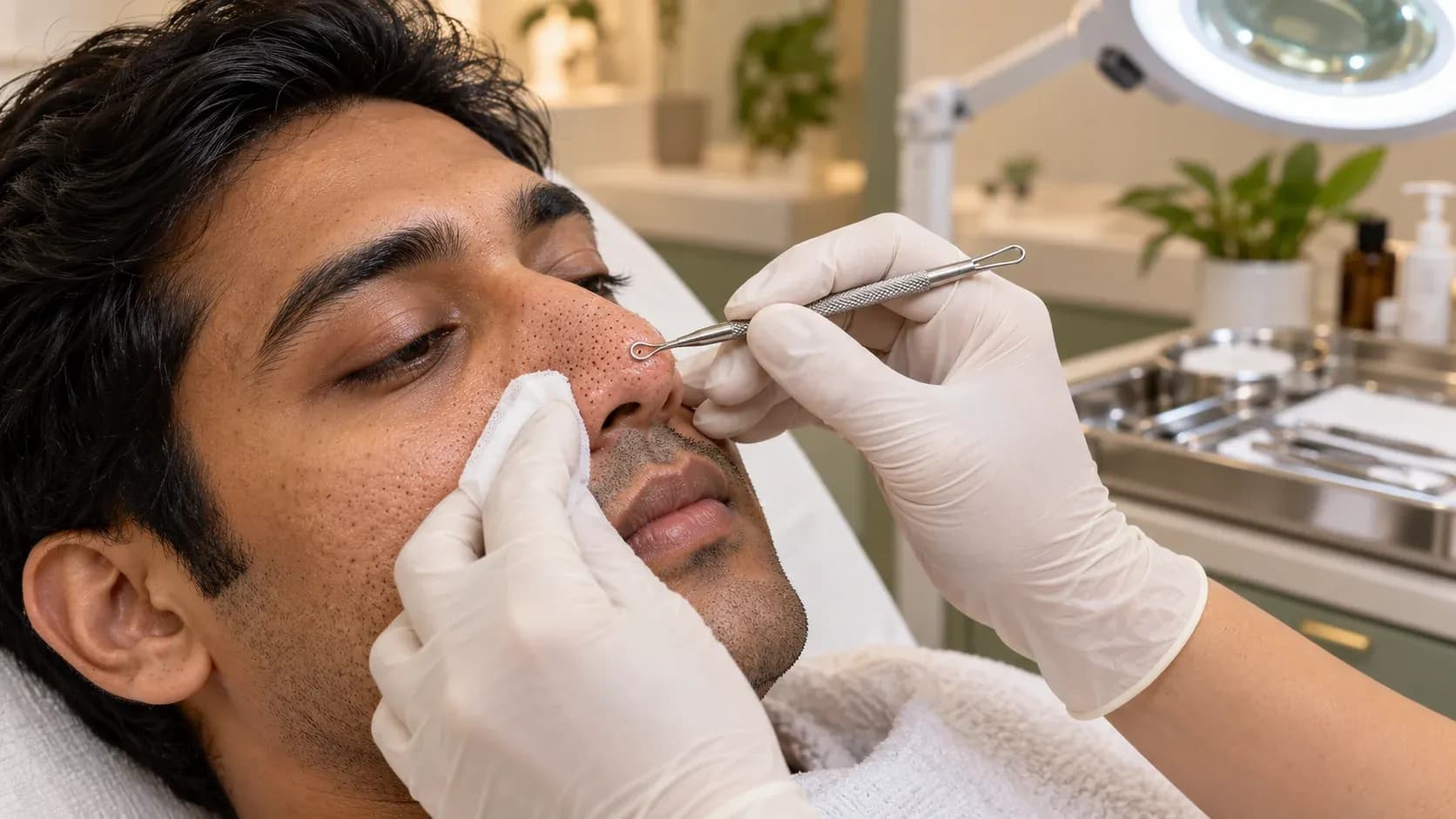
Professional blackhead extraction is a clinic or salon-based procedure where trained dermatologists or estheticians remove blackheads manually or using advanced tools under sterile conditions.
Clear Ritual defines professional extraction as any medically supervised or esthetician-led process that uses controlled pressure and sterilised instruments to physically remove oxidized sebum plugs: as distinct from chemical exfoliation or home squeezing.
Three primary extraction methods used by professional providers:
- Comedone extractor (manual): A sterile metal loop applies controlled, even pressure around the blackhead. The sebum plug lifts out cleanly without the tearing that DIY squeezing causes. Best for superficial, visible comedones.
- Ultrasonic skin scrubbing: A spatula-shaped device vibrates at 28,000+ Hz, loosening sebum and dead cells from pore walls using sonic wave energy rather than physical pressure. Best for sensitive skin and mild congestion.
- Steam-assisted vacuum suction: A heated suction wand softens and lifts debris simultaneously. Steam relaxes the pore opening by warming sebum to a more liquid state; the vacuum draws out the loosened plug. Best for moderate-to-severe blackheads and T-zone congestion.
Most professional extraction facials combine all three methods in sequence: steam first, suction second, manual finishing: for the most thorough result.
How Does a Professional Blackhead Extraction Appointment Work?
Professional blackhead extraction follows a consistent four-step sequence across clinics and dermatology practices.
Step 1: Skin Analysis and Consultation Your esthetician or dermatologist assesses your skin type, pore size, and blackhead severity. They will advise you to stop retinoids and exfoliating acids 48–72 hours before your appointment to minimize irritation risk.
Step 2: Deep Cleansing and Steam Therapy A gentle cleanser removes surface makeup and debris. Steam therapy follows: softening the skin, loosening debris inside pores, and reducing discomfort during extraction. Steaming is not optional; it directly affects how cleanly plugs release.
Step 3: Manual or Mechanical Extraction Once pores are softened, the provider uses sterile tools or suction devices to extract blackheads precisely. Controlled pressure and proper sanitation prevent redness and scarring. You may feel mild pressure, but discomfort is minimal and brief.
Step 4: Soothing and Aftercare Treatments A cooling mask or soothing gel is applied to calm post-extraction redness. Clinics typically follow with hydrating serums, LED therapy, and SPF application to protect the freshly cleared skin barrier.
Which Extraction Method Is Right for Your Skin Type?
The right extraction method depends on your skin type, blackhead depth, and sensitivity level. Clear Ritual's skin assessment process identifies these factors before recommending a treatment approach.
| Method | Mechanism | Best Skin Type | Recovery Time | Extraction Depth |
|---|---|---|---|---|
| Manual (comedone extractor) | Physical pressure via sterile loop | Oily, normal | 1–2 hours | Surface to mid-depth |
| Ultrasonic scrubbing | Sonic wave vibration at 28,000+ Hz | Sensitive, mild congestion | None | Surface only |
| Steam-assisted suction | Heat + vacuum | Oily, combination | Up to 24 hours | Mid to deep |
Key guidance by skin type:
- Oily or acne-prone skin: Manual extraction or steam-assisted suction; sessions every 3–4 weeks
- Sensitive skin: Ultrasonic scrubbing; sessions every 6–8 weeks
- Combination skin: Combined approach (steam + suction + manual finishing); sessions every 4–6 weeks
- Rosacea-prone or very thin skin: Steam-assisted suction is not suitable; consult a dermatologist before any extraction
Dermatologist vs. Esthetician: Who Should Perform Your Extraction?
Both licensed estheticians and dermatologists perform professional blackhead extraction: but their scope and capabilities differ meaningfully.
| Licensed Esthetician | Dermatologist | |
|---|---|---|
| Training focus | Skincare, facials, cosmetic procedures | Medical skin conditions, disease diagnosis |
| Tools used | Comedone extractors, steam, ultrasonic devices | All esthetician tools + medical-grade lasers, prescription treatments |
| Prescription access | No | Yes |
| Best for | Routine maintenance, mild-to-moderate blackheads | Severe acne, cystic breakouts, conditions requiring diagnosis |
| Average cost (India) | ₹2,000 – ₹4,000 | ₹5,000 – ₹8,000 |
When to see a dermatologist instead of an esthetician:
If your blackheads are accompanied by painful nodules, cystic acne, or inflamed lesions, a dermatologist is the appropriate first step. Dermatologists can prescribe topical retinoids or oral medications that estheticians cannot provide, and they can rule out conditions like sebaceous hyperplasia that closely mimic blackheads.
For healthy skin with routine blackhead congestion, a skilled esthetician is a perfectly appropriate and cost-effective choice.
How to Prepare for a Professional Blackhead Extraction Appointment
What you do in the 48–72 hours before your appointment directly affects how comfortable and effective your session will be.
Do these before your appointment:
- Stop retinoids and exfoliating acids 48–72 hours before. Retinol, AHAs (glycolic, lactic acid), and BHAs (salicylic acid) thin the skin's surface barrier. Active retinoids combined with extraction pressure increases the chance of micro-tears and prolonged redness.
- Arrive with clean, makeup-free skin if possible. Your provider will cleanse you anyway, but arriving clean shortens session prep and reduces irritation from product residue.
- Stay well-hydrated in the days before. Well-hydrated skin steams more evenly and extracts more cleanly because sebum in a hydrated follicle is less viscous.
- Avoid waxing or threading the area within 48 hours. Both temporarily sensitise follicles, making extraction more uncomfortable.
- Disclose active breakouts, skin conditions, or medications. This includes oral isotretinoin (Accutane), which makes skin too fragile for any extraction.
Skip the morning of your appointment:
- Thick oils or balms on the extraction area
- Self-tanner (it interferes with skin analysis)
- Pre-extracting at home the night before: this increases inflammation going into your session
What to Expect After Blackhead Extraction: A 72-Hour Recovery Timeline
Most people leave a professional extraction session with noticeably clearer, smoother skin. The next 72 hours require attentive care to protect results.
Hours 0–4 (Immediately after): Skin appears slightly pink or flushed, especially over extracted areas. Pores may look temporarily larger: this is normal and resolves quickly. The soothing mask applied at the end of your session brings most redness down before you leave the clinic. Avoid touching your face and skip makeup for the rest of the day.
Hours 4–24: Redness typically resolves fully within 24 hours. Skin may feel slightly dry or tight as extracted pores begin to close. Apply a non-comedogenic moisturiser generously and use SPF 30+ if going outdoors: freshly extracted skin is more vulnerable to UV damage and post-inflammatory pigmentation.
Days 1–3: Some people experience a brief purging phase, particularly after their first session. A few small pimples may appear near previously congested pores as residual debris migrates upward. This is temporary and typically resolves within 3–5 days.
Days 3–7: Skin texture improves noticeably. Pores appear tighter as they contract without the sebum plug distending them. Skincare products absorb more effectively because the physical barrier of congestion is cleared.
Weeks 4–6: Blackheads begin to reform gradually due to ongoing sebum production. This is the ideal window for your next extraction session if you are on a maintenance schedule.
Important: If redness, swelling, or pain persists beyond 48 hours, contact your provider. This can occasionally indicate a reaction to tools or aftercare products used.
Benefits of Professional Blackhead Extraction
Professional blackhead extraction delivers measurable improvements that at-home methods typically cannot match.
Clinical and cosmetic benefits:
- Deep pore cleansing that removes oxidized sebum plugs entirely, not just surface debris
- Smoother skin texture within 3–7 days post-session
- Reduced blackhead and acne recurrence when combined with a home routine
- Minimized visible pore size as pores contract after congestion is cleared
- Better absorption of skincare serums and moisturisers post-treatment
- Safe, hygienic procedure with minimal risk of scarring when performed correctly
Clear Ritual's skin health team notes that results are most sustained when professional extraction is paired with evidence-backed topical ingredients at home: particularly BHAs and niacinamide: which slow the rate at which pores re-congest between sessions.
Who Should and Should Not Get Professional Blackhead Extraction
Professional blackhead extraction is appropriate for most people with congested pores: but certain skin conditions make it unsuitable without prior medical clearance.
Best candidates for professional extraction:
- Individuals with clogged pores, dull skin texture, or mild-to-moderate acne
- Those with persistent blackheads unresponsive to topical care alone
- People with oily or combination skin types
- Anyone who has previously experienced scarring or infection from at-home extraction attempts
Avoid professional extraction if you have:
- Active cystic acne or open wounds in the treatment area
- Rosacea or eczema-prone skin (steam and suction may trigger flares)
- Severe skin sensitivity or compromised skin barrier
- A current prescription for oral isotretinoin (Accutane)
Always schedule a pre-treatment consultation to confirm the procedure suits your skin condition. A reputable clinic will offer this before your first session.
Cost of Professional Blackhead Extraction in India
Professional blackhead extraction in India typically costs between ₹2,000 and ₹15,000 per session, depending on the provider type, city, and add-on treatments included.
| Provider | Typical Cost (India) | What's Included | Best For |
|---|---|---|---|
| Salon / Spa | ₹2,000 – ₹4,000 | Basic facial, steam, manual extraction | Routine maintenance, mild blackheads |
| Dermatology Clinic | ₹5,000 – ₹8,000 | Skin analysis, advanced tools, LED therapy, medical supervision | Moderate-severe congestion, sensitive skin |
| Premium Medi-Spa | ₹8,000 – ₹15,000 | HydraFacial, chemical peel add-ons, prescription aftercare | Severe congestion, combination acne treatment |
What drives the cost up:
- City tier: Metro clinic prices (Mumbai, Delhi, Bengaluru) run 30–50% higher than smaller cities
- Add-on treatments: LED therapy, chemical peels, or HydraFacial modules add ₹1,500–₹3,000 each
- Provider credentials: A dermatologist's session includes medical expertise and prescription access
- Tool quality: Medical-grade suction and ultrasonic equipment costs more to operate than manual tools
Is it worth it compared to DIY? Over 12 months, monthly professional extraction at the lower salon tier costs ₹24,000–₹48,000. DIY extraction tools cost ₹200–₹800 upfront. However, the hidden costs of DIY: dermatologist visits to treat post-extraction scarring, prescription fading creams, and cumulative pore damage from improper technique: frequently exceed the cost of professional sessions. For most people with persistent blackheads, a professional session every 4–6 weeks paired with a consistent home routine delivers better long-term skin texture and lower total treatment cost.
At-Home Extraction vs. Professional Extraction: A Direct Comparison
At-home blackhead removal and professional extraction both aim to clear clogged pores: but they differ significantly in safety, effectiveness, and long-term outcomes.
| Parameter | At-Home Extraction | Professional Extraction |
|---|---|---|
| Safety | High risk of scarring and infection | Safe and sterile under expert care |
| Tools used | Basic or non-sterile kits | Medical-grade, sterilised instruments |
| Results | Temporary; high recurrence | Longer-lasting clarity |
| Pain level | Often uncomfortable; uncontrolled pressure | Minimal discomfort; controlled technique |
| Scarring risk | High with improper technique | Low when performed correctly |
| Cost | Lower upfront | Moderate: but higher long-term value |
Studies on facial extraction techniques consistently show that expert-performed procedures do not increase pore size, while improper home extraction often causes permanent pore enlargement. The controlled pressure of a comedone extractor in professional hands lifts the plug cleanly; DIY squeezing tears surrounding tissue.
What Dermatologists Recommend for Long-Term Blackhead Management
Professional extraction alone is not a long-term solution. According to current dermatology consensus (2024–2025), the American Academy of Dermatology and British Association of Dermatologists both recommend a combined topical and procedural approach for persistent comedonal acne.
The reasoning is direct: extraction clears the current backlog, but topical actives slow the rate at which the backlog reforms.
Evidence-backed ingredients for blackhead prevention:
- Salicylic acid / BHA (0.5–2%): A lipid-soluble acid that penetrates inside the pore and dissolves the sebum-dead cell matrix. A 2021 review in Dermatology and Therapy confirmed BHA's superiority over AHAs for comedonal acne because of its oil-solubility.
- Niacinamide (4–10%): Regulates sebum secretion and reduces surface oil without drying the skin. Consistent use reduces the rate of pore refill between extraction sessions.
- Retinoids (adapalene 0.1%, tretinoin 0.025–0.05%): Increase skin cell turnover, preventing dead cells from accumulating inside pores. A 2020 Cochrane review found adapalene gel 0.1% significantly reduces both open and closed comedones within 12 weeks.
- Non-comedogenic SPF 30+: Post-extraction skin is more susceptible to UV-triggered hyperpigmentation. Daily sunscreen is non-negotiable.
Clear Ritual's formulation team recommends building a routine around BHA and niacinamide between extraction sessions: both are suitable for routine use when introduced gradually and tolerated well.
Use one active at a time and follow the product directions. Over-exfoliation can disrupt the skin barrier and make redness, sensitivity, and congestion more noticeable.
Risks and Side Effects of Professional Blackhead Extraction
Professional extraction is generally low-risk when performed by a trained provider using sterile instruments. Temporary redness, mild tenderness, dryness, or small areas of swelling can occur after the session.
Possible risks include:
- Temporary redness: Usually settles within a few hours to 24 hours.
- Skin irritation: More likely when strong exfoliants or retinoids were used shortly before the appointment.
- Post-inflammatory pigmentation: Can occur if excessive pressure or repeated attempts injure the skin.
- Infection: Uncommon with sterile technique, but possible when tools or hands are not properly sanitised.
- Scarring: Primarily associated with forceful extraction, inflamed lesions, or repeated squeezing.
Do not allow a provider to repeatedly press an area that does not release easily. A resistant lesion may not be a blackhead and should be assessed rather than forced.
How to Maintain Results Between Extraction Sessions
The aim between appointments is to reduce the buildup of oil and dead skin cells without stripping or irritating the skin.
- Cleanse gently twice daily: Use a mild cleanser and avoid abrasive scrubs.
- Introduce a pore-clearing active: Salicylic acid may help reduce buildup inside oily pores when used as directed.
- Support oil balance: Niacinamide may help manage excess surface oil and support the skin barrier.
- Moisturise consistently: Choose a lightweight, non-comedogenic formula suited to your skin type.
- Use sunscreen every morning: Apply broad-spectrum SPF 30 or higher and reapply during prolonged sun exposure.
- Avoid squeezing: Picking at new blackheads can create inflammation and marks before your next appointment.
Book follow-up sessions based on how quickly congestion returns rather than following an unnecessarily frequent schedule. Many people find that an interval of 4–6 weeks is adequate, while sensitive skin may require longer gaps.
When Should You See a Dermatologist?
Consult a dermatologist if blackheads are accompanied by painful nodules, cysts, widespread inflammation, repeated scarring, or pigmentation that continues to worsen. You should also seek professional assessment when lesions do not respond to a consistent routine or when you are unsure whether the dark dots are blackheads, sebaceous filaments, or another skin condition.
A dermatologist can confirm the diagnosis and decide whether topical retinoids, other prescription options, chemical peels, or a different procedure is appropriate.
Clear Ritual’s Perspective on Professional Blackhead Extraction
Professional extraction can safely clear existing blackheads, but lasting improvement depends on what happens between appointments. A gentle cleanser, suitable pore-clearing ingredients, moisturiser, and daily sunscreen can help slow congestion without overwhelming the skin.
The Clear Ritual Skin Test can help you understand your skin type and concerns before you build a routine around blackhead prevention.
Understand What Your Skin Needs
Identify your skin type and concerns to build a routine that feels clear, focused, and suitable for your skin.
Take the Free Skin Test
Frequently Asked Questions
1. Is professional blackhead extraction safe?
It is generally safe when a trained dermatologist or licensed esthetician uses sterile tools and controlled pressure. Extracting inflamed or resistant lesions can increase irritation and scarring risk.
2. How often should you get professional blackhead extraction?
Many people schedule sessions every 4–6 weeks, but the ideal interval depends on skin sensitivity, oil production, congestion, and the home routine used between appointments.
3. Do blackheads return after professional extraction?
Yes. Extraction removes current plugs but does not stop sebum production or dead skin buildup. A consistent routine can help slow their return.
4. Does blackhead extraction make pores larger?
Correct professional extraction does not permanently enlarge pores. Pores may look temporarily more visible immediately after a plug is removed.
5. Can you extract blackheads at home?
Home squeezing carries a higher risk of inflammation, infection, marks, and scarring. Persistent or deep blackheads are safer to address with a trained professional.
References
- American Academy of Dermatology. Pimple popping: Why only a dermatologist should do it.
- American Academy of Dermatology. Acne: Signs and symptoms.
- National Institute for Health and Care Excellence. Acne vulgaris: Management.
- National Health Service. Acne.
Disclaimer
This article is intended for general informational purposes and is not a substitute for personalised medical advice, diagnosis, or treatment. Consult a qualified dermatologist if your blackheads occur with painful, inflamed, persistent, or scarring breakouts.
Editorial Standards
Clear Ritual has Strict sourcing guidelines to ensure our content is accurate and current. We rely on peer-reviewed studies, academic research institutions, and medical associations. We strive to use primary sources and refrain from using tertiary references. See a mistake? Learn More about our Editorial Standards.
Related Articles
Laser Treatments for Blackheads: Do They Really Help?
Published 24 July 2026
Skincare Ingredients That Support Scar Healing
Published 17 July 2026

Skincare Ingredients Suitable for Acne Prone Skin
Published 24 July 2026

Niacinamide for Acne Scars: What It Actually Fades (And What It Can't)
Published 15 September 2026