Do Blackhead Vacuums Work? Results, Risks & Safety
Quick Answer:
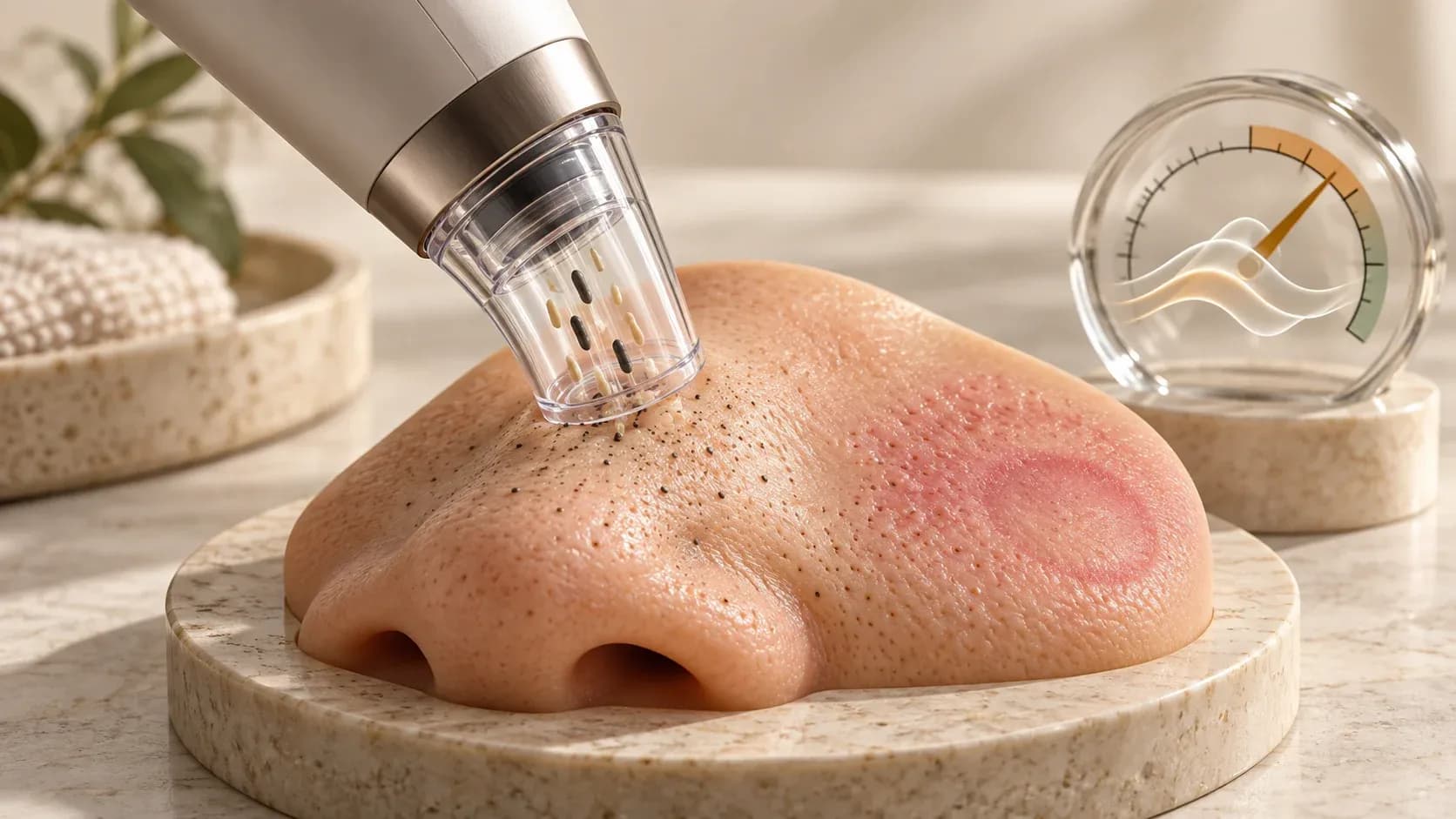
Blackhead vacuums can lift surface oil and loose dead skin cells, giving pores a visibly cleaner appearance immediately after use. They cannot remove deeply embedded blackheads, permanently reduce pore size, or address the sebum overproduction that causes congestion to return within 24 to 72 hours.
The one-line answer: Pore vacuums are a temporary surface tool, not a blackhead treatment.
What Is a Blackhead Vacuum and How Does It Work?
A blackhead vacuum is a handheld suction device that creates negative pressure at the skin's surface to draw out sebum, dead skin cells, and loose debris from pores. Most consumer models operate at 40 to 80 mmHg of suction: enough to dislodge surface material, but not enough to extract a hardened comedone anchored deep inside the follicle canal.
The three main types available:
| Type | Mechanism | Best For | Price Range |
|---|---|---|---|
| Manual extractor | Physical pressure via metal loop | All skin types | ₹300 to ₹800 |
| Suction vacuum | Electric negative pressure | Oily / combination skin | ₹1,000 to ₹3,000 |
| Vacuum + exfoliation | Suction with microdermabrasion tip | Dull or acne-prone skin | ₹3,000 to ₹7,000 |
How a blackhead vacuum works, step by step:
- Negative pressure forms. Pressing the device tip against skin creates a localised vacuum at the pore opening: the same physical principle as a household vacuum, scaled to a 5 to 8 mm nozzle.
- Loose debris is dislodged. Surface oil, dead skin cells, and sebum that has already migrated to the top of the pore are drawn upward. This is what produces the satisfying before-and-after visuals.
- Deep blackheads resist suction. A true blackhead (open comedone) is a compacted plug of sebum and keratin held inside the follicle walls. Consumer suction levels of 40 to 80 mmHg cannot shear this plug free without also traumatising surrounding tissue.
- The pore refills within 24 to 72 hours. Because the root cause: excess sebum production and abnormal keratinocyte buildup: is untouched, congestion rebuilds rapidly.
According to Clear Ritual's dermatology team, no amount of suction replaces chemistry. Ingredients such as salicylic acid dissolve the plug from inside the follicle; suction can only act at the surface opening.
What Do Dermatologists Actually Say About Blackhead Vacuums?
Dermatologists consistently classify blackhead vacuums as a cosmetic convenience tool, not a clinical treatment. Key positions from major authorities include:
- American Academy of Dermatology (AAD): Suction devices can temporarily clear surface debris but have not been shown to eliminate deep comedones or produce lasting pore refinement. The AAD advises patients with inflammatory acne, rosacea, or sensitive skin to avoid them entirely.
- Cleveland Clinic: Dermatologists note that high-suction home devices carry meaningful risk of bruising and capillary damage, and recommend in-office professional extraction instead: where suction levels and technique can be controlled.
- British Journal of Dermatology (2021): A comparative study found that twice-daily 2% salicylic acid reduced open comedone count by 32% at 4 weeks, compared to no statistically significant reduction in the mechanical extraction group at the same interval.
- Journal of Clinical and Aesthetic Dermatology: Research identifies repeated mechanical trauma: including aggressive suction: as a modifiable risk factor for post-inflammatory hyperpigmentation (PIH) in Fitzpatrick skin types III to VI.
The scientific consensus, reviewed by Dr. Divya Poulose, is that pore vacuums are not supported by peer-reviewed evidence as a primary blackhead intervention.
What Are the Real Side Effects of Blackhead Remover Machines?
The side effects of blackhead remover machines are real and, in some cases, permanent. Each risk has a specific mechanism and a population most likely to experience it.
Redness and bruising (most common) Suction held above 60 mmHg in one spot for more than 2 to 3 seconds ruptures small capillaries below the skin surface, producing a bruise-like mark. This typically fades in 2 to 5 days, but repeated bruising in the same area causes cumulative tissue damage. Most at risk: fair or thin skin, cheeks, and nose bridge.
Broken capillaries (telangiectasia) Repeated suction trauma weakens superficial blood vessel walls. The resulting thread-like red veins can be permanent and typically require laser treatment to resolve. Most at risk: anyone with rosacea, couperose skin, or existing visible capillaries.
Post-inflammatory hyperpigmentation (PIH) For medium-to-deep skin tones (Fitzpatrick types III to VI), suction-induced inflammation can trigger melanin overproduction, causing dark spots that outlast redness by weeks or months. Most at risk: Indian, South Asian, Middle Eastern, and East Asian skin tones.
Worsened acne and folliculitis Using suction over active pustules or papules forces bacteria deeper into the follicle rather than out of it, potentially triggering new breakouts in the treated area. Most at risk: anyone with active inflammatory acne.
Skin barrier disruption Frequent use strips the natural lipid barrier, increasing trans-epidermal water loss (TEWL), dehydration, and sensitivity to other skincare products. Most at risk: anyone using the device more than twice per week.
Common mistakes that worsen every side effect:
- Starting on the highest suction setting
- Holding the device still rather than gliding continuously
- Using on inflamed, sunburned, or broken skin
- Skipping moisturiser after each session
- Applying over the eye contour or lip area, where skin is too thin
⚠️ Dermatologists advise keeping suction at or below 40 to 50 mmHg for home use and limiting sessions to once per week on non-sensitive areas.
Who Should and Should Not Use a Blackhead Vacuum?
Blackhead vacuums are safe for a specific subset of people, used in a specific way. For everyone else, the risks outweigh the benefits.
| Factor | Safe to Use With Caution | Should Avoid |
|---|---|---|
| Skin type | Oily, non-sensitive, normal | Dry, sensitive, dehydrated |
| Skin condition | No active breakouts or rashes | Active acne, rosacea, eczema, psoriasis |
| Skin tone | Lighter tones (lower PIH risk) | Medium-to-deep tones (higher PIH risk) |
| Current routine | No active acids or retinoids | Using retinoids, AHAs, BHAs, or benzoyl peroxide |
| Frequency | Once per week maximum | Daily or more often |
| Skin history | No visible capillaries | Couperose, rosacea, or visible thread veins |
Why retinoid and acid users should avoid it: These actives thin the stratum corneum and increase skin fragility. Adding mechanical suction on a sensitised barrier significantly raises the risk of irritation and barrier damage.
Why people with rosacea should avoid it: Rosacea involves already-dilated and reactive blood vessels. Suction directly over rosacea-prone areas: cheeks and nose: can trigger flushing, worsen redness, and cause permanent capillary damage.
Clear Ritual recommends a patch test on the inner forearm at the lowest suction setting before applying any vacuum device to the face, regardless of skin type.
How to Use a Blackhead Vacuum Safely: 5 Steps
If you choose to use a pore vacuum, following these dermatologist-aligned steps significantly reduces the risk of damage.
- Steam first. Apply a warm compress or steam your face for 5 to 10 minutes. This softens the keratin plug and opens the pore opening, requiring less suction force to lift surface debris. Skipping this step is the most common reason users increase suction unnecessarily.
- Start on the lowest setting. Consumer devices range from 40 to 100+ mmHg. Begin at the minimum. If redness does not fade within 10 minutes, that setting is already too high for your skin.
- Keep the device moving continuously. The bruising 'hickey' effect occurs when the tip sits in one spot. Glide in slow overlapping passes, spending no more than 2 to 3 seconds over any single point.
- Apply soothing aftercare immediately. After the session, your pores are temporarily more open and your barrier is slightly stressed. Apply a fragrance-free, non-comedogenic moisturiser straight away. Avoid actives, exfoliants, and alcohol-based products for at least 24 hours.
- Limit frequency strictly. Once per week is the maximum for non-sensitive, oily skin. Many skin types tolerate once per fortnight better. If redness lasts more than 30 minutes post-session, extend the interval to every 10 to 14 days.
Additional precautions:
- Never use on active acne, open wounds, or sunburned skin
- Avoid the eye contour and lip area entirely
- Discontinue immediately if bruising, broken capillaries, or increased sensitivity appear
Blackhead Vacuum vs. Proven Alternatives: Which Works Better?
The following comparison covers effectiveness, cost, risk level, and timelines for the most commonly recommended approaches to blackhead management.
| Method | Effectiveness | Cost | Risk Level | Best For |
|---|---|---|---|---|
| Pore vacuum | Moderate (surface only) | ₹₹ | Medium | Oily, non-sensitive skin: occasional use |
| Salicylic acid (2% BHA) | High | ₹ | Low | Acne-prone or congested skin |
| Clay mask | Medium | ₹ | Low | Oily and combination skin |
| Professional extraction facial | High | ₹₹₹ | Low (in-office) | All skin types |
| Retinoid (adapalene / tretinoin) | High | ₹₹ | Moderate (initial adjustment) | Mature or acne-prone skin |
Why each dermatologist-backed alternative outperforms a pore vacuum:
- Salicylic acid (BHA) at 1 to 2% is oil-soluble, meaning it penetrates into the follicle and dissolves the sebum plug from inside: the mechanism a vacuum physically cannot replicate. Studies show a 32% greater reduction in open comedones at 4 weeks compared to mechanical extraction.
- Retinoids (adapalene 0.1%, tretinoin 0.025 to 0.05%) accelerate keratinocyte turnover, preventing new comedones from forming at the follicle level. Effects compound over 8 to 12 weeks.
- Clay masks absorb excess surface oil without mechanical stress, making them a lower-risk option for surface oil control.
- Professional extraction facials every 4 to 6 weeks deliver complete comedone removal by a trained aesthetician using precise technique: and include post-treatment barrier support.
Blackhead Vacuum Results Timeline: What to Realistically Expect
The results timeline for a blackhead vacuum differs fundamentally from ingredient-based treatments because the mechanism of action is entirely different.
| Timeframe | Blackhead Vacuum | Salicylic Acid (BHA) | Retinoid |
|---|---|---|---|
| Immediately after use | Pores look visibly cleaner; mild redness possible | No visible change | No visible change |
| 24 to 72 hours | Pores refill with sebum; effect fades | Mild exfoliation begins | Cell turnover begins |
| 2 to 4 weeks | No cumulative improvement; risk increases with frequency | 20 to 32% measurable reduction in blackhead count | Early smoothing of skin texture |
| 8 to 12 weeks | No structural improvement; possible barrier damage from overuse | Sustained pore clarity; sebum regulation improving | Significant reduction in comedones; improved pore structure |
| 6+ months | No lasting benefit | Maintained clarity with consistent use | Near-complete suppression of new blackhead formation in many users |
The core difference: a blackhead vacuum is a surface tool with a 24-hour effect window. Salicylic acid and retinoids are structural treatments that change what happens inside the follicle: results compound over time rather than resetting daily.
According to Clear Ritual's dermatology review team, for most people with recurring blackheads, a pore vacuum delivers the satisfaction of instant results while underlying congestion rebuilds. That cycle is why ingredient-based approaches are consistently recommended as the primary strategy.
Are Blackhead Vacuums Worth It? The Final Verdict
Blackhead vacuums can be a useful occasional tool for a narrow group of users: but they are not a standalone blackhead solution for most people.
Where pore vacuums can add value:
- ✅ Quick visible results before an event
- ✅ Mild surface exfoliation effect on oily skin
- ✅ Satisfying visual feedback of debris removal
- ✅ Lower irritation risk than manual DIY squeezing
Where pore vacuums consistently fall short:
- ❌ Cannot remove deeply embedded or hardened comedones
- ❌ No cumulative or long-term improvement in blackheads
- ❌ Real risk of redness, bruising, and broken capillaries
- ❌ Higher PIH risk for medium-to-deep skin tones
- ❌ Pores refill within 24 to 72 hours regardless of frequency
The verdict: Blackhead vacuums may work for occasional, careful use on non-sensitive, oily skin already supported by a consistent skincare routine. For anyone with sensitive skin, deeper skin tones, rosacea, active acne, or a goal of lasting clarity: the risks outweigh the temporary benefit. Dermatologist-approved exfoliants and a consistent routine will produce better results with less risk.
Understand What Your Skin Needs
Identify your skin type and concerns to build a focused routine without unnecessary product overload.
Take the Free Skin Test
Frequently Asked Questions About Blackhead Vacuums
Q. Do blackhead vacuums actually remove blackheads or just surface oil?
Blackhead vacuums primarily remove surface oil and loose dead skin cells: not true blackheads. A blackhead is a hardened plug of sebum and keratin seated deep inside the follicle canal. Consumer suction levels of 40 to 80 mmHg cannot generate enough force to extract this plug without also damaging surrounding tissue. What collects in the device is mostly sebaceous filament content and surface debris, which is why pores refill within 24 to 72 hours of each session.
Q. How often can I safely use a blackhead vacuum?
Once per week is the maximum dermatologists recommend for non-sensitive, oily skin: and many advise once per fortnight for most skin types. More frequent use disrupts the skin's lipid barrier, increases trans-epidermal water loss, and progressively sensitises the skin. If redness lasts more than 30 minutes after use, extend the interval to every 10 to 14 days.
Q. Is a blackhead vacuum safe for Indian or South Asian skin?
Suction devices carry a higher risk for medium-to-deep skin tones (Fitzpatrick types III to VI) due to elevated susceptibility to post-inflammatory hyperpigmentation. Any suction-induced inflammation can trigger melanin overproduction, causing dark spots that outlast redness by weeks or months. Clear Ritual's dermatology team generally recommends a 2% salicylic acid cleanser instead for South Asian, East Asian, and Middle Eastern skin tones: it targets the same congestion with no PIH risk.
Q. Can a pore vacuum make acne worse?
Yes: if used over active inflammatory acne (papules, pustules, or cysts), suction can rupture the follicle wall and force bacteria deeper into the dermis, triggering new breakouts in the treated area. Pore vacuums should only ever be used on non-inflamed, comedonal congestion. If your visible spots are red, raised, or pus-filled, a vacuum will worsen them.
Q. What happens if I use a blackhead vacuum every day?
Daily use progressively strips the skin's lipid barrier, causes micro-inflammation, and increases sensitivity. Within 2 to 4 weeks, most people notice increased skin reactivity, tightness, and potential flaking. In people with existing capillary fragility, daily suction can cause permanent telangiectasia: visible thread veins: that require laser treatment to resolve. The 'clean' sensation after daily use reflects barrier disruption, not skin health.
Q. How is a pore vacuum different from a professional extraction facial?
Professional extractions are performed after steam softening by a trained aesthetician or dermatologist using a sterile metal extractor or comedone spoon, applying precise directional pressure to each individual blackhead for complete removal. Home pore vacuums apply indiscriminate suction across the skin surface, removing loose debris without completing the extraction of each follicular plug. Professional care also allows the practitioner to assess the skin, control pressure, maintain hygiene, and provide suitable aftercare, which lowers the risk of bruising, irritation, and incomplete extraction.
Disclaimer
This article is intended for general informational purposes and is not a substitute for personalised medical advice, diagnosis, or treatment. Consult a qualified dermatologist if blackheads are persistent, inflamed, painful, or associated with scarring.
Editorial Standards
Clear Ritual has Strict sourcing guidelines to ensure our content is accurate and current. We rely on peer-reviewed studies, academic research institutions, and medical associations. We strive to use primary sources and refrain from using tertiary references. See a mistake? Learn More about our Editorial Standards.
Related Articles
Sunscreen and Pimples: Can SPF Cause Breakouts?
Published 21 July 2026
Summer Skincare Routine: Complete Guide — How It Works, Benefits & Best Practices
Published 20 July 2026

Men's Skin Care Kit Under 500: Complete Guide — How It Works, Benefits & Best Practices
Published 20 July 2026
Korean Skincare Routine for Acne-Prone Skin: What Actually Helps
Published 20 July 2026