Blackhead Remover Tools: Types, Safety, and How to Use Them
Quick Answer:
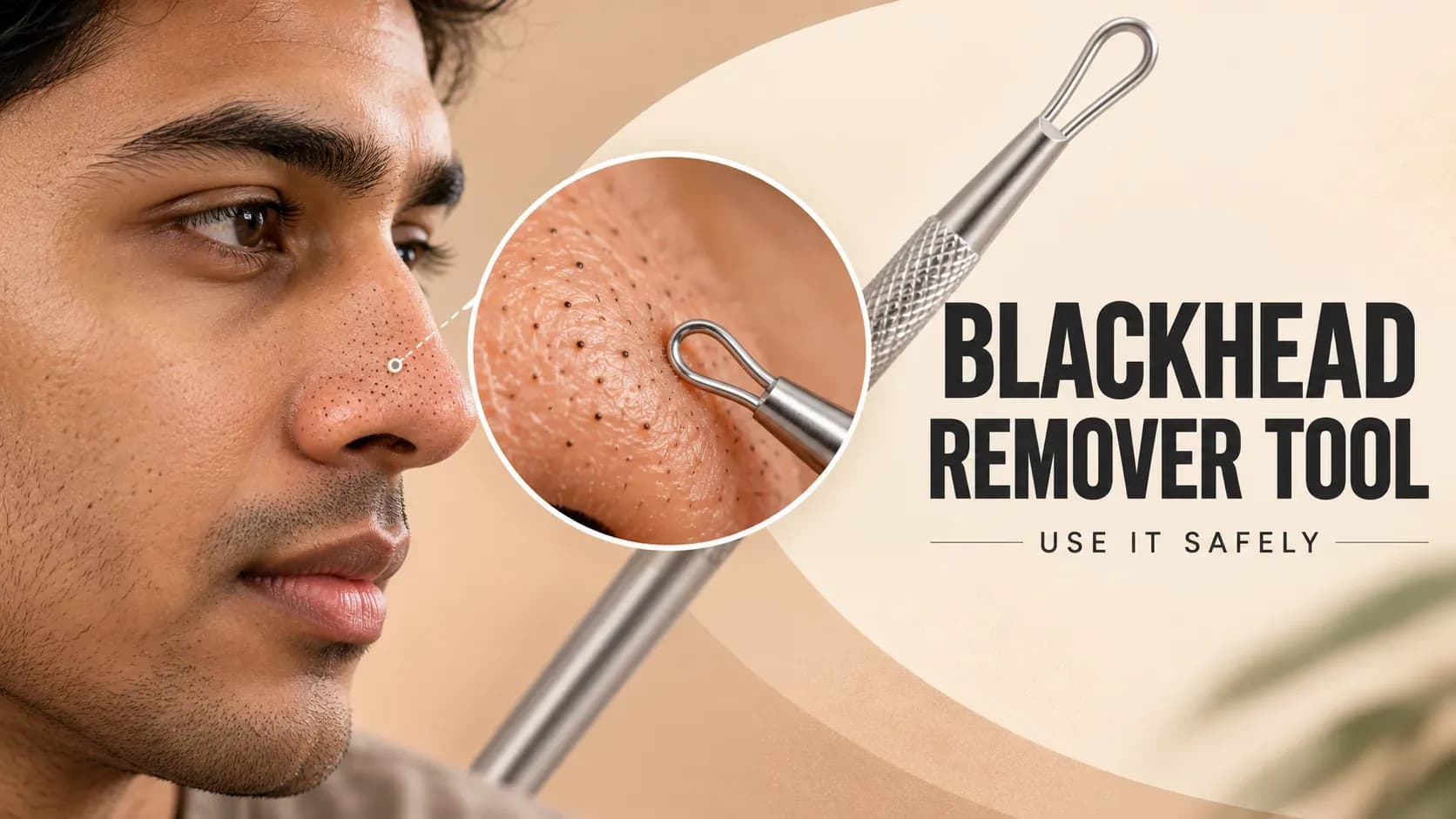
Blackhead remover tools work, but only when you match the right tool to your skin type and apply the correct technique. Comedone extractors physically dislodge the oil-and-debris plug from the follicle. Pore vacuums draw the plug upward using suction. Both methods reduce visible blackheads when used correctly. Misuse causes bruising, broken capillaries, and infection.
Before picking up any tool, these facts matter most:
- Skin prep matters more than the tool itself: steaming for 5–10 minutes before extraction is the difference between a clean result and skin damage
- Manual extractors outperform vacuums for deep, individual blackheads on the nose
- Pore vacuums suit larger surface areas but should never suction one spot for more than 3 seconds
- Lancets and needles belong in a dermatologist's hands, not at home
- Results build over 4–6 consistent sessions: one extraction session will not clear a persistent blackhead problem
What Is a Blackhead and Why Does It Form?
A blackhead is a type of acne, also called an open comedone, that forms when a hair follicle becomes blocked with excess sebum, dead skin cells, dirt, and bacteria. The top of this plug is exposed to air, which oxidises the melanin in the debris and turns it dark: that is why blackheads appear black, not because the pore is dirty.
Blackheads most commonly appear in the T-zone: the forehead, nose, and chin: because these areas produce the highest concentration of sebum. They can also appear on the back, chest, and shoulders, where follicles produce thicker sebum.
Key facts about blackhead formation:
- Blackheads are classified as non-inflammatory acne, meaning they do not involve infection or swelling at the point of formation
- The T-zone follicles are among the deepest on the face, making plugs more compact and harder to remove
- Sebum production is influenced by hormones, diet, stress, and genetics: which is why blackheads tend to recur even after extraction
- Pores typically begin refilling within 2–4 weeks after extraction because the underlying cause: excess sebum production: has not changed
According to The Clear Ritual's skin analysis team, blackheads are shaped by genetics, skin renewal cycles, environmental factors, and the products you use. Generic solutions rarely bring lasting improvement without addressing these underlying causes.
What Is a Blackhead Remover Tool?
A blackhead remover tool, also known as a comedone extractor, is a device designed to safely remove blackheads and whiteheads from clogged pores without excessive scrubbing or squeezing.
There are two main categories of blackhead remover tools:
- Manual stainless steel tools: rigid rods with loop-shaped, curved, or pointed ends that apply controlled mechanical pressure to dislodge the plug
- Electric vacuum devices: battery or USB-powered devices that use negative pressure (suction) to draw the plug upward through the follicle opening
The right choice depends on your skin type, the area being treated, and whether your blackheads are shallow or deeply embedded. The Clear Ritual's approach to blackhead management treats tool selection as part of a broader, personalised skincare strategy: not a one-size-fits-all recommendation.
What Are the Different Types of Blackhead Remover Tools?
Five types of blackhead remover tools are widely available, each with a different mechanism, use case, and risk profile.
| Tool | Description | How to Use | Safety Limitation | When to Avoid |
|---|---|---|---|---|
| Comedone Extractor | Stainless steel rod with a loop-shaped end | Steam face, centre loop over blackhead, apply gentle lateral pressure | Excessive pressure causes bruising | Avoid sensitive areas like under-eyes |
| Blackhead Tweezers | Small rod with curved or angled tips | Pinch clogged pores and lift plugs gently | Can cause cuts if pressure is uneven | Avoid if inexperienced |
| Lancets | Small rod with a sharp needle tip | Used to open pores before extraction of whiteheads | High risk of puncture wounds | Avoid home use entirely: seek professional help |
| Pore Vacuum | Electronic suction device | Move slowly over skin; never hold one spot more than 3 seconds | Suction breaks small capillaries if too strong or too prolonged | Avoid with sensitive skin, rosacea, or thin skin |
| Vibration Spatula | Ultrasonic skin scrubber with a flat spatula tip | Glide gently over skin after applying serum or toner | Use toner first; too dry without it | Avoid for severely clogged or deeply embedded blackheads |
The Clear Ritual recommends:
- Manual comedone extractors for precise, individual nose blackheads
- Pore vacuums or vibration spatulas for larger areas of surface congestion
- Vibration spatulas as the gentlest option for dry or sensitive skin
- Lancets only in a dermatologist's clinic, never at home
How Does Blackhead Extraction Actually Work?
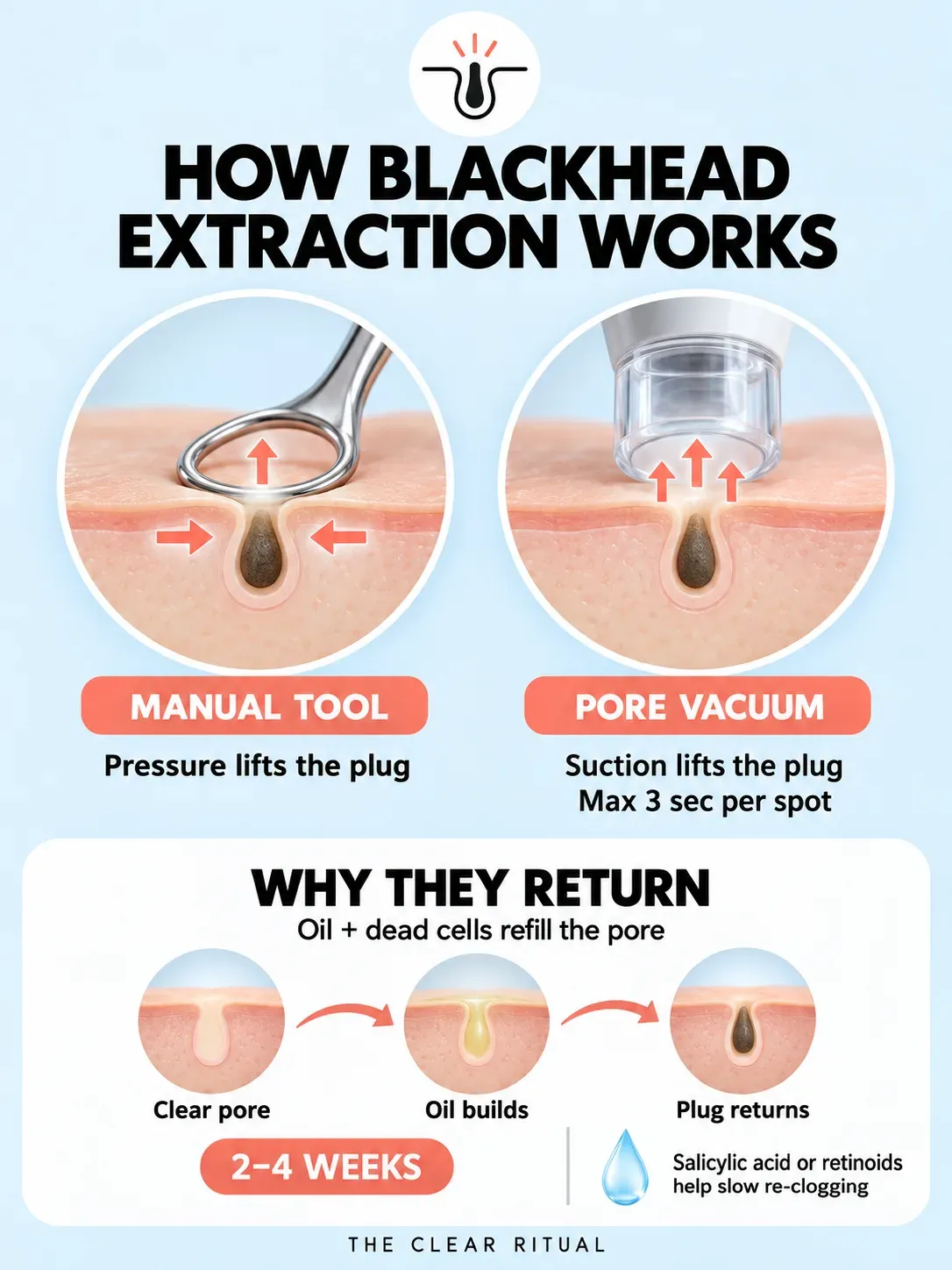
A blackhead remover tool works by either compressing the follicle walls or creating negative pressure above the follicle opening: both mechanisms force the hardened sebum plug upward and out of the pore.
How manual extraction removes the plug:
When you press a comedone extractor loop around a blackhead, you apply lateral compression to the follicle walls. This pressure forces the hardened sebum plug upward through the follicle opening. Steaming the skin first is critical because heat softens the plug and relaxes the follicle walls, significantly reducing the force required for clean extraction.
How pore vacuums remove the plug:
A pore vacuum creates negative pressure above the follicle opening. This draws the softened plug upward by suction rather than compression. The mechanism is gentler on surrounding tissue, but suction held too long: more than 3 seconds per spot: can rupture small capillaries, causing redness or bruising that can persist for several days.
Why pores refill after extraction:
Extraction removes the current plug but does not change the underlying cause: excess sebum production and accelerated skin cell turnover. Pores typically begin refilling within 2–4 weeks. This is why dermatologists pair extraction with topical treatments like salicylic acid or retinoids to slow the rate of reclogging.
Dr. Divya's tip: Think of extraction as clearing the drain: it helps immediately, but you also need to reduce the flow. A consistent skincare routine with a pore-minimising ingredient like niacinamide will extend the time between extractions significantly.
Are Blackhead Remover Tools Safe to Use at Home?
Blackhead remover tools are safe for most skin types when used correctly. Manual comedone extractors made from surgical-grade stainless steel carry minimal infection risk when sanitised before each use. Pore vacuums are safe for normal to oily skin at low-to-medium suction settings.
The risks arise almost entirely from technique errors, not from the tools themselves.
When blackhead remover tools cause harm:
- Excessive pressure with a manual extractor tears the follicle wall, causing bruising, post-inflammatory hyperpigmentation (PIH), and scarring
- Over-suctioning with a pore vacuum: more than 3 seconds per spot: breaks small capillaries, leaving red marks that take 1–2 weeks to fade
- Skipping the steaming step forces you to apply more pressure than the skin can safely handle
- Using a non-sanitised tool introduces bacteria into an open follicle, converting a blackhead into an infected pustule
- Extracting active inflammatory acne: red, raised pimples: spreads bacteria and deepens scarring
Who should avoid at-home extraction tools entirely:
| Skin Condition | Why Tools Are Risky | Safer Alternative |
|---|---|---|
| Active inflammatory acne | Spreads bacteria, deepens scars | Dermatologist extraction or benzoyl peroxide |
| Rosacea | Suction worsens flushing and capillary damage | Gentle acids only (azelaic acid) |
| Eczema or psoriasis on the face | Broken skin barrier; very high infection risk | Consult a dermatologist first |
| Very sensitive or thin skin | Higher bruising and capillary risk | Enzyme exfoliants, no physical extraction |
| Post-procedure skin (post-peel or post-laser) | Skin too vulnerable for mechanical stress | Wait 4–6 weeks post-procedure |
For most people with oily or combination skin who prep correctly, a comedone extractor used once every 1–2 weeks is safe and effective. Visible results typically appear within 2–4 sessions.
Comedone Extractor vs Pore Vacuum: Which Blackhead Tool Is Actually Better?
The best blackhead remover tool is the one that matches your skin type, the area you are treating, and your comfort level with manual technique. Here is a direct comparison of the two most widely used at-home options.
| Feature | Manual Comedone Extractor | Electric Pore Vacuum |
|---|---|---|
| How it works | Mechanical loop compression | Negative pressure suction |
| Best for | Individual, deep nose blackheads | Larger areas: chin, forehead |
| Suitable skin type | Normal, combination, oily | Normal, combination, oily |
| Skill required | Moderate: technique matters | Low: easier for beginners |
| Speed | Slow and precise | Fast, covers more area |
| Risk level | Medium (pressure-dependent) | Medium (suction-time-dependent) |
| Cost range (India) | ₹150 – ₹800 | ₹800 – ₹5,000+ |
| Avoid if | Sensitive skin, under-eye area | Rosacea, sensitive or thin skin |
| Results timeline | Immediate per blackhead | Immediate surface clearing |
Choose a manual comedone extractor if:
- You have a few deep blackheads on your nose or chin
- You are comfortable with precise, slow technique
- You want the tool dermatologists most commonly recommend
Choose a pore vacuum if:
- You have widespread surface-level congestion across your forehead or cheeks
- You want a less technique-sensitive option
- You have oily, resilient skin with no capillary sensitivity
The honest answer: Most dermatologists prefer manual comedone extractors for precision because suction devices cannot target a single follicle: they clear whatever is within the suction zone, including oil that may not be ready for removal. For home use, a combination approach often works well: vacuum for large-area surface congestion, manual extractor for stubborn individual blackheads.
The Clear Ritual's skin specialists note that tool choice is secondary to preparation technique: the steaming step and correct loop positioning matter more than whether you spend ₹250 or ₹3,000 on the device.
How to Use a Blackhead Remover Tool on Your Nose: Step-by-Step
The nose is the most common area for blackheads because the T-zone produces the highest concentration of sebum. It is also the trickiest area because the skin is thinner and more curved than the forehead or cheeks. Follow these steps precisely.
Step 1: Steam for 5–10 minutes (not optional) Hold your face 20–25 cm above a bowl of hot water with a towel draped over your head. Five minutes is the minimum. The nose follicles are among the deepest on the face, and the plugs tend to be more compact. Under-steaming means you will tear the plug rather than cleanly extracting it.
Step 2: Sanitise the tool Wipe the comedone extractor with a cloth soaked in 70% isopropyl alcohol. Allow it to dry completely before touching the skin. This step is required every single time you use the tool, not just occasionally.
Step 3: Select the correct loop size Most comedone extractors come with two loop sizes. For the nose, use the smaller, rounder loop. Position it so the blackhead sits at the exact centre of the loop: not off to one side, which increases the risk of uneven pressure and bruising.
Step 4: Apply pressure laterally, not downward Press the loop against the skin and gently slide it across the blackhead rather than pushing straight down. The motion is a slow, controlled slide from one side to the other. You should feel the plug release with minimal resistance. If you need significant force, the skin is not ready: steam again for another 3–5 minutes.
Step 5: Do not revisit the same spot more than once If a blackhead does not release on the first pass, leave it for this session. Repeated pressure on the same follicle causes bruising and can rupture the follicle wall below the skin surface, creating inflammation that is far harder to treat than the original blackhead.
Step 6: Apply a soothing serum immediately After extraction, the pores are briefly more open. Apply a niacinamide serum within 2–3 minutes to help calm post-extraction redness and support pore contraction. Follow with a light, non-comedogenic moisturiser.
Dr. Divya's tip: Never use a pore vacuum on the nose bridge or the thin skin around the nostrils. This area is particularly prone to broken capillaries from suction. Stick to a manual comedone extractor for all nose work.
Which Blackhead Remover Tool Is Best for Your Skin Type?
The best blackhead remover tool depends on three factors: your skin type, the size of the area you want to treat, and whether your blackheads are shallow or deeply embedded.
| Skin Type | Best Tool | Why | Avoid |
|---|---|---|---|
| Oily, resilient | Comedone extractor | Handles deeper plugs precisely | N/A |
| Combination (T-zone oily) | Comedone extractor for nose; pore vacuum for cheeks | Targets different depths per zone | Lancets at home |
| Dry | Vibration spatula | Gentlest physical option; also exfoliates | Pore vacuums (too drying) |
| Sensitive | Vibration spatula on low setting | Minimal mechanical stress | All high-suction tools |
| Acne-prone (non-inflammatory) | Comedone extractor (for comedones only) | Precise; does not spread bacteria | Pore vacuum over active breakouts |
| Acne-prone (inflammatory) | None: see a dermatologist | Extraction worsens active cysts | All extraction tools |
For the nose specifically: Manual comedone extractors consistently outperform pore vacuums because the curved surface of the nose and the depth of T-zone follicles make suction less effective and lateral compression more reliable.
For large surface areas: forehead and chin: Pore vacuums or vibration spatulas cover more area with less effort and reduce the risk of over-handling individual follicles.
For beginners: Start with a comedone extractor with a wide, smooth loop rather than a lancet or blackhead tweezers. The learning curve is short and the risk of overcorrection is significantly lower than with sharp-tipped tools.
The Clear Ritual Skin Test analyses your skin's unique patterns and daily influences to help identify the best tool and routine combination for your specific skin type and blackhead presentation.
Blackheads vs Sebaceous Filaments: How to Tell the Difference
Blackheads and sebaceous filaments often look similar but are not the same condition. Treating them the same way leads to overuse of extraction tools on pores that do not need clearing.
| Feature | Blackheads | Sebaceous Filaments |
|---|---|---|
| Appearance | Dark black dots, often slightly raised | Light brown or grey dots, usually flat |
| Location | Can appear anywhere on face or body | Mostly nose, chin, and forehead |
| Cause | Clogged pores (excess oil, dead skin, bacteria) | Normal oil flow through follicle |
| After removal | Pores look visibly cleaner | Pores refill quickly: within hours to days |
| Skin types affected | Common in oily, acne-prone skin | Common in all skin types |
| Best treatment | Salicylic acid, retinoids, extraction tools | Niacinamide, clay masks: no extraction needed |
Why this distinction matters for tool use: Attempting to extract sebaceous filaments with a comedone extractor will cause repeated irritation without meaningful improvement, because the follicle refills within days regardless. If your "blackheads" appear all over the nose in a uniform pattern and the dots are grey or brown rather than black, they are likely sebaceous filaments: and extraction tools are the wrong approach.
What Dermatologists Use for Blackhead Removal: And How It Differs from Home Use
Dermatologists use the same basic comedone extractor tool available for home purchase: but with critical differences in preparation, technique, and aftercare protocol that produce better results and fewer complications.
During professional blackhead extraction, the clinician first examines whether each dark spot is a true blackhead, a sebaceous filament, or another lesion. The skin and instruments are sanitised, plugs are softened with controlled steam or topical preparation, and pressure is applied at the correct angle under good lighting.
A dermatologist can also stop when a plug is too deep or inflamed, instead of repeatedly pressing the same follicle. This judgement reduces the risk of bruising, post-inflammatory hyperpigmentation, infection, and scarring. Professional extraction is the safer option when blackheads are numerous, deeply embedded, recurrent, or surrounded by active inflammatory acne.
Aftercare generally involves gentle cleansing, a non-comedogenic moisturiser, and sun protection. Strong acids, retinoids, scrubs, and additional extraction should be avoided until redness and sensitivity settle.
How to Keep Blackheads from Returning After Extraction
Extraction removes existing plugs but does not prevent new ones. A consistent blackhead removal routine should address excess oil, irregular cell shedding, and skin-barrier irritation between extraction sessions.
- Cleanse gently once or twice daily without scrubbing the skin
- Use salicylic acid gradually if your skin tolerates it
- Introduce retinoids only as directed and avoid combining too many strong actives
- Apply a lightweight, non-comedogenic moisturiser after active treatments
- Use sunscreen daily to reduce irritation and post-extraction marks
- Sanitise extraction tools before and after every use
- Limit extraction sessions to once every 1–2 weeks
If blackheads continue returning despite 8–12 weeks of consistent care, stop increasing pressure or extraction frequency. A dermatologist can assess whether prescription treatment or professional extraction is more appropriate.
Conclusion
Blackhead remover tools can provide immediate visible clearing, but technique and preparation determine whether the result is helpful or harmful. Manual comedone extractors are better for individual, deep plugs, while pore vacuums and vibration spatulas may suit larger areas of surface congestion. Avoid lancets at home, never extract inflamed acne, and stop if a plug does not release with gentle pressure. Long-term control still requires a consistent skincare routine that reduces pore blockage between sessions.
Understand What Your Skin Needs
Take the Clear Ritual Skin Test to identify your skin type, concerns, and potential triggers before building your routine.
Take the Free Skin Test
Frequently Asked Questions
Q. Do blackhead remover tools actually work?
A. Yes. They can remove visible plugs temporarily when the skin is prepared correctly and the tool is used gently. They do not address the excess oil and cell buildup that causes blackheads to return.
Q. Which blackhead remover tool is best for the nose?
A. A smooth-loop manual comedone extractor is usually more precise for individual nose blackheads. Avoid using strong suction on the nose bridge or around the nostrils.
Q. How often can I use a comedone extractor?
A. For suitable skin, limit use to once every 1–2 weeks. Repeated pressure or frequent extraction increases the risk of bruising, irritation, pigmentation, and scarring.
Q. Are pore vacuums safe for sensitive skin?
A. They may bruise or irritate sensitive, thin, rosacea-prone, or capillary-prone skin. A gentler topical routine or professional assessment is safer for these skin types.
Q. Should I steam my face before extracting blackheads?
A. Warmth can soften compact plugs and reduce the pressure needed for extraction. Keep the steam comfortably warm, not painfully hot, and limit exposure to 5–10 minutes.
Q. When should a dermatologist remove blackheads?
A. Seek professional extraction when blackheads are deep, widespread, repeatedly return, do not release with gentle pressure, or appear alongside inflamed or painful acne.
References
- American Academy of Dermatology. Acne: Diagnosis and treatment. Read guidance
- American Academy of Dermatology. Skin care habits that can worsen acne. Read guidance
- DermNet. Comedonal acne. Read reference
- National Library of Medicine. Acne Vulgaris. View reference
Disclaimer: This article is for general educational purposes and does not replace medical advice, diagnosis, or treatment. Stop using an extraction tool if you experience significant pain, bleeding, bruising, swelling, or persistent irritation. Consult a dermatologist for deep, inflamed, recurrent, or scarring acne.
Editorial Standards
Clear Ritual has Strict sourcing guidelines to ensure our content is accurate and current. We rely on peer-reviewed studies, academic research institutions, and medical associations. We strive to use primary sources and refrain from using tertiary references. See a mistake? Learn More about our Editorial Standards.