Boils vs Pimples: How to Tell the Difference and When to See a Doctor
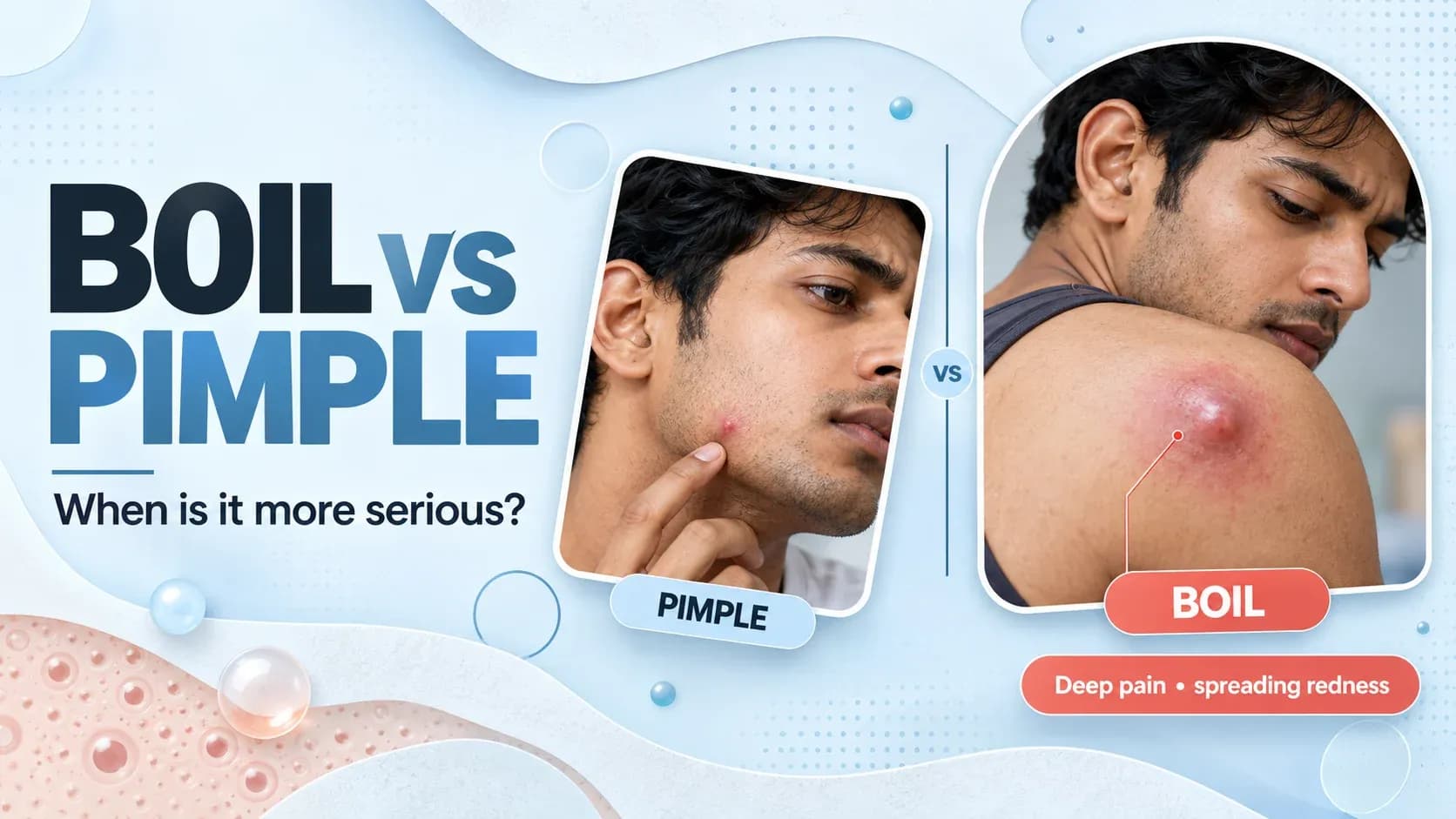
Pimples are small, surface-level clogged pores that usually cause mild discomfort. Boils are deeper bacterial infections that become larger, warmer, increasingly painful, and may cause spreading redness or fever.
At a glance:
- Pimples: small, surface-level, mild pain, resolve in 3-7 days
- Boils: deep, painful, warm, may need medical drainage or antibiotics
What Is the Difference Between a Boil and a Pimple?
A boil and a pimple look similar on the surface but have different causes, depths, and levels of severity.
- Pimple: A superficial clogged pore (comedone) caused by sebum, dead skin cells, and sometimes Cutibacterium acnes bacteria. Pimples sit in the upper layers of the skin and typically measure 1-5 mm in diameter.
- Boil (furuncle): A deep bacterial infection, most commonly caused by Staphylococcus aureus, that begins at a hair follicle and extends into surrounding tissue. Boils are always deeper, more painful, and larger than pimples.
A boil is significantly more tender to the touch and feels firm or fluctuant beneath the skin surface. A pimple typically causes mild or no pain. According to The Clear Ritual's skincare team, confusing the two is one of the most common reasons people apply the wrong treatment and delay recovery.
What Is a Pimple?
A pimple is a small, inflamed skin lesion that forms when a hair follicle or pore becomes blocked with excess sebum and dead skin cells. Pimples are among the most common skin concerns worldwide, affecting an estimated 85% of people between the ages of 12 and 24 at some point in their lives.
Types of pimples include:
- Whiteheads: closed clogged pores with a white tip
- Blackheads: open clogged pores oxidised by air exposure
- Papules: small, raised, red inflamed bumps without visible pus
- Pustules: papules with visible pus at the centre
- Nodules and cysts: deeper, larger lesions that can cause scarring
Pimples typically measure 1-5 mm in diameter and may resolve on their own within 3-7 days with minimal treatment. Nodules and cysts can persist for 4-6 weeks without appropriate care.
What Is a Boil?
A boil is a painful, pus-filled lump that develops when bacteria infect a hair follicle and the surrounding skin tissue. The infection creates a pocket of pus called an abscess.
Boils can grow to 2-5 cm in diameter and are almost always caused by Staphylococcus aureus bacteria. They pass through four recognisable stages:
- Days 1-3: A hard, red, painful lump forms at a hair follicle site
- Days 3-5: The lump grows larger as white blood cells accumulate and pus forms
- Days 5-7: The boil develops a visible yellow or white head at the surface
- Days 7-10: The boil typically drains on its own or requires medical drainage
A cluster of connected boils is called a carbuncle - a more serious condition that almost always requires antibiotic treatment and professional drainage. The Clear Ritual advises treating any boil larger than 2 cm as a medical situation, not a skincare one.
How to Tell If It's a Boil or a Pimple
If the bump is larger than a pencil eraser, painful to the touch, warm, and surrounded by spreading redness, it is more likely a boil than a pimple.
| Feature | Pimple | Boil |
|---|---|---|
| Size | 1-5 mm | 5-50 mm |
| Depth | Superficial (surface layer) | Deep (into subcutaneous tissue) |
| Pain level | Mild or none | Moderate to severe |
| Cause | Clogged pore, excess sebum | Bacterial infection (S. aureus) |
| Warmth | Minimal | Noticeable warmth and redness |
| Fever | Rare | Possible, especially in carbuncles |
| Surrounding redness | Limited to pore | Spreads outward |
| Time to resolve | 3-7 days | 7-14 days or longer |
| Common locations | Face, chest, back | Neck, armpits, groin, buttocks |
Boil vs Pimple vs Cyst: What Is the Difference?
A boil is not the same as a cystic pimple or a blood-filled pimple. Confusing them leads to the wrong treatment.
| Feature | Pimple (pustule) | Boil (furuncle) | Cystic acne | Blood-filled pimple |
|---|---|---|---|---|
| Cause | Clogged pore + C. acnes | S. aureus infection | Clogged pore + deep inflammation | Broken capillary inside a pimple |
| Depth | Superficial | Deep (subcutaneous) | Deep (dermal) | Superficial |
| Size | 1-5 mm | 5-50 mm | 5-20 mm | 1-5 mm |
| Pain | Mild | Severe | Moderate to severe | Mild |
| Pus colour | White or yellow | Yellow, creamy | White or yellow | Red or dark (blood) |
| Warmth | Minimal | Marked | Minimal to mild | Minimal |
| Fever risk | None | Possible | None | None |
| Treated with | Salicylic acid, benzoyl peroxide | Warm compress, medical drainage | Prescription retinoids, isotretinoin | Spot treatment, leave alone |
What is a cystic pimple vs a boil? A cystic pimple forms entirely within the acne framework - a blocked pore becomes severely inflamed and forms a closed, painful sac under the skin. It does not involve Staphylococcus aureus and is not contagious. A boil, by contrast, is a bacterial infection that starts at a hair follicle and can spread to surrounding tissue.
What is a blood-filled pimple vs a boil? A blood-filled pimple is a regular pimple - usually a papule or pustule - in which a small capillary has ruptured from picking or pressure. It stays small (1-5 mm), is not warm, does not spread, and resolves within 3-7 days. A boil is always warm, grows progressively larger over days, and is caused by a bacterial infection that can spread.
What is a pustule vs a boil? A pustule is a surface-level inflamed bump with visible pus, measuring 1-5 mm, caused by C. acnes bacteria inside a blocked pore. A boil is at least five to ten times larger, originates deep in a hair follicle, and is caused by a different bacteria (S. aureus). Salicylic acid and benzoyl peroxide work on pustules. They do not treat boils.
Where Do Boils and Pimples Form?
Location provides a useful clue when distinguishing a boil from a pimple.
Where pimples form: Pimples tend to appear where sebaceous (oil) glands are most concentrated - the face (particularly the T-zone), upper back, chest, and shoulders. Hormonal fluctuations increase sebum production in these areas, which is why pimples are most common during puberty, menstruation, and pregnancy.
Where boils form: Boils form wherever hair follicles exist and friction or moisture creates an entry point for bacteria. The most common locations include the back of the neck, armpits, inner thighs, groin, buttocks, and face. Areas prone to sweating and skin-to-skin contact carry a higher risk of boil formation.
What Causes Boils vs Pimples?
Understanding the cause explains why treatments differ significantly between the two conditions.
Pimple causes:
- Excess sebum production driven by androgens
- Accumulation of dead skin cells that block pores
- Proliferation of Cutibacterium acnes skin bacteria
- Hormonal changes, including puberty, menstrual cycle, and stress
- Use of comedogenic skincare or makeup products
Boil causes:
- Skin entry by Staphylococcus aureus bacteria through a cut, insect bite, or hair follicle
- Conditions that weaken immune function, including diabetes, HIV, and malnutrition
- Close contact with someone who carries S. aureus
- Poor hygiene or repeated skin trauma from friction
- Sharing contaminated towels, razors, or clothing
Studies suggest that approximately 30% of the general population carries S. aureus on their skin or nasal passages without symptoms. Boils are more likely to develop when this bacteria enters a compromised skin barrier.
Why Do Some People Get Boils Instead of Pimples?
Some individuals are more prone to boils than to typical acne-related pimples. The Clear Ritual's clinical team identifies several contributing factors.
- Carrying S. aureus: People who are nasal carriers of this bacteria are at higher risk of recurrent boils
- Compromised immunity: Conditions such as type 2 diabetes, HIV, or long-term corticosteroid use reduce the skin's ability to fight bacterial infection
- Iron deficiency anaemia: Low iron levels can impair neutrophil function, reducing bacterial clearance
- Friction and occlusion: Tight clothing, excessive sweating, and frequent skin contact create ideal conditions for follicular bacterial entry
- Poor skin barrier integrity: Eczema and other chronic skin conditions that disrupt the outer skin layer allow bacteria easier access
Recurrent boils affecting the armpits and groin may indicate hidradenitis suppurativa (HS) - a chronic inflammatory condition that requires specialist diagnosis and management, not home treatment. HS involves inflammation of apocrine sweat glands and hair follicles, forms interconnected tunnels under the skin (sinus tracts), and does not respond to the warm compress approach used for standard boils.
How to Treat Pimples: Step-by-Step Guide
Pimple treatment focuses on unblocking pores and reducing bacterial activity. Most surface pimples show visible improvement within 2-4 weeks of consistent treatment.
- Cleanse twice daily with a gentle, non-comedogenic cleanser to remove excess sebum and surface bacteria
- Apply a targeted active ingredient: salicylic acid (0.5-2%) for blackheads and whiteheads, or benzoyl peroxide (2.5-5%) for inflamed papules and pustules
- Use a non-comedogenic moisturiser to maintain the skin barrier and prevent rebound oil production
- Apply a spot treatment containing niacinamide or tea tree oil to reduce localised inflammation
- Avoid picking or squeezing - this pushes bacteria deeper and increases the risk of scarring and post-inflammatory hyperpigmentation (PIH)
- Consult a dermatologist for persistent cystic acne; prescription retinoids or oral antibiotics may be required
Common mistakes to avoid:
- Over-washing, which strips the skin barrier and increases oil production
- Using harsh physical exfoliants on active pimples
- Applying unverified home remedies such as toothpaste, which can irritate skin
How to Treat Boils: What You Can and Cannot Do
Boil treatment depends on severity. Most small boils can be managed at home, but larger or recurring boils require medical attention.
Home management for small boils (under 2 cm):
- Apply a warm compress - a clean cloth soaked in warm water - to the affected area for 10-15 minutes, 3-4 times per day
- Continue warm compress application daily until the boil develops a visible head and drains on its own
- Once drained, clean the area with antiseptic and cover with a sterile dressing
- Wash hands thoroughly before and after touching the area
- Do not squeeze or attempt to lance the boil yourself - this can spread the infection
Medical treatment for larger or persistent boils:
- Incision and drainage (I&D): A doctor makes a small incision to drain the pus. This is typically required for boils larger than 2 cm
- Oral antibiotics: Prescribed when the infection has spread to surrounding tissue, or if the patient has diabetes, a weakened immune system, or a fever
- Carbuncle treatment: Always requires medical drainage and usually antibiotic therapy
When to see a doctor immediately: Seek urgent care if the boil is larger than 2-3 cm, located on the face especially near the nose or eyes, accompanied by fever above 38°C (100.4°F), or if red streaks appear spreading outward from the site.
Does Salicylic Acid or Benzoyl Peroxide Work on Boils?
Salicylic acid does not treat boils. Benzoyl peroxide does not treat boils. Applying these ingredients to a boil is ineffective and may irritate the surrounding skin.
Why salicylic acid doesn't work on boils: Salicylic acid is a beta-hydroxy acid that works by dissolving the keratin plug inside a blocked pore. Boils are not clogged pores - they are bacterial infections deep in a hair follicle and subcutaneous tissue. Salicylic acid has no meaningful antibacterial action against S. aureus and cannot reach the depth of a boil.
Why benzoyl peroxide doesn't work on boils: Benzoyl peroxide has antibacterial properties but works specifically against Cutibacterium acnes on the skin surface. S. aureus - the bacteria that causes boils - is largely unaffected by topical benzoyl peroxide, and the concentration available in OTC products (2.5-10%) does not penetrate deep enough to reach a boil's abscess.
What actually works on boils:
- Warm compresses applied for 10-15 minutes, three to four times daily
- Medical incision and drainage (I&D) for boils larger than 2 cm or those that do not self-resolve
- Oral antibiotics when infection has spread, fever is present, or the patient is immunocompromised
The Clear Ritual advises against applying acne treatments to boils. Using salicylic acid or benzoyl peroxide on a boil delays the right treatment and may cause additional irritation around an already-painful lesion.
Can a Pimple Turn Into a Boil?
No - a pimple does not turn into a boil. They begin through completely different biological processes and one does not evolve into the other.
A pimple starts when a pore becomes blocked with sebum and dead skin cells. The bacteria involved (Cutibacterium acnes) is a normal resident of healthy skin. A boil starts when Staphylococcus aureus - a different and more aggressive bacteria - enters the skin through a cut, hair follicle, or break in the skin barrier.
What can happen: If you pick or squeeze a pimple, you create a small wound. That wound becomes an entry point for S. aureus from your fingers or surrounding skin. The result is a new, separate infection at the same site - not the pimple transforming, but a boil forming alongside it.
How to tell if a pimple has been replaced by a boil:
- The lesion grows noticeably larger over 24-48 hours after you touched it
- The surrounding skin becomes warm and red beyond the original bump
- Pain increases from mild to moderate or severe
- A low-grade fever develops
If any of these signs appear after handling a pimple, stop applying acne treatments to that spot. Apply a warm compress instead and see a doctor if it continues to grow.
Can You Pop a Boil or a Pimple?
Popping either a boil or a pimple is generally not recommended, but the risks differ considerably in severity.
Popping a pimple: Squeezing a pimple can push bacteria and sebum deeper into the pore, causing a more severe lesion. It also increases the risk of post-inflammatory hyperpigmentation (PIH) and permanent scarring, particularly in people with medium to deep skin tones.
Popping a boil: Squeezing or attempting to pop a boil at home carries a significantly higher risk. Forcing a boil to drain before it is ready can spread Staphylococcus aureus into surrounding tissue or the bloodstream. Never cut, puncture, or lance a boil at home.
If a boil drains naturally, wash your hands, clean the area gently, cover it with a sterile dressing, and avoid sharing towels or clothing until the skin has healed.
How to Prevent Pimples and Boils
Pimples and boils require different treatments, but several hygiene and skin-care habits can reduce the risk of both.
- Wash the face gently twice daily and after heavy sweating.
- Choose non-comedogenic skincare and makeup products.
- Avoid picking pimples, scratching follicles, or shaving over inflamed bumps.
- Do not share razors, towels, clothing, or sports equipment.
- Wash frequently used towels, pillowcases, and workout clothing regularly.
- Keep cuts and abrasions clean and covered while they heal.
- Manage medical conditions such as diabetes with professional guidance.
Learning the causes and triggers of acne can help prevent clogged pores, while recurrent boils require assessment for bacterial carriage, immune factors, diabetes, or hidradenitis suppurativa.
When Should You See a Doctor for a Boil or Pimple?
Most small pimples can be managed with consistent skincare. A boil needs medical assessment when there are signs that the infection is deep, spreading, recurrent, or affecting a higher-risk area.
Seek medical care if:
- The boil is larger than 2 cm or continues growing.
- It is located on the face, especially near the nose or eyes.
- You have fever, chills, red streaks, or rapidly spreading redness.
- The pain is severe or the centre becomes soft without draining.
- Several boils form together or keep returning.
- You have diabetes, reduced immunity, or take immune-suppressing medicines.
- The lesion has not improved after one week of warm compresses.
For recurring breakouts rather than infection, an evidence-based acne treatment guide can explain treatment options. A dermatologist should assess painful nodules, scarring, or breakouts that persist despite consistent care.
Clear Ritual's Perspective on Boils vs Pimples
The most useful clues are size, depth, warmth, pain, spreading redness, and how quickly the bump changes. Acne treatments are designed for blocked pores, while boils are bacterial infections that may require drainage or antibiotics.
Recognising the symptoms of acne-prone skin can help you understand recurring pimples, but a rapidly enlarging, warm, or intensely painful lump should be treated as a possible infection rather than routine acne.
Understand What Your Skin Needs
Take the Clear Ritual Skin Test to identify your skin type, concerns, and potential triggers before building your routine.
Take the Free Skin Test
Frequently Asked Questions
Q. How can you tell if a bump is a boil or a pimple?
A. A boil is usually larger, deeper, warmer, and more painful, with redness that may spread beyond the bump. A pimple is generally smaller and limited to a clogged pore.
Q. Can a pimple turn into a boil?
A. No. They develop through different processes, but squeezing a pimple can create a wound through which boil-causing bacteria enter.
Q. Should you pop a boil?
A. No. Squeezing or puncturing a boil can spread infection into surrounding tissue. Use warm compresses and seek medical care when warning signs are present.
Q. Does benzoyl peroxide treat boils?
A. No. Benzoyl peroxide is used for acne-related bacteria and does not adequately treat a deep Staphylococcus aureus infection.
Q. How long does a boil take to heal?
A. A small boil may drain and heal within 7 to 14 days. Larger, persistent, or complicated boils may need medical drainage or antibiotics.
Q. When is a boil an emergency?
A. Seek urgent medical care for facial boils near the nose or eyes, fever, red streaks, spreading redness, severe pain, or rapidly worsening swelling.
References
- National Health Service. Boils.
- American Academy of Dermatology. Boils and Styes: Treatment.
- National Institute of Arthritis and Musculoskeletal and Skin Diseases. Acne.
- Mayo Clinic. Boils and Carbuncles.
Editorial Standards
Clear Ritual has Strict sourcing guidelines to ensure our content is accurate and current. We rely on peer-reviewed studies, academic research institutions, and medical associations. We strive to use primary sources and refrain from using tertiary references. See a mistake? Learn More about our Editorial Standards.
Related Articles
Cystic Acne Explained: Why Deep, Painful Breakouts Form and How to Treat Them
Published 23 September 2026
Fungal Acne vs Closed Comedones: The One Sign That Tells Them Apart
Published 13 October 2026

Whiteheads: Causes, Symptoms, Treatment & Prevention Guide
Published 17 July 2026
Blackheads: What Causes Them and When to See a Dermatologist
Published 17 July 2026