Does Sleeping Late Cause Acne? Sleep Timing and Breakouts Explained

Sleeping late can cause acne. Staying up past your natural sleep window raises cortisol, increases sebum production, and disrupts skin repair - creating conditions where acne is more likely to develop or worsen, especially hormonal and inflammatory acne.
Three things happen simultaneously when you sleep late:
- Cortisol rises and directly stimulates sebaceous glands to produce more oil
- The skin's primary repair window (11 PM-4 AM) closes before your follicles benefit from it
- Melatonin, which acts as an antioxidant for skin cells, is suppressed
What Is Sleep Acne? A Clear Definition
Sleep acne is not a formal clinical diagnosis - it is a descriptive term used by dermatologists for acne that worsens measurably and predictably when sleep timing shifts later or sleep duration falls below seven hours. The term describes breakouts driven primarily by circadian disruption, elevated cortisol, and missed skin-repair windows rather than diet, topical products, or underlying hormonal disorders.
Sleep acne is most recognisable when breakouts correlate directly with late-night periods - exam weeks, shift work, or travel across time zones - and improve when sleep normalises.
Three facts that define sleep acne:
- It can affect anyone with acne-prone skin, regardless of age or skin type
- It predominantly worsens hormonal and inflammatory acne, not comedonal (non-inflamed) acne
- It is reversible - most people see measurable skin improvement within two to four weeks of correcting sleep timing
What Is the Connection Between Sleeping Late and Acne?
Sleeping late causes acne by disrupting the body's circadian rhythm - the internal 24-hour clock that governs hormone secretion, immune function, and cellular repair. When sleep timing shifts later than the biological clock expects, several skin-damaging processes are set in motion simultaneously.
Acne develops when hair follicles become clogged with excess oil (sebum), dead skin cells, and bacteria (Cutibacterium acnes). Both sleep deprivation and late sleeping amplify each of these three factors.
Key figures:
- Adults need 7-9 hours of sleep per night for optimal skin repair
- Cortisol, the stress hormone that drives excess oil production, rises by up to 37% after a single night of poor sleep
- Skin cell turnover peaks between 11 PM and 4 AM - late sleepers miss this primary repair window
- Individuals sleeping fewer than 6 hours per night report 30% higher rates of inflammatory skin conditions compared to those sleeping 7-8 hours
According to The Clear Ritual's dermatology-informed team, the connection between sleep and acne is not a single pathway - it is a cascade of hormonal, immune, and structural events that compound each other within hours of sleep disruption.
Two distinct variables drive sleep-related acne. Sleep timing - going to bed after midnight, even with 7-8 total hours - disrupts the circadian hormone cycle that controls oil production and skin repair. Sleep duration - consistently getting fewer than 6 hours - amplifies inflammation and elevates the stress hormones that feed acne bacteria. Most people experience both simultaneously, which is why the effect on skin is pronounced.
How Does Sleeping Late Cause Acne? The Physiological Mechanism
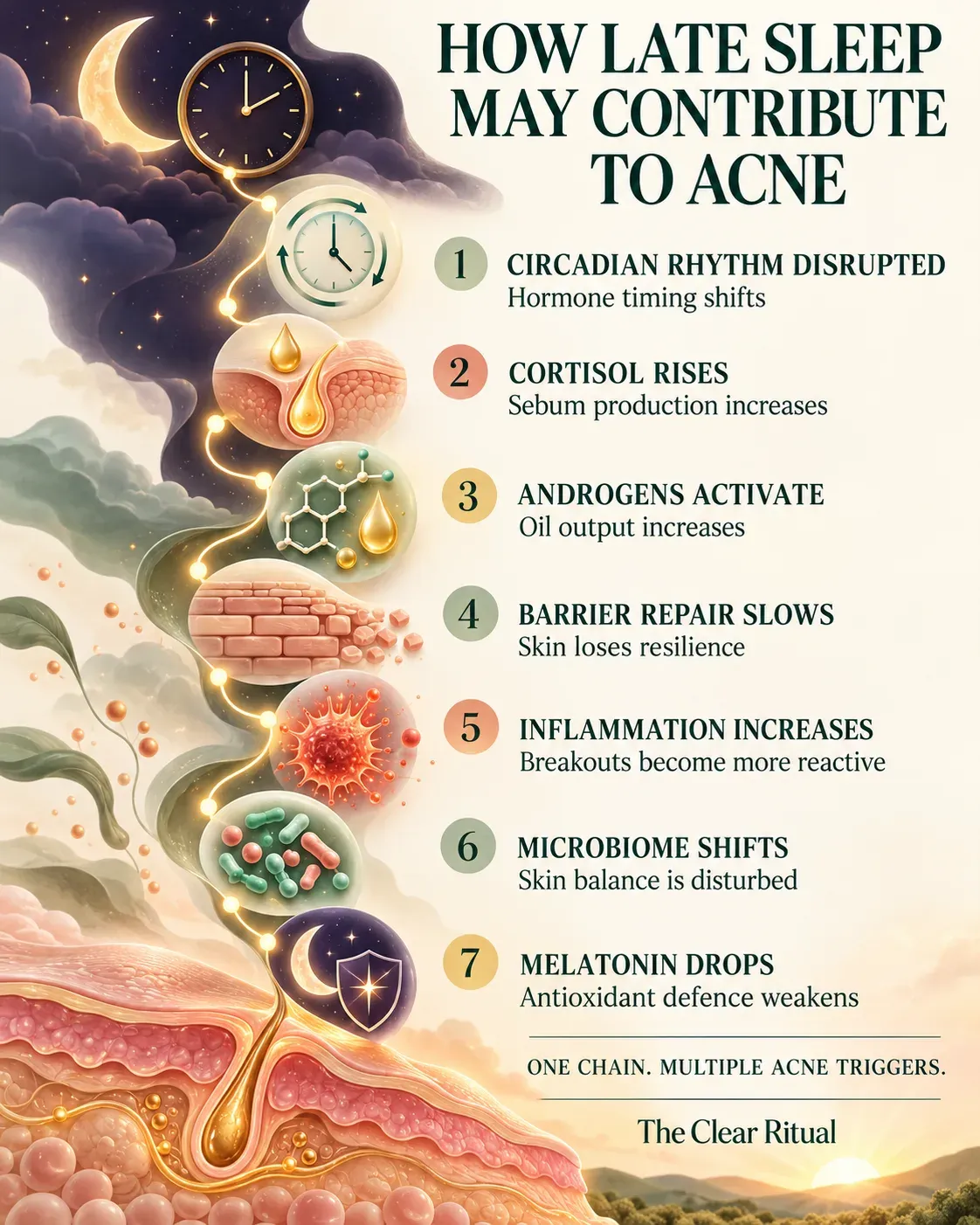
Sleeping late causes acne through a chain of interconnected physiological events, not a single cause. Understanding this sequence explains why improving sleep timing can produce visible skin changes within weeks.
Step-by-step mechanism:
- Circadian rhythm disruption. Consistently sleeping after midnight misaligns the body's internal clock with the natural light-dark cycle, shifting the timing of hormone release.
- Cortisol spike. Late sleeping and sleep deprivation trigger elevated cortisol production. High cortisol signals the sebaceous glands to produce more sebum - the primary raw material for acne formation.
- Androgen activation. Elevated cortisol stimulates adrenal androgens (DHEA-S), which directly increase sebaceous gland size and oil output, particularly around the forehead, nose, and chin - the classic acne-prone zones.
- Impaired skin barrier repair. The skin's barrier is restored primarily during deep (slow-wave) sleep. Late sleepers who get fewer than 7 hours experience reduced production of collagen and ceramides, leaving skin more permeable and prone to bacterial entry.
- Inflammatory response. Poor sleep elevates pro-inflammatory cytokines, specifically IL-1β and TNF-α, making existing acne lesions more severe and increasing the likelihood of new inflammatory lesions forming.
- Microbiome imbalance. Research published in PubMed Central found measurable differences in skin bacterial profiles between adequate sleepers and late sleepers, with late sleepers showing a higher relative abundance of acne-associated bacteria.
- Reduced melatonin. Melatonin acts as an antioxidant for skin cells. Sleeping late suppresses melatonin secretion, removing a key defence against oxidative skin damage.
Each step in this chain feeds the next. Excess cortisol functions as an acne trigger because it directly activates sebaceous glands and simultaneously reduces the skin's ability to neutralise inflammation.
What Types of Acne Are Worsened by Sleeping Late?
Sleeping late does not worsen every type of acne equally. The mechanism primarily affects hormone-driven and inflammatory acne, while having less direct impact on purely comedonal (non-inflamed) acne.
- Hormonal acne appears along the jawline, chin, and lower cheeks. It is driven by androgen fluctuations - the exact hormones that late sleeping amplifies. This type is most directly worsened by poor sleep timing.
- Inflammatory acne (papules and pustules) is characterised by red, tender bumps. Late sleeping elevates pro-inflammatory cytokines, making this type more severe and slower to heal.
- Stress-related acne appears during periods of high cortisol, including when sleep is consistently disrupted. It commonly appears on the forehead and nose. Late sleeping is a direct driver of sustained cortisol elevation.
- Cystic acne, the deepest and most painful form, can be aggravated by prolonged sleep deprivation. While not caused by sleep alone, inadequate sleep extends healing time and increases the risk of cystic lesions becoming more severe.
- Comedonal acne (blackheads and whiteheads) is the least directly affected by sleep - skincare routine is more relevant for this type.
| Acne Type | Location | Sleep Impact | Priority Fix |
|---|---|---|---|
| Hormonal | Jaw, chin | High | Sleep before midnight |
| Inflammatory | Cheeks, nose | High | Increase sleep duration |
| Stress-related | Forehead, T-zone | Very High | Reduce cortisol via consistent schedule |
| Cystic | Deep, jaw/cheeks | Moderate-High | Sleep + medical treatment |
| Comedonal | Nose, forehead | Low-Moderate | Primarily skincare-driven |
Does Sleeping Late Cause Acne Even If You Get 8 Hours of Sleep?
Yes - sleeping late can still worsen acne even when total sleep duration reaches 8 hours. Sleep timing and sleep duration are two separate variables, and both affect skin independently.
The body's circadian clock follows the natural light-dark cycle, not a personal schedule. Cortisol, growth hormone, and melatonin are all released on a fixed biological timetable anchored to sunset and sunrise. Sleeping from 2 AM to 10 AM provides 8 hours, but not the right 8 hours for skin repair.
The critical skin-repair window is 10 PM to 2 AM. Growth hormone - which drives cellular regeneration - peaks in the first slow-wave sleep cycle and is most effective when sleep begins before midnight. Falling asleep at 2 AM reduces the growth hormone output available for skin repair even when total hours are adequate.
| Sleep Pattern | Total Hours | Skin Repair Quality | Cortisol Impact |
|---|---|---|---|
| 10 PM - 6 AM | 8 hours | High - catches full repair window | Normal |
| 12 AM - 8 AM | 8 hours | Moderate - partial repair window | Mildly elevated |
| 2 AM - 10 AM | 8 hours | Low - misses primary repair window | Elevated |
| 11 PM - 5 AM | 6 hours | Moderate - catches window, short duration | Elevated |
| 2 AM - 6 AM | 4 hours | Very low - timing and duration both impaired | Significantly elevated |
Sleeping late but long is better than sleeping late and short - but it is not equivalent to sleeping at the right time. If an immediate schedule shift is not possible, restoring sleep duration is the first step, with sleep timing as the second target.
Dermatologist note: Circadian misalignment - sleeping at the wrong biological time - is an independent acne risk factor, separate from sleep deprivation. Addressing only duration while ignoring timing leaves one of the two drivers unaddressed.
What Is the Best Time to Sleep to Avoid Acne?
The best time to fall asleep to protect skin from acne is between 10 PM and 11 PM. This window ensures the body enters deep sleep before the growth hormone peak at roughly midnight, capturing the full 10 PM-2 AM skin repair window that late sleepers consistently miss.
Why 10-11 PM specifically:
Growth hormone - which drives cell renewal and collagen repair - is released in a single large pulse during the first slow-wave sleep cycle. That pulse is most effective when it occurs close to midnight, aligned with the body's circadian clock. Falling asleep at 10 PM gives the body time to reach deep sleep before the pulse. Falling asleep at 2 AM means the pulse either does not happen or happens at reduced intensity, even with eight total hours.
Melatonin, which acts as the skin's overnight antioxidant, begins rising around 9-10 PM in a dark environment. Going to bed by 11 PM means melatonin is already elevated at sleep onset, giving it the maximum window to neutralise oxidative damage in skin cells before morning light suppresses it.
| Approach | Acne Impact | Why |
|---|---|---|
| Sleep earlier (10-11 PM), same total hours | High positive impact | Captures growth hormone peak + full melatonin window |
| Sleep later but longer (2 AM-10 AM, 8 hrs) | Moderate impact | More hours but misses peak repair window |
| Sleep earlier AND longer | Highest positive impact | Both variables optimised |
| Melatonin supplement without fixing timing | Low impact | Does not replicate circadian melatonin pattern |
Practical target: Aim to be in bed with lights off by 10:30 PM. If the current bedtime is 2 AM, shift it back by 15 minutes every three days - abrupt changes trigger cortisol spikes that can worsen acne in the short term.
Sleep Timing vs. Sleep Deprivation: Which Matters More for Acne?
Sleep timing and sleep deprivation are two separate acne triggers, and understanding the difference helps prioritise what to address first.
Sleep timing refers to when you sleep relative to your biological clock. Going to bed after midnight - even with adequate total hours - misaligns circadian hormone release and reduces time in the peak skin-repair window.
Sleep deprivation refers to getting fewer hours than the body requires, typically fewer than 7 hours for most adults. This elevates cortisol, prolongs inflammatory cytokine activity, and impairs the immune response to acne bacteria.
| Factor | Primary Acne Mechanism | How Quickly It Affects Skin | Reversibility |
|---|---|---|---|
| Late timing (after midnight) | Circadian disruption, missed repair window, melatonin suppression | 3-5 days of consistent late sleeping | Reverses within 1-2 weeks of corrected timing |
| Sleep deprivation (<6 hrs) | Cortisol elevation, cytokine surge, impaired barrier repair | 24-48 hours of acute deprivation | Reverses within days of restored duration |
| Both simultaneously | All mechanisms, compounded | 24-48 hours | Takes 3-4 weeks for full hormonal normalisation |
For most adults experiencing stress-related or hormonal acne, sleep timing is the higher-leverage variable. Research shows that circadian misalignment produces measurable cortisol and sebum increases even when total sleep hours are adequate. Duration matters most for inflammatory acne severity and healing speed.
Practical priority order:
- Restore total sleep duration to 7-9 hours first - faster to implement
- Shift sleep timing earlier - target asleep by 11 PM, which takes 2-4 weeks of gradual adjustment
- Maintain consistency across all 7 days including weekends - the hardest step and the highest long-term impact
Does Sleeping Late Cause Skin Darkening and Dark Circles?
Sleeping late causes skin darkening through four distinct physiological mechanisms, each operating independently but compounding the others over time.
1. Blood pooling under thin periorbital skin The skin beneath the eyes is approximately 0.5 mm thick - four times thinner than the rest of the face. When sleep is delayed or shortened, circulation slows and blood vessels dilate. Pooled, deoxygenated blood shows through translucent under-eye skin as a blue-purple tint. This is the immediate cause of dark circles after a late night.
2. Cortisol-driven melanin activation Elevated cortisol from late sleeping stimulates melanocortin receptors, which regulate melanin production. Higher cortisol levels can upregulate melanogenesis - the biological process that produces skin pigment. Over weeks and months of chronic late sleeping, this contributes to uneven pigmentation and post-inflammatory hyperpigmentation, particularly in individuals with medium to deep skin tones.
3. Impaired lymphatic drainage During deep sleep, peripheral lymphatic drainage accelerates. Late sleeping reduces time in deep sleep, allowing fluid and metabolic waste to accumulate in facial tissues. This produces puffiness that makes pigmentation appear more pronounced.
4. Reduced melatonin antioxidant activity Melatonin is one of the skin's most potent antioxidants, neutralising reactive oxygen species that damage melanocytes (pigment-producing cells). When late sleeping suppresses melatonin, oxidative damage to melanocytes increases, contributing to irregular pigmentation over time.
Timeline for skin darkening:
- Within 24-48 hours: Under-eye dark circles from blood pooling and fluid retention
- Within 2-4 weeks: Mild dullness from reduced cellular turnover and antioxidant activity
- Within 2-3 months: Noticeable uneven pigmentation if late sleeping continues chronically
Correcting sleep timing reverses acute effects (dark circles, puffiness) within a few days. Chronic hyperpigmentation from melanin activation typically requires 4-8 weeks of corrected sleep plus a targeted skincare routine to show visible improvement.
Both skin darkening and acne share cortisol elevation and melatonin suppression as root drivers. If both are occurring simultaneously, the common cause is almost certainly circadian disruption from consistently late sleeping.
What Are the Skin Benefits of Getting Enough Sleep?
Getting adequate sleep - and sleeping at the right time - produces measurable skin improvements, particularly for acne-prone individuals. The Clear Ritual's dermatology-informed team identifies both short-term and long-term benefits of correcting sleep timing.
Short-term benefits (within 1-2 weeks):
- Reduced facial redness and inflammation in existing acne lesions
- Less oil on the skin surface by morning
- Decreased skin sensitivity and surface tightness
- Improved hydration levels due to restored barrier function
Long-term benefits (4-12 weeks):
- Fewer new acne breakouts due to normalised cortisol and androgen levels
- Faster healing of post-acne marks as cell turnover resumes at normal rates
- Reduced pore appearance - pores enlarge when sebum production is chronically elevated
- More even skin tone from consistent melatonin-mediated antioxidant activity
| Sleep Quality | Sebum Production | Inflammation Level | Acne Lesion Count |
|---|---|---|---|
| Poor (<6 hrs or late timing) | High | Elevated | Higher |
| Moderate (6-7 hrs) | Moderate | Mild | Moderate |
| Optimal (7-9 hrs, before midnight) | Normalised | Low | Lower |
Studies suggest individuals who corrected sleep timing alongside a basic skincare routine saw up to 25% reduction in acne lesion count over 8 weeks, compared to those using skincare alone.
When Is Sleeping Late the Primary Cause of Acne - and When Is It Not?
Sleeping late contributes to acne, but it is not the sole cause in every case. The Clear Ritual's skin health team identifies the situations where sleep is the primary driver versus a secondary contributor.
Sleep is more likely to be a primary trigger when:
- Breakouts begin or worsen during exams, shift work, travel, or repeated late nights
- Acne improves after two to four weeks of a consistent sleep schedule
- New lesions are mainly inflammatory and appear alongside increased oiliness
- There has been no major change in skincare, medication, diet, or menstrual health
Sleep is more likely to be a secondary contributor when:
- Breakouts remain unchanged despite consistent sleep for several weeks
- Acne is severe, painful, cystic, or causing scars
- There are signs of an underlying hormonal condition such as irregular periods or excess facial hair
- A new cosmetic, hair product, medicine, or supplement matches the start of the breakout
- The bumps itch, look identical, or do not behave like typical acne
Reviewing the symptoms of acne-prone skin can help you recognise whether the pattern is consistent with acne, but persistent or unusual lesions should be assessed by a dermatologist.
How to Fix Sleep-Related Acne: A Practical Routine
Correcting sleep-related acne requires consistency rather than a sudden, extreme schedule change. The goal is to support the circadian rhythm while keeping skincare simple enough to avoid additional irritation.
Step 1: Restore sleep duration. Aim for seven to nine hours each night. If this is not currently possible, increase sleep by 30 minutes and maintain the new duration for several days before adjusting again.
Step 2: Move bedtime earlier gradually. Shift bedtime earlier by 15 minutes every three days until you reach a sustainable schedule.
Step 3: Keep wake time consistent. A stable wake time helps reset the circadian rhythm more effectively than changing bedtime alone.
Step 4: Reduce late-night light exposure. Dim room lighting and reduce bright-screen use during the hour before bed.
Step 5: Keep nighttime skincare simple. Cleanse gently, use treatment appropriate for your acne type, and apply a non-comedogenic moisturiser. Over-exfoliation can contribute to skin barrier damage and acne.
Step 6: Track the pattern for four weeks. Record bedtime, total sleep, menstrual cycle where relevant, and the number or severity of new breakouts. This helps distinguish a sleep association from coincidence.
If poor sleep is aggravating deep lesions, the relationship between stress and cystic acne flare-ups may also be relevant.
Common Mistakes When Trying to Improve Sleep Acne
- Changing everything at once: Starting several skincare products while changing sleep makes it difficult to identify what helped or caused irritation.
- Trying to force an early bedtime immediately: A sudden shift may be difficult to maintain. Gradual changes are more practical.
- Sleeping longer only on weekends: Large weekday and weekend differences can keep the circadian rhythm inconsistent.
- Ignoring pillowcase and hair hygiene: Oil, sweat, and hair products can remain in contact with acne-prone areas overnight.
- Assuming sleep is the only cause: Acne can involve hormones, genetics, products, medication, and other health factors.
People with recurring jawline breakouts may also need to consider hormonal acne rather than relying on sleep correction alone.
When Should You See a Dermatologist?
See a dermatologist if acne is painful, deep, rapidly worsening, leaving scars, or not improving after six to eight weeks of consistent sleep and skincare habits. Medical care is particularly important for cystic acne, which has a higher risk of permanent scarring.
A dermatologist can check whether the breakout is acne vulgaris or another condition and recommend treatment based on its type and severity. The Clear Ritual acne treatment guide provides a broader overview, but it does not replace an individual diagnosis.
Clear Ritual's Perspective on Sleep and Acne
Sleep is an important part of acne care, but it should be considered alongside skin type, hormones, products, stress, and the location and appearance of breakouts. A regular sleep schedule may reduce one important trigger, especially when acne consistently worsens after late nights.
Clear Ritual focuses on identifying the pattern behind recurring breakouts so that the routine matches the skin's actual needs rather than adding unnecessary products.
Understand What Your Skin Needs
Take the Clear Ritual Skin Test to identify your skin type, concerns, and potential triggers before building your routine.
Take the Free Skin Test
Frequently Asked Questions
Q. Does sleeping late directly cause acne?
A. Sleeping late can contribute to acne by affecting stress hormones, inflammation, oil production, and skin recovery, but it is rarely the only cause.
Q. Can sleeping early clear acne?
A. An earlier and consistent sleep schedule may reduce a contributing trigger, but existing acne may still require an appropriate skincare or medical treatment plan.
Q. How many hours should I sleep to reduce breakouts?
A. Most adults should aim for seven to nine hours of sleep each night while keeping sleep and wake times consistent.
Q. How long does sleep-related acne take to improve?
A. Some people notice reduced oiliness or inflammation within one to two weeks, while visible changes in breakouts may take four to eight weeks.
Q. Does sleeping late worsen hormonal acne?
A. Poor or irregular sleep may worsen hormonal and stress-related acne by affecting cortisol and inflammatory signalling.
Q. Can dirty pillowcases cause acne?
A. Pillowcases can collect oil, sweat, hair products, and residue that may irritate acne-prone skin, but they are usually one contributing factor rather than the sole cause.
References
- American Academy of Dermatology Association. Acne: Who gets and causes.
- National Heart, Lung, and Blood Institute. Sleep deprivation and deficiency.
- Oyetakin-White P, et al. Does poor sleep quality affect skin ageing?
Disclaimer: This article is for general educational purposes and does not replace personalised medical advice. Consult a qualified dermatologist for persistent, painful, scarring, or recurrent acne.
Editorial Standards
Clear Ritual has Strict sourcing guidelines to ensure our content is accurate and current. We rely on peer-reviewed studies, academic research institutions, and medical associations. We strive to use primary sources and refrain from using tertiary references. See a mistake? Learn More about our Editorial Standards.
Related Articles
Does Eating Mango Cause Acne? What the Evidence Actually Shows
Published 21 July 2026
Whey Protein and Acne: Why Gym Supplements Cause Breakouts
Published 21 July 2026
Coffee and Acne: Does Caffeine Trigger Breakouts?
Published 21 July 2026
Alcohol and Acne: Does Drinking Cause Breakouts?
Published 21 July 2026